
2011 AIME I Solutions
Scroll down to view professionally curated solutions from LIVE by Po-Shen Loh, print PDF solutions, view answer key, or take the full timed exam.
All problems are used with official legal permission of the Mathematical Association of America (MAA).
1.
Jar contains four liters of a solution that is % acid. Jar contains five liters of a solution that is % acid. Jar contains one liter of a solution that is % acid. From jar , liters of the solution is added to jar , and the remainder of the solution in jar is added to jar . At the end both jar and jar contain solutions that are % acid. Given that and are relatively prime positive integers, find
Small Hint:
Imagine pouring all three jars together: the result is liters that must be % acid, which determines
Big Hint:
With known, let be the amount added to jar and set jar ’s acid equal to half of its new volume
Solution:
If all three jars were combined, the result would be liters of % acid, since both final jars are % acid. The total acid is therefore liters, so which gives
Now let be the number of liters poured from jar into jar . Jar then holds liters containing liters of acid, so giving so
Thus and
2.
In rectangle and Points and lie inside rectangle so that and line intersects segment The length can be expressed in the form where and are positive integers and is not divisible by the square of any prime. Find
Small Hint:
Since write and for one unit vector
Big Hint:
forces and to the same height, giving then is a difference of -coordinates
Solution:
Place Since there is a unit vector with such that and line heads down and to the left so that it can cross while points up and to the right into the rectangle.
Because is horizontal, and have equal heights: so and
Then and have -coordinates and so since Thus
3.
Let be the line with slope that contains the point and let be the line perpendicular to line that contains the point The original coordinate axes are erased, and line is made the -axis and line the -axis. In the new coordinate system, point is on the positive -axis, and point is on the positive -axis. The point with coordinates in the original system has coordinates in the new coordinate system. Find
Small Hint:
The new coordinates of are its signed distances to the new axes: is the distance to line and the distance to line
Big Hint:
Use the point-to-line distance formula, fixing each sign by checking whether is on the same side as (for ) or as (for )
Solution:
Line is and line is The new -coordinate of a point is its signed distance to line counted positive on the side containing and the new -coordinate is its signed distance to line positive on the side containing
Substituting into gives while gives dividing by we get Substituting into gives and gives so lies on the same side of as and
Therefore
4.
In triangle and The angle bisector of angle intersects at point and the angle bisector of angle intersects at point Let and be the feet of the perpendiculars from to and respectively. Find
Small Hint:
Extend and until they meet
Big Hint:
is both a bisector and an altitude of triangle so that triangle is isosceles and is a midpoint; then is a midline
Solution:
Extend and to meet at and respectively. In triangle the segment is both an angle bisector and an altitude, so the triangle is isosceles with and is the midpoint of Similarly, triangle is isosceles with and is the midpoint of
Hence is a midline of triangle so Since we conclude
5.
The vertices of a regular nonagon (-sided polygon) are to be labeled with the digits through in such a way that the sum of the numbers on every three consecutive vertices is a multiple of Two acceptable arrangements are considered to be indistinguishable if one can be obtained from the other by rotating the nonagon in the plane. Find the number of distinguishable acceptable arrangements.
Small Hint:
Compare two overlapping triples of consecutive vertices: their sums differ by the labels three apart, so labels three apart are congruent mod
Big Hint:
Each of the residue classes occupies one of the three position classes; count assignments and orderings, then divide by rotations
Solution:
Two overlapping triples of consecutive vertices share two labels, so their sums differ by labels three positions apart. Since all triple sums are multiples of labels three apart are congruent mod Thus the position classes each carry a single residue class of digits, and the digits through consist of exactly three digits from each residue class mod
Every triple of consecutive positions then contains one digit from each residue class, with sum so all assignments of residue classes to position classes are acceptable, and within each position class the three digits can be arranged in ways. That gives acceptable labelings.
Because the digits are distinct, no nontrivial rotation fixes a labeling, so the labelings split into rotation classes of size giving distinguishable arrangements.
6.
Suppose that a parabola has vertex and equation where and is an integer. The minimum possible value of can be written in the form where and are relatively prime positive integers. Find
Small Hint:
Write the parabola in vertex form and note that is the value of at
Big Hint:
So must be an integer; choose the integer that makes as small as possible while keeping
Solution:
In vertex form the parabola is Since equals the value of at
If this equals the integer then The condition requires that is and is smallest when giving
Thus
7.
Find the number of positive integers for which there exist nonnegative integers such that
Small Hint:
Reduce both sides mod every power of is congruent to
Big Hint:
So must divide Conversely, expand by repeatedly splitting one power into copies of the next-lower power; each split adds terms.
Solution:
The value fails, since the right side would be while the left side is For reduce mod every power of is so the equation forces that is, divides
Conversely, suppose Take let of the equal and for each let of the equal This uses terms, and the sum telescopes:
So the equation is solvable exactly when divides which has divisors. There are such
8.
In and Points and are on with on points and are on with on and points and are on with on In addition, the points are positioned so that and Right angle folds are then made along and The resulting figure is placed on a level floor to make a table with triangular legs. Let be the maximum possible height of a table constructed from whose top is parallel to the floor. Then can be written in the form where and are relatively prime positive integers and is a positive integer that is not divisible by the square of any prime. Find
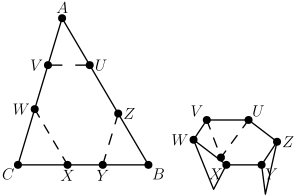
Small Hint:
A flap folded down from a vertex hangs to a depth equal to the distance from that vertex to its fold line, so all three fold lines must be at distance from their vertices
Big Hint:
Two folds cutting the same side must not overlap: for each side, multiplying by the sum of the other two side lengths gives at most twice the triangle’s area; the largest such sum is the binding constraint
Solution:
Write and let be the area of By Heron’s formula with semiperimeter When the corner at a vertex is folded down at a right angle, the flap hangs to a depth equal to the distance from that vertex to the fold line, so for a level tabletop of height each fold line must lie at distance from its vertex.
The flap at is similar to with ratio (dividing by the distance from to ), so it uses up of side likewise the flap at uses of the same side. The two folds fit without crossing exactly when that is, The other two sides give and
The binding constraint comes from the largest sum, so the maximum height is and
9.
Suppose is in the interval and Find
Small Hint:
Rewrite the equation in exponential form and square both sides to get
Big Hint:
Replace by and look for a rational root of the resulting cubic in
Solution:
In exponential form the equation says Squaring gives so
Writing and using we get which factors as The quadratic factor has negative discriminant, so
Then
10.
The probability that a set of three distinct vertices chosen at random from among the vertices of a regular -gon determine an obtuse triangle is Find the sum of all possible values of
Small Hint:
A triangle inscribed in a circle is obtuse exactly when its three vertices lie strictly inside some semicircle
Big Hint:
Count obtuse triangles by their clockwise-first vertex, and handle even and odd separately (only even has right triangles)
Solution:
By the inscribed angle theorem, an inscribed triangle is obtuse exactly when its three vertices lie strictly within some semicircle. Count obtuse triangles by their “first” vertex, the vertex from which the other two are reached going clockwise within half the circle. If the open semicircle clockwise of a vertex contains vertices, giving obtuse triangles; if it contains vertices, giving
For the probability is so giving and
For the probability is so giving and The sum of all possible values is
11.
Let be the set of all possible remainders when a number of the form a nonnegative integer, is divided by Let be the sum of the elements in Find the remainder when is divided by
Small Hint:
From on, every remainder is a multiple of and the powers of repeat mod with period
Big Hint:
Show so remainders apart in the cycle sum to exactly
Solution:
The remainders and occur, and for every is divisible by Modulo the powers of for repeat with period so consists of and the distinct remainders of
The key fact is indeed where is divisible by and the second factor is because Hence for the sum is divisible by and by so by
Pairing each remainder in the cycle with the one steps later therefore gives pairs of distinct remainders, each pair summing to exactly so those remainders contribute a multiple of to Thus
12.
Six men and some number of women stand in a line in random order. Let be the probability that a group of at least four men stand together in the line, given that every man stands next to at least one other man. Find the least number of women in the line such that does not exceed percent.
Small Hint:
Every man next to a man means the men split into blocks of sizes or place the blocks into gaps between the women
Big Hint:
The conditional probability simplifies to require it to be at most
Solution:
Let be the number of women; only the pattern of men’s and women’s positions matters. If every man stands next to another man, the men form maximal blocks whose sizes, in order, are or A pattern with blocks amounts to choosing of the gaps determined by the women, so there are patterns for for each of the three two-block orders, and for a single block.
At least four men stand together in the orders and so
The condition becomes Since and the least number of women is
13.
A cube with side length is suspended above a plane. The vertex closest to the plane is labeled The three vertices adjacent to vertex are at heights and above the plane. The distance from vertex to the plane can be expressed as where and are positive integers. Find
Small Hint:
If is at height the three edges at gain heights and
Big Hint:
Those gains are times the components of the upward unit normal along the three perpendicular edges, so their squares sum to
Solution:
Let be the height of and let be unit vectors along the three mutually perpendicular edges at If is the upward unit normal of the plane, the height of the vertex along edge is so and Because form an orthonormal basis,
Therefore which simplifies to so
Since is the closest vertex to the plane, forcing and
14.
Let be a regular octagon. Let and be the midpoints of sides and respectively. For ray is constructed from towards the interior of the octagon such that and Pairs of rays and and and and and meet at and respectively. If then can be written in the form where and are positive integers. Find
Small Hint:
By the rotational symmetry, both and lie on ray so
Big Hint:
Right triangle gives with known, find and use
Solution:
Scale so that A rotation about the center carries the whole configuration to itself, so is a square and the distances and do not depend on Both and lie on ray (at distances and from ), so Also, makes triangle right-angled at so
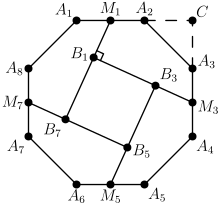
Lines and meet at a point at a right angle, and triangle is an isosceles right triangle with legs so and Then
Since triangle is an isosceles right triangle and lies on segment we have while from the right triangle. The tangent addition formula gives so Therefore and
15.
For some integer the polynomial has the three integer roots and Find
Small Hint:
Vieta gives and eliminate to get
Big Hint:
Multiply by If is the smaller nonnegative root, then test which makes a perfect square.
Solution:
By Vieta’s formulas, and Negating all three roots replaces by so we may assume two roots, say are nonnegative. Substituting into the second equation gives that is,
Multiplying by and completing the square, Since we have so Checking these values, is a perfect square only for where
Then gives and (Indeed ) Therefore