
2009 AIME II Problems
Scroll down and press Start to try the exam! Or, go to the printable PDF, answer key, or professional solutions curated by LIVE by Po-Shen Loh.
All problems are used with official legal permission of the Mathematical Association of America (MAA).
Or jump straight to a single problem with its solution: 1 · 2 · 3 · 4 · 5 · 6 · 7 · 8 · 9 · 10 · 11 · 12 · 13 · 14 · 15
Want to learn professionally through interactive video classes?
Timed
3:00:00
1.
Before starting to paint, Bill had ounces of blue paint, ounces of red paint, and ounces of white paint. Bill painted four equally sized stripes on a wall, making a blue stripe, a red stripe, a white stripe, and a pink stripe. Pink is a mixture of red and white, not necessarily in equal amounts. When Bill finished, he had equal amounts of blue, red, and white paint left. Find the total number of ounces of paint Bill had left.
Answer: 114
Small Hint:
Equal leftovers mean the red used exceeds the blue used by and similarly for white
Big Hint:
Those excesses all went into the pink stripe, so one stripe’s worth of paint is ounces
Solution:
Say each stripe used ounces of paint. Blue was used only on the blue stripe, so ounces of blue were used. Since the three leftovers are equal and the colors started and ounces apart, red use exceeded blue use by ounces and white use exceeded blue use by ounces. That extra red and white is exactly the pink stripe, so
Bill therefore had ounces of each color left, for a total of ounces.
2.
3.
In rectangle Let be the midpoint of Given that line and line are perpendicular, find the greatest integer less than
Answer: 141
Small Hint:
Place coordinates: so and
Big Hint:
Perpendicular lines have slopes whose product is
Solution:
Let and place so Line has slope and line has slope Perpendicularity gives so and
The greatest integer less than is
4.
A group of children held a grape-eating contest. When the contest was over, the winner had eaten grapes, and the child in th place had eaten grapes. The total number of grapes eaten in the contest was Find the smallest possible value of
Answer: 89
Small Hint:
With children the grape counts are an arithmetic sequence, and the total is
Big Hint:
The last-place child ate grapes; check which divisors of survive that condition
Solution:
Let be the number of children. The grape counts form an arithmetic sequence, so the total is times the average of the first and last terms: Thus is divisible by and
The last-place child ate grapes, which forces ruling out and The remaining divisors give for for and for
The smallest possible value is
5.
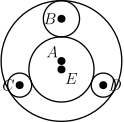
Equilateral triangle is inscribed in circle which has radius Circle with radius is internally tangent to circle at one vertex of Circles and both with radius are internally tangent to circle at the other two vertices of Circles and are all externally tangent to circle which has radius where and are relatively prime positive integers. Find
Answer: 32
Small Hint:
Centers of internally tangent circles lie along radii of circle put the center of at the origin with the radius- vertex on top
Big Hint:
By symmetry ’s center is on the vertical axis. Tangency to puts it at height then tangency to gives an equation in
Solution:
Place the center of circle at the origin with the triangle’s vertices at and A circle internally tangent to at a vertex has its center on the radius to that vertex, so circle has center and circles and have centers (at distance from the origin).
By symmetry the center of circle of radius lies on the -axis at External tangency to gives so External tangency to gives that is, which simplifies to so
Then
6.
Let be the number of five-element subsets that can be chosen from the set of the first natural numbers so that at least two of the five numbers are consecutive. Find the remainder when is divided by
Answer: 750
Small Hint:
Count the complement: five-element subsets with no two consecutive numbers
Big Hint:
Subtracting from the five numbers in increasing order matches no-two-consecutive subsets of with arbitrary subsets of
Solution:
Count the complement: subsets with no two consecutive. Setting turns each such subset into five distinct numbers in and this map is reversible, so there are subsets with no two consecutive numbers.
Therefore and the remainder upon division by is
7.
Define to be for odd and for even. When is expressed as a fraction in lowest terms, its denominator is with odd. Find
Answer: 401
Small Hint:
and since is an integer, all odd factors of cancel into
Big Hint:
Term in lowest terms has denominator the exponent of in These strictly increase, so the last term controls.
Solution:
The th term is with odd numerator, and Because is an integer, every odd prime power dividing also divides Hence in lowest terms the th term has denominator exactly where and is the exponent of in The strictly increase, so over the common denominator every term except the last contributes an even numerator while the last contributes an odd one. The sum in lowest terms therefore has denominator exactly so
By Legendre’s formula, so Then
8.
Dave rolls a fair six-sided die until a six appears for the first time. Independently, Linda rolls a fair six-sided die until a six appears for the first time. Let and be relatively prime positive integers such that is the probability that the number of times Dave rolls his die is equal to or within one of the number of times Linda rolls her die. Find
Answer: 41
Small Hint:
The chance the first six appears on roll is
Big Hint:
Compute for a tie and for a difference of one; both are geometric series with ratio
Solution:
The probability that a player’s first six appears on roll is The probability of a tie is
The probability that Linda needs exactly one more roll than Dave is and by symmetry the same holds with the players swapped.
The total probability is so
9.
Let be the number of solutions in positive integers to the equation and let be the number of solutions in positive integers to the equation Find the remainder when is divided by
Answer: 0
Small Hint:
Subtracting from each variable matches positive solutions of the equation with nonnegative solutions of the equation, since
Big Hint:
So counts nonnegative solutions of in which some variable is Count the three cases and correct for double counting.
Solution:
If is a positive solution of then is a nonnegative solution of and conversely, since So equals the number of nonnegative solutions of and counts the nonnegative solutions of that equation in which at least one variable is
If forces even, giving solutions. If with gives If forces giving The solutions and are each counted twice, so
The remainder upon division by is
10.
Four lighthouses are located at points and The lighthouse at is kilometers from the lighthouse at the lighthouse at is kilometers from the lighthouse at and the lighthouse at is kilometers from the lighthouse at To an observer at the angle determined by the lights at and and the angle determined by the lights at and are equal. To an observer at the angle determined by the lights at and and the angle determined by the lights at and are equal. The number of kilometers from to is given by where and are relatively prime positive integers, and is not divisible by the square of any prime. Find
Answer: 96
Small Hint:
The triangle is right-angled at The conditions say bisects angle and bisects angle
Big Hint:
With ray is the mirror of ray over the vertical line so it hits and
Solution:
Since angle is right. Place The condition at says so lies on the bisector of angle Using the half-angle formula with so lies on the line
The condition at says bisects angle so ray is the reflection of ray over line which is the vertical line The reflection of is so lies on the line through and namely
Solving and gives Then so
11.
For certain pairs of positive integers with there are exactly distinct positive integers such that Find the sum of all possible values of the product
Answer: 125
Small Hint:
The inequality says exactly that
Big Hint:
Write with the count of such is so leaves only a few cases
Solution:
The inequality is equivalent to Write with since (for no works), The integers in the interval are so there are of them, that is, or
For the left side is at least so Checking each case, only (so ) and (so ) work. These give and indeed and each contain exactly integers.
The sum of all possible values of is
12.
From the set of integers choose pairs with so that no two pairs have a common element. Suppose that all the sums are distinct and less than or equal to Find the maximum possible value of
Answer: 803
Small Hint:
Add up all sums in two ways: the elements are distinct, so the total is at least
Big Hint:
The sums are distinct integers at most so the total is at most Compare the bounds, then build a pairing that achieves the resulting
Solution:
Let The chosen elements are distinct positive integers, so The sums are distinct integers at most so Combining, so
To achieve take the pairs for whose sums are the even numbers together with the pairs for whose sums are the odd numbers The elements used are – – with no repeats, and all sums are distinct and at most
The maximum is
13.
Let and be the endpoints of a semicircular arc of radius The arc is divided into seven congruent arcs by six equally spaced points All chords of the form or are drawn. Let be the product of the lengths of these twelve chords. Find the remainder when is divided by
Answer: 672
Small Hint:
Model the circle in the complex plane with and where
Big Hint:
and the are exactly the nontrivial th roots of unity, whose product of distances to is
Solution:
Put the circle in the complex plane with center and for where Then and so
As runs over the numbers run over all six nontrivial th roots of unity. Let Since plugging in gives Therefore
The remainder when is divided by is
14.
The sequence satisfies and for Find the greatest integer less than or equal to
Answer: 983
Small Hint:
Try then and the recursion is angle addition with
Big Hint:
Since the angle climbs to whose cosine is negative, and then oscillates between and
Solution:
Write with so Let so The recursion becomes with the plus sign when and the minus sign when
Since we have The angles have positive cosine, so the sequence of angles runs But has negative cosine, so and from then on the angle alternates between and In particular for every even
With so the answer is
15.
Let be a diameter of a circle with diameter Let and be points on one of the semicircular arcs determined by such that is the midpoint of the semicircle and Point lies on the other semicircular arc. Let be the length of the line segment whose endpoints are the intersections of diameter with the chords and The largest possible value of can be written in the form where and are positive integers and is not divisible by the square of any prime. Find
Answer: 14
Small Hint:
If chord meets at then since angles and are supplementary
Big Hint:
With the length works out to minimize by AM-GM
Solution:
Let chords and meet at and and set Since (angle in a semicircle) and we get also Because lies on both and the ratio equals the ratio of the distances from and to line i.e. In cyclic quadrilateral the angles and are supplementary, so their sines are equal and
Since these give and so
As ranges over the far semicircle, takes every positive value. By AM-GM, with equality at Hence the largest value of is since Then