
2008 AIME I Problems
Scroll down and press Start to try the exam! Or, go to the printable PDF, answer key, or professional solutions curated by LIVE by Po-Shen Loh.
All problems are used with official legal permission of the Mathematical Association of America (MAA).
Or jump straight to a single problem with its solution: 1 · 2 · 3 · 4 · 5 · 6 · 7 · 8 · 9 · 10 · 11 · 12 · 13 · 14 · 15
Want to learn professionally through interactive video classes?
Timed
3:00:00
1.
Of the students attending a school party, of the students are girls, and of the students like to dance. After these students are joined by more boy students, all of whom like to dance, the party is now girls. How many students now at the party like to dance?
Answer: 252
Small Hint:
Let be the original number of students; the number of girls does not change when the boys arrive
Big Hint:
Solve then count of the original students plus all new boys
Solution:
Let be the number of students originally at the party, so are girls and like to dance. When the boys arrive, the number of girls is unchanged but the total becomes so Then giving
The number of students who now like to dance is
2.
Square has sides of length units. Isosceles triangle has base and the area common to triangle and square is square units. Find the length of the altitude to in
Answer: 25
Small Hint:
If the altitude were at most the overlap would be the whole triangle, forcing — impossible, so the apex pokes out above the square
Big Hint:
The overlap is triangle minus a similar triangle above the square with height and base
Solution:
Here is a side of the square. Let be the altitude of triangle If the triangle would lie entirely inside the square, and its area would force a contradiction. So and the apex lies outside the square; the opposite side cuts off a smaller triangle similar to with height and base
The common region is triangle minus that small triangle: Multiplying by gives so and
3.
Ed and Sue bike at equal and constant rates. Similarly, they jog at equal and constant rates, and they swim at equal and constant rates. Ed covers kilometers after biking for hours, jogging for hours, and swimming for hours, while Sue covers kilometers after jogging for hours, swimming for hours, and biking for hours. Their biking, jogging, and swimming rates are all whole numbers of kilometers per hour. Find the sum of the squares of Ed’s biking, jogging, and swimming rates.
Answer: 314
Small Hint:
The two trips give and in whole numbers
Big Hint:
Eliminate to get of its three positive solutions, only one makes a whole number
Solution:
Let and be the biking, jogging, and swimming rates. The two trips give and Doubling the first equation and subtracting the second yields whose positive integer solutions are and
The corresponding values of are and so only gives a whole-number rate, The sum of the squares is
4.
There exist unique positive integers and that satisfy the equation Find
Answer: 80
Small Hint:
Compare with
Big Hint:
Write and factor: and both factors of the difference of squares must be even
Solution:
Completing the square, so which factors as The two factors have the same parity, and their product is even, so both are even: and
Adding gives and then indeed Therefore
5.
A right circular cone has base radius and height The cone lies on its side on a flat table. As the cone rolls on the surface of the table without slipping, the point where the cone’s base meets the table traces a circular arc centered at the point where the vertex touches the table. The cone first returns to its original position on the table after making complete rotations. The value of can be written in the form where and are positive integers and is not divisible by the square of any prime. Find
Answer: 14
Small Hint:
The vertex stays fixed, so the point of contact traces a circle whose radius is the slant height
Big Hint:
Seventeen rotations means square and simplify
Solution:
The contact point of the base stays at distance (the slant height) from the fixed vertex, so it traces a circle of radius Rolling without slipping, the cone makes one rotation for each base circumference of arc, so returning after exactly rotations means i.e.
Squaring gives so and
6.
A triangular array of numbers has a first row consisting of the odd integers in increasing order. Each row below the first has one fewer entry than the row above it, and the bottom row has a single entry. Each entry in any row after the top row equals the sum of the two entries diagonally above it in the row immediately above it. How many entries in the array are multiples of
Answer: 17
Small Hint:
Show the th entry of row is so only the odd factor matters for divisibility by
Big Hint:
Across row the factor takes every value of ’s parity from to so the only multiple of it can hit is itself
Solution:
By induction, the th entry of row is row gives and summing two adjacent entries of row gives the formula for row Row has entries, so
Since is odd, an entry is a multiple of exactly when is divisible by As runs through row the quantity takes the values all with the same parity as and all less than So the only possible multiple of is itself, which requires odd and that is,
Each odd row contains exactly one such entry, for a total of
7.
Let be the set of all integers such that For example, is the set How many of the sets do not contain a perfect square?
Answer: 708
Small Hint:
Consecutive squares differ by which is less than for so every set up through the one containing has a square
Big Hint:
Past the gaps exceed so each remaining set holds at most one square; count the squares up to and subtract
Solution:
Consecutive squares and differ by for so the squares from to never skip a hundred-block: every set contains a perfect square. For the gap exceeds so each of the sets contains at most one square.
The largest number involved is and So the squares landing in are — that is, squares occupying distinct sets out of those
Therefore sets contain no perfect square.
8.
Find the positive integer such that
Answer: 47
Small Hint:
Combine two terms at a time using (valid here since all products are small)
Big Hint:
The first three arctangents sum to the last term must top it up to
Solution:
For positive with the tangent addition formula gives Applying it twice:
The equation becomes so Clearing denominators, giving
9.
Ten identical crates each have dimensions ft ft ft. The first crate is placed flat on the floor. Each of the remaining nine crates is placed, in turn, flat on top of the previous crate, and the orientation of each crate is chosen at random. Let be the probability that the stack of crates is exactly ft tall, where and are relatively prime positive integers. Find
Answer: 190
Small Hint:
If crates contribute heights then and
Big Hint:
Subtracting gives with three solutions; count the orderings of each with multinomial coefficients out of equally likely stacks
Solution:
Each crate independently contributes height or each with probability so there are equally likely stacks. If crates have heights then and subtracting three times the first equation gives so
These can be ordered in and ways, for stacks in all. The probability is which is in lowest terms since Thus
10.
Let be an isosceles trapezoid with whose angle at the longer base is The diagonals have length and point is at distances and from vertices and respectively. Let be the foot of the altitude from to The distance can be expressed in the form where and are positive integers and is not divisible by the square of any prime. Find
Answer: 32
Small Hint:
The triangle inequality gives so
Big Hint:
The Law of Sines in triangle gives so equality holds everywhere: and lies on ray beyond
Solution:
By the triangle inequality, so On the other hand, in triangle the angle at is and so the Law of Sines gives
Both bounds force so and equality in the triangle inequality means lies on line with between and From the right triangle, and since the foot satisfies
Points and are on line on the same side of so and
11.
Consider sequences that consist entirely of ’s and ’s and that have the property that every run of consecutive ’s has even length, and every run of consecutive ’s has odd length. Examples of such sequences are and while is not such a sequence. How many such sequences have length
Answer: 172
Small Hint:
Classify by the first letter: a valid sequence starting with must begin with followed by any valid (possibly empty) sequence
Big Hint:
With counting valid length- sequences starting with or and Iterate up to
Solution:
Let and count valid sequences of length beginning with and with A sequence beginning with starts with followed by any valid sequence of length (possibly empty), so where the empty sequence counts once. A sequence beginning with starts either with a single followed by a sequence beginning with or with followed by a sequence beginning with so
Starting from and the pairs for are
The number of valid sequences of length is
12.
On a long straight stretch of one-way single-lane highway, cars all travel at the same speed and all obey the safety rule: the distance from the back of the car ahead to the front of the car behind is exactly one car length for each kilometers per hour of speed or fraction thereof. (Thus the front of a car traveling kilometers per hour will be four car lengths behind the back of the car in front of it.)
A photoelectric eye by the side of the road counts the number of cars that pass in one hour. Assuming that each car is meters long and that the cars can travel at any speed, let be the maximum whole number of cars that can pass the photoelectric eye in one hour. Find the quotient when is divided by
Answer: 375
Small Hint:
At km/h the front-to-front spacing is meters, and meters of traffic pass the eye per hour
Big Hint:
For the gap count rises toward a limit it never attains, but with a car exactly at the eye as the hour starts, the number of whole cars passing does reach that limit
Solution:
Suppose the cars travel at kilometers per hour. The gap is car lengths, so successive fronts are meters apart, and in one hour a column of meters of traffic passes the eye — that is, gaps per hour.
For a fixed value the count is largest at where it equals This is always less than but approaches as grows. Although the gap count never reaches the car count can: choose so large that more than gaps pass, and start the hour with a car exactly at the eye. That car, plus one car for each of the complete gaps that follow, makes cars.
So and the quotient when is divided by is
13.
Let Suppose that
There is a point for which for all such polynomials, where and are positive integers, and are relatively prime, and Find
Answer: 40
Small Hint:
Apply the conditions in order: the first five force
Big Hint:
Eventually a point that works for every choice of and must be a common zero of and which factor nicely
Solution:
From we get Adding and subtracting gives and similarly give and Then and reduce to and so and Now and gives i.e.
Therefore and a point that is a zero for every choice of must kill both brackets. The first bracket factors as so for a new point (with ) we need The second bracket is substituting turns into whose roots are and
The root reproduces the given point so the new point has and Thus and
14.
Let be a diameter of circle Extend through to Point lies on so that line is tangent to Point is the foot of the perpendicular from to line Suppose and let denote the maximum possible length of segment Find
Answer: 432
Small Hint:
Put the center at the origin; if the tangent line is
Big Hint:
The foot is and simplifies to a quadratic in — maximize it
Solution:
Place the center at the origin with radius so and If the point of tangency is the tangent line is it meets the -axis at which lies beyond exactly when Writing the signed distance from to the line is so the foot of the perpendicular is
Then and using This quadratic in is maximized at which is inside (there ), giving
Therefore
15.
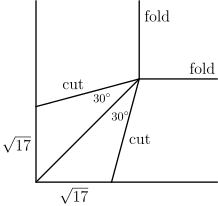
A square piece of paper has sides of length From each corner a wedge is cut in the following manner: at each corner, the two cuts for the wedge each start at distance from the corner, and they meet on the diagonal at an angle of (see the figure below). The paper is then folded up along the lines joining the vertices of adjacent cuts. When the two edges of a cut meet, they are taped together. The result is a paper tray whose sides are not at right angles to the base. The height of the tray, that is, the perpendicular distance between the plane of the base and the plane formed by the upper edges, can be written in the form where and are positive integers, and is not divisible by the th power of any prime. Find
Answer: 871
Small Hint:
Set the corner at with cut start the cuts meet at on the diagonal with and
Big Hint:
Folding swings about the fold line through to a point above the height is with on the fold line above
Solution:
Put the corner at the origin with the two sides along the positive axes, and write The cut on the bottom edge starts at and the two cuts meet at on the diagonal each making a angle with the diagonal. In triangle and so the Law of Sines gives The fold lines are the horizontal and vertical lines through Let be the point of the horizontal fold line directly above and the point where the vertical line through meets the diagonal. Since segment makes a angle with the bottom edge, so
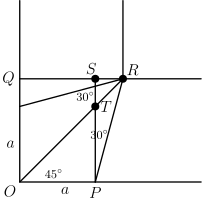
When the bottom strip folds up along the horizontal line through point stays at distance from moving in the vertical plane through perpendicular to that fold line. By symmetry the two taped cut edges meet above the diagonal, so lands at a point directly above and is the height of the tray. By the Pythagorean theorem,
So the height is and