
2007 AIME I Problems
Scroll down and press Start to try the exam! Or, go to the printable PDF, answer key, or professional solutions curated by LIVE by Po-Shen Loh.
All problems are used with official legal permission of the Mathematical Association of America (MAA).
Or jump straight to a single problem with its solution: 1 · 2 · 3 · 4 · 5 · 6 · 7 · 8 · 9 · 10 · 11 · 12 · 13 · 14 · 15
Want to learn professionally through interactive video classes?
Timed
3:00:00
1.
How many positive perfect squares less than are multiples of
Answer: 83
Small Hint:
A perfect square is a multiple of exactly when its square root is a multiple of
Big Hint:
Count the multiples of whose squares are less than i.e. the multiples of less than
Solution:
Since a square is a multiple of exactly when is a multiple of the factor forces to contain the factor forces to contain and conversely is always a multiple of Also exactly when
The multiples of less than are and there are of them.
2.
A foot long moving walkway moves at a constant rate of feet per second. Al steps onto the start of the walkway and stands. Bob steps onto the start of the walkway two seconds later and strolls forward along the walkway at a constant rate of feet per second. Two seconds after that, Cy reaches the start of the walkway and walks briskly forward beside the walkway at a constant rate of feet per second. At a certain time, one of these three persons is exactly halfway between the other two. At that time, find the distance in feet between the start of the walkway and the middle person.
Answer: 52
Small Hint:
Measure time from Al’s step: Al is at Bob at and Cy at
Big Hint:
Try each person as the one in the middle: twice the middle position must equal the sum of the other two. Only one case gives
Solution:
Measure time in seconds from when Al steps on. Al stands on the walkway, so he is at Bob moves at feet per second, so he is at Cy walks beside the walkway at feet per second, so he is at All three are moving once
The middle person’s position doubled must equal the sum of the other two. If Bob were in the middle, gives impossible. If Cy were in the middle, reduces to with no solution. If Al is in the middle, so
At that moment Al is at feet, while Bob and Cy are at and whose average is indeed The middle person is feet from the start.
3.
The complex number is equal to where is a positive real number and Given that the imaginary parts of and are equal, find
Answer: 15
Small Hint:
Expand and with the binomial theorem and extract the imaginary parts
Big Hint:
Both imaginary parts are divisible by cancel it before solving
Solution:
By the binomial theorem, and Setting the imaginary parts equal gives
Since is positive we may divide by leaving so
4.
Three planets revolve about a star in coplanar circular orbits with the star at the center. All planets revolve in the same direction, each at a constant speed, and the periods of their orbits are and years. The positions of the star and all three planets are currently collinear. They will next be collinear after years. Find
Answer: 105
Small Hint:
All four bodies are collinear exactly when each pair of planets has revolution counts differing by a multiple of
Big Hint:
Two of the pairwise gaps grow at revolution per year and the third twice as fast; make every gap a multiple of
Solution:
All four bodies lie on one line exactly when every pair of planets is collinear with the star, i.e. when each pair’s angular positions differ by a multiple of — half a revolution. In years the planets complete and revolutions, so the pairwise differences are
We need and to be multiples of The first requires to be a multiple of and any such makes an integer. The smallest positive choice is
5.
The formula for converting a Fahrenheit temperature to the corresponding Celsius temperature is An integer Fahrenheit temperature is converted to Celsius and rounded to the nearest integer; the resulting integer Celsius temperature is converted back to Fahrenheit and rounded to the nearest integer. For how many integer Fahrenheit temperatures with does the original temperature equal the final temperature?
Answer: 539
Small Hint:
Adding to adds exactly to so the round trip behaves identically for and
Big Hint:
Check through by hand to see how many of each consecutive temperatures survive, then handle through separately
Solution:
Adding to adds exactly to hence to the rounded Celsius value, hence to the final Fahrenheit value. So returns to itself if and only if does, and it suffices to check nine consecutive temperatures. Checking through the final values are so exactly the five temperatures survive.
The range from through contains integers, contributing survivors. The remaining behave like of which survive, adding more.
The total is
6.
A frog is placed at the origin on the number line, and moves according to the following rule: in a given move, the frog advances to either the closest point with a greater integer coordinate that is a multiple of or to the closest point with a greater integer coordinate that is a multiple of A move sequence is a sequence of coordinates which correspond to valid moves, beginning with and ending with For example, is a move sequence. How many move sequences are possible for the frog?
Answer: 169
Small Hint:
Split the journey at the landmarks and count routes for each segment and multiply
Big Hint:
There are routes between consecutive multiples of and routes across a stretch that skips the multiple of in the middle
Solution:
Split the journey at the landmarks and From the frog climbs the multiples of and may jump to from any of giving routes from to likewise there are routes from to (jump to from ) and from to To skip entirely the frog must take the multiple-of- option every time through then jump to from one of routes from to avoiding Similarly there are routes from to avoiding and from to avoiding both.
Combining the segments: through both landmarks, through only, through only, through neither, The total is
7.
Let Find the remainder when is divided by (Here denotes the greatest integer that is less than or equal to and denotes the least integer that is greater than or equal to )
Answer: 477
Small Hint:
equals unless is an integer, when it equals
Big Hint:
For integers is an integer exactly when is a power of so subtract the powers of from
Solution:
The difference equals when is not an integer and when it is. Now is an integer exactly when for some integer and for to be an integer, must be even — that is, must be a power of The powers at most are
Therefore and the remainder upon division by is
8.
The polynomial is cubic. What is the largest value of for which the polynomials and are both factors of
Answer: 30
Small Hint:
Two quadratic factors of a cubic must share a common root
Big Hint:
At a common root is a linear equation giving substitute back into
Solution:
If and had no common root, their product — of degree — would divide the cubic which is impossible. So they share a root and Computing, so
Substituting into gives multiplying by and simplifying yields so or
For and and both divide The largest value is
9.
In right triangle with right angle and Its legs and are extended beyond and Points and lie in the exterior of the triangle and are the centers of two circles with equal radii. The circle with center is tangent to the hypotenuse and to the extension of leg the circle with center is tangent to the hypotenuse and to the extension of leg and the circles are externally tangent to each other. The length of the radius of either circle can be expressed as where and are relatively prime positive integers. Find
Answer: 737
Small Hint:
Each circle is inscribed in an external angle of the triangle, so its tangent length from along the hypotenuse is
Big Hint:
The tangency points split the hypotenuse: with and
Solution:
The hypotenuse is Let and be the points where the circles touch Both centers lie at distance from line on the side away from the triangle, so is parallel to and since the circles are externally tangent. Thus
Circle is inscribed in the angle at between ray and the extension of beyond which measures Its tangent length from is therefore With and the half-angle formula gives and similarly
So giving Since and share no common factor,
10.
In the grid shown, of the squares are to be shaded so that there are two shaded squares in each row and three shaded squares in each column. Let be the number of shadings with this property. Find the remainder when is divided by

Answer: 860
Small Hint:
Shade column first, then classify by the number of rows shaded in both of the first two columns
Big Hint:
The rows still empty must be shaded in both remaining columns; choosing column then forces column
Solution:
Shade three of the six rows in column ways. Let be the number of rows shaded in both columns and column can then be chosen in ways. After these two columns, rows are complete with two shaded squares, rows have one, and rows have none.
The empty rows must be shaded in both columns and Column takes those rows plus of the singly-shaded rows, in ways, and column is then forced: it must cover the empty rows and exactly the singly-shaded rows skipped by column
Summing, so the remainder is
11.
For each positive integer let denote the unique positive integer such that For example, and If find the remainder when is divided by
Answer: 955
Small Hint:
exactly when a block of values of
Big Hint:
Complete blocks for cover every remaining up to has
Solution:
For a positive integer the condition means which for integers is exactly So for precisely values of
Since the blocks exactly cover and contribute The remaining values each have adding
Thus and the remainder is
12.
In isosceles triangle is located at the origin and is located at Point is in the first quadrant with and If is rotated counterclockwise about point until the image of lies on the positive -axis, the area of the region common to the original triangle and the rotated triangle is in the form where are integers. Find
Answer: 875
Small Hint:
The rotation is by and since the image of is perpendicular to
Big Hint:
The overlap is where is the foot of on and lie on use the law of sines and
Solution:
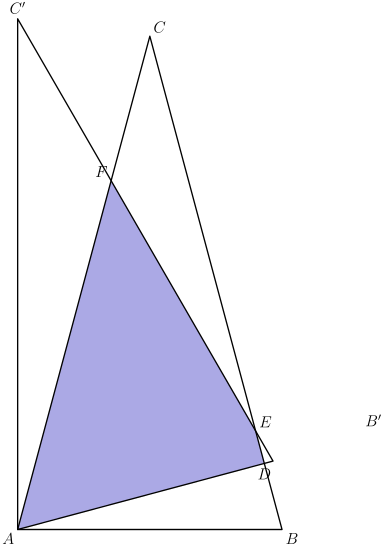
Since makes a angle with the positive -axis, the rotation is by Let and be the images of and Because and segment is perpendicular to let be their intersection, and let and The common region is the quadrilateral whose area is
In triangle and so and the law of sines gives With
In right triangle and so and Triangles and are similar (right angles at and ), so, using Therefore so and
13.
A square pyramid with base and vertex has eight edges of length A plane passes through the midpoints of and The plane’s intersection with the pyramid has an area that can be expressed as Find
Answer: 80
Small Hint:
Use coordinates: base and apex the plane through the three midpoints is
Big Hint:
The cross-section is a pentagon; split it into an isosceles triangle and an isosceles trapezoid to find its area
Solution:
Place the base at the apex is then since The given midpoints are and and all three satisfy the equation of the cutting plane.
Parametrizing edges and shows the plane meets them at and The cross-section is the pentagon with and diagonal
Split the pentagon along Isosceles triangle has height and area Isosceles trapezoid has height and area The total is so
14.
Let a sequence be defined as follows: and for Find the largest integer less than or equal to
Answer: 224
Small Hint:
Subtract the relation for consecutive indices to show is the same for all
Big Hint:
Multiply the constant-ratio relation by and use the original recurrence: the target fraction is that constant minus a tiny positive amount
Solution:
For both and hold. Subtracting and regrouping gives so has the same value for every Since that value is and the sequence satisfies
Multiplying by and substituting yields so
The sequence increases: and whenever Hence so the fraction lies strictly between and and the answer is
15.
Let be an equilateral triangle, and let and be points on sides and respectively, with and Point lies on side such that The area of triangle is The two possible values of the length of side are where and are rational, and is an integer not divisible by the square of a prime. Find
Answer: 989
Small Hint:
Let and and subtract the three corner triangles from to get
Big Hint:
forces so
Solution:
Let and Using the angles at and the area formula and Subtracting all three from and simplifying, so
At the angles and sum to while in triangle the angles and also sum to Hence and since triangles and are similar. Then gives so
Substituting into gives or so From we get so Both values yield valid configurations, so