
Soluciones del 2000 AMC 8
Desplázate hacia abajo para ver las soluciones preparadas profesionalmente de LIVE by Po-Shen Loh, imprime las soluciones en PDF, consulta la clave de respuestas, o haz el examen cronometrado completo.
Todos los problemas se usan con el permiso legal oficial de la Mathematical Association of America (MAA).
1.
La tía Anna tiene años. Caitlin es años menor que Brianna, y Brianna tiene la mitad de la edad de la tía Anna. ¿Cuántos años tiene Caitlin?
Aunt Anna is years old. Caitlin is years younger than Brianna, and Brianna is half as old as Aunt Anna. How old is Caitlin?
Pista pequeña:
Primero halla la edad de Brianna.
Find Brianna’s age first
Pista grande:
Caitlin es años menor que Brianna.
Caitlin is years younger than Brianna
Solución:
Brianna tiene años. Por lo tanto, Caitlin tiene años.
Así, B es la respuesta correcta.
Brianna is years old. Caitlin is therefore years old.
Thus, B is the correct answer.
2.
¿Cuál de estos números es menor que su recíproco?
Which of these numbers is less than its reciprocal?
Pista pequeña:
Comprueba si tiene recíproco.
Check whether has a reciprocal
Pista grande:
Compara con
Compare with
Solución:
no tiene recíproco, y y son sus propios recíprocos.
El recíproco de es pero no es menor que
Por lo tanto, como sabemos que es la única de las opciones de respuesta que es menor que su recíproco.
Así, A es la respuesta correcta.
has no reciprocal, and and are their own reciprocals.
The reciprocal of is but is not less than
Therefore, as we know that is the only one of the answer choices that is less than its reciprocal.
Thus, A is the correct answer.
3.
¿Cuántos números enteros hay en el intervalo entre y ?
How many whole numbers lie in the interval between and
infinitos
infinitely many
Pista pequeña:
Ubica y entre números enteros.
Locate and between whole numbers
Pista grande:
Cuenta los números enteros estrictamente dentro del intervalo.
Count the whole numbers strictly inside the interval
Solución:
El menor número entero mayor que es El mayor número entero menor que es
Los números enteros dentro de este rango son
Así, D es la respuesta correcta.
The smallest whole number greater than is The greatest whole number less than is
The whole numbers within this range are
Thus, D is the correct answer.
4.
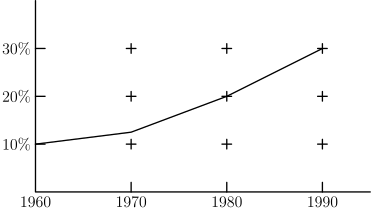
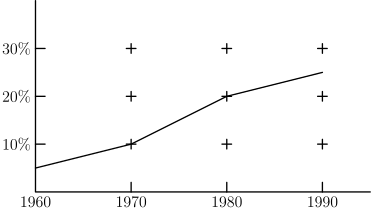
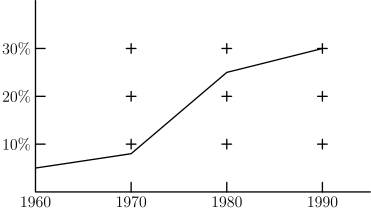
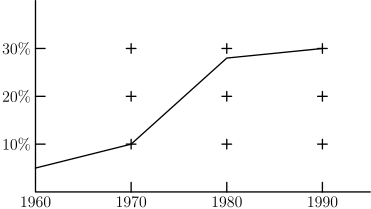
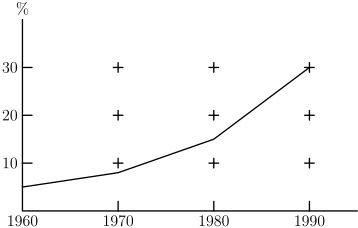
En solo el de los adultos trabajadores de la ciudad de Carlin trabajaba en casa. Para la fuerza laboral que trabajaba “en casa” había aumentado al En había aproximadamente un trabajando en casa, y en había un La gráfica que mejor ilustra esto es
In only of the working adults in Carlin City worked at home. By the “at-home” work force had increased to In there were approximately working at home, and in there were The graph that best illustrates this is
Pista pequeña:
Empareja los cuatro porcentajes con los cuatro años.
Match the four percentages to the four years
Pista grande:
Los valores graficados deben subir desde aproximadamente hasta
The plotted values should rise from about to
Solución:
La única gráfica que muestra todos los puntos de datos es la gráfica E.
Así, E es la respuesta correcta.
The only graph that shows all the data points is graph E .
Thus, E is the correct answer.
5.
Cada director de Lincoln High School cumple exactamente un mandato de años. ¿Cuál es el número máximo de directores que esta escuela podría tener durante un período de años?
Each principal of Lincoln High School serves exactly one -year term. What is the maximum number of principals this school could have during an -year period?
Pista pequeña:
Haz que la ventana de años comience al final de un mandato.
Let the -year window start at the end of a term
Pista grande:
Un director puede aparecer solo durante parte del período de años.
A principal can appear for only part of the -year period
Solución:
Para maximizar el número de directores, supón que el primer año de este período es el último año del mandato de algún director.
Luego, puede haber directores más durante años, seguidos de otro director que trabaja el último año.
Esto da directores.
Así, C es la respuesta correcta.
To maximize the number of principals, assume that the first year of this period is the final year of some principal’s term.
Then, there can be more principals for years, followed by another principal who works the final year.
This is principals.
Thus, C is the correct answer.
6.
La figura es un cuadrado. Dentro de este cuadrado se dibujan tres cuadrados más pequeños con las longitudes de lado indicadas. El área de la región sombreada en forma de L es
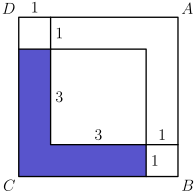
Figure is a square. Inside this square three smaller squares are drawn with side lengths as labeled. The area of the shaded L-shaped region is
Pista pequeña:
Divide la L sombreada en rectángulos.
Break the shaded L into rectangles
Pista grande:
Un cuadrado de menos un cuadrado de también funciona.
A square minus a square also works
Solución:
Podemos restar las áreas del cuadrado unitario superior, el cuadrado unitario inferior derecho y el cuadrado superior derecho.
El área sombreada en es, por lo tanto,
Así, A es la respuesta correcta.
We can subtract out the areas of the top unit square, the bottom right unit square, and the top right square.
The shaded area in is therefore
Thus, A is the correct answer.
7.
¿Cuál es el producto mínimo posible de tres números diferentes del conjunto
What is the minimum possible product of three different numbers of the set
Pista pequeña:
Un producto negativo necesita un número impar de factores negativos.
A negative product needs an odd number of negative factors
Pista grande:
Compara usar tres negativos frente a un negativo y dos positivos.
Compare using three negatives versus one negative and two positives
Solución:
Un producto negativo proviene de tres factores negativos o de un factor negativo y dos factores positivos.
Con tres factores negativos, el producto mínimo es Con un factor negativo, usamos el número más negativo y los dos positivos mayores para obtener Como el producto mínimo posible es
Así, B es la respuesta correcta.
A negative product comes either from three negative factors or from one negative factor and two positive factors.
With three negative factors, the minimum is With one negative factor, use the most negative number and the two largest positive numbers to get Since the minimum possible product is
Thus, B is the correct answer.
8.
Tres dados con caras numeradas del al se apilan como se muestra. Siete de las dieciocho caras son visibles, quedando once caras ocultas (atrás, abajo, entre ellas). El número total de puntos que NO son visibles en esta vista es
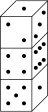
Three dice with faces numbered through are stacked as shown. Seven of the eighteen faces are visible, leaving eleven faces hidden (back, bottom, between). The total number of dots NOT visible in this view is
Pista pequeña:
Cada dado tiene puntos en total.
Each die has total dots
Pista grande:
Resta los puntos visibles del total de los tres dados.
Subtract the visible dots from the total on all three dice
Solución:
La suma de los números de un dado es Por lo tanto, la suma de los números de los dados es
Los números visibles suman Esto hace que la suma de los números no vistos sea
Así, D es la respuesta correcta.
The sum of the numbers on one die is Therefore, the sum of the numbers on all dice is
The visible numbers add up to This makes the sum of the unseen numbers
Thus, D is the correct answer.
9.
En este acertijo de “crucinúmeros” se usan potencias de tres dígitos de y de ¿Cuál es el único dígito posible para el cuadrado destacado?
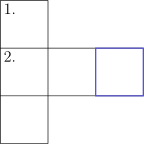
Three-digit powers of and are used in this “cross-number” puzzle. What is the only possible digit for the outlined square?
Pista pequeña:
Enumera las potencias de tres dígitos de
List the three-digit powers of
Pista grande:
La entrada horizontal es una potencia de tres dígitos de que empieza con
The across entry is a three-digit power of starting with
Solución:
Las únicas potencias de dígitos de son y Esto significa que la casilla se llena con un
La única potencia de dígitos de que empieza con es así que el cuadrado destacado se llena con un
Así, D es la respuesta correcta.
The only -digit powers of are and This means that the spot is filled with a
The only -digit power of beginning with a is so the outlined square is filled with a
Thus, D is the correct answer.
10.
Ara y Shea alguna vez tuvieron la misma estatura. Desde entonces, Shea ha crecido un mientras que Ara ha crecido la mitad de pulgadas de lo que creció Shea. Shea ahora mide pulgadas. ¿Cuántas pulgadas mide Ara ahora?
Ara and Shea were once the same height. Since then Shea has grown while Ara has grown half as many inches as Shea. Shea is now inches tall. How tall, in inches, is Ara now?
Pista pequeña:
Recupera la estatura común original a partir de la nueva estatura de Shea.
Recover the original common height from Shea’s new height
Pista grande:
Ara creció la mitad de pulgadas de lo que creció Shea.
Ara grew half as many inches as Shea
Solución:
Sea la estatura inicial de Ara y Shea. Entonces obtenemos
Esto significa que Shea creció pulgadas, lo que significa que Ara creció pulgadas, por lo que ahora mide pulgadas.
Así, E es la respuesta correcta.
Let be Ara and Shea’s initial height. Then we get that
This means that Shea grew inches, which means that Ara grew inches, making her inches tall.
Thus, E is the correct answer.
11.
El número tiene la propiedad de que es divisible entre su dígito de las unidades. ¿Cuántos números enteros entre y tienen esta propiedad?
The number has the property that it is divisible by its unit digit. How many whole numbers between and have this property?
Pista pequeña:
Agrupa los números por su dígito de las unidades.
Group numbers by their units digit
Pista grande:
Recuerda que los números que terminan en no funcionan.
Remember numbers ending in do not work
Solución:
Los números que terminan en o funcionan todos en las listas y y y y Esto da números.
Los demás números que funcionan son y Los números que terminan en no funcionan porque la división entre no está definida.
Por lo tanto, hay números de este tipo.
Así, C es la respuesta correcta.
Numbers ending in or all work in the lists and and and and This gives numbers.
The remaining working numbers are and Numbers ending in do not work because division by is undefined.
Thus there are such numbers.
Thus, C is the correct answer.
12.
Se construirá un muro de bloques de pies de largo y pies de alto usando bloques de pie de alto y de pies de largo o pie de largo (no se pueden cortar los bloques). Las juntas verticales de los bloques deben estar escalonadas como se muestra, y el muro debe quedar parejo en los extremos. ¿Cuál es el menor número de bloques necesarios para construir este muro?

A block wall feet long and feet high will be constructed using blocks that are foot high and either feet long or foot long (no blocks may be cut). The vertical joins in the blocks must be staggered as shown, and the wall must be even on the ends. What is the smallest number of blocks needed to build this wall?
Pista pequeña:
Empieza con todos los bloques de pies.
Start with all -foot blocks
Pista grande:
Solo una fila de cada dos necesita un bloque extra para escalonar las juntas.
Only every other row needs an extra block to stagger joins
Solución:
El número total de filas del muro es y cada fila tiene pie de alto.
Para usar el número mínimo de bloques, las filas y tendrán el mismo patrón que la fila inferior de la imagen, que requiere bloques.
Las filas y tendrán el mismo patrón que la fila superior de la imagen, que tiene bloques de pies en el centro y un bloque de pie en cada extremo, para un total de bloques.
Al sumar filas de bloques y filas de bloques, se obtiene un total de bloques.
Así, D es la respuesta correcta.
The total number of rows in the wall is with each row being foot high.
To use the minimum number of bricks, rows and will have the same pattern as the bottom row in the picture, which requires bricks to construct.
Rows and will have the same pattern as the upper row in the picture, which has -foot bricks in the middle and one -foot brick on each end, for a total of bricks.
When you add up rows of bricks and rows of bricks, you get a total of bricks.
Thus, D is the correct answer.
13.
En el triángulo tenemos y Si biseca entonces
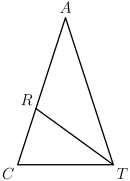
In triangle we have and If bisects then
Pista pequeña:
Primero halla los dos ángulos de la base iguales de
First find the two equal base angles of
Pista grande:
Usa la bisectriz del ángulo en
Use the angle bisector at
Solución:
Obtenemos
Debido a la bisección, también sabemos que
Finalmente, vemos que
Así, C es la respuesta correcta.
We get
Due to bisection, we also know that
Finally, we see that
Thus, C is the correct answer.
14.
¿Cuál es el dígito de las unidades de ?
What is the units digit of
Pista pequeña:
Solo importa el dígito de las unidades.
Only the units digit matters
Pista grande:
Las potencias impares de un número que termina en terminan en
Odd powers of a number ending in end in
Solución:
Observa que el dígito de las unidades de una potencia depende solo del dígito de las unidades de la base.
Experimentando, obtenemos que elevado a una potencia par termina en y elevado a una potencia impar termina en
Por lo tanto, termina en y también termina en Sumándolos se obtiene un número que termina en
Así, D es la respuesta correcta.
Note that the units digit of a power depends only upon the units digit of the base.
Experimenting, we get that to an even power ends with a and to an odd power ends with a
Therefore, ends with a and also ends with a Adding them together yields a number that ends in
Thus, D is the correct answer.
15.
Los triángulos y son todos equiláteros. Los puntos y son los puntos medios de y respectivamente. Si ¿cuál es el perímetro de la figura ?
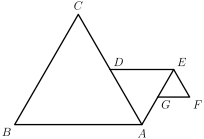
Triangles and are all equilateral. Points and are midpoints of and respectively. If what is the perimeter of figure
Pista pequeña:
Usa la información de los puntos medios para hallar las longitudes de lado de los triángulos equiláteros más pequeños.
Use the midpoint information to find smaller equilateral side lengths
Pista grande:
Suma solo las longitudes del contorno exterior.
Add the outside boundary lengths only
Solución:
El triángulo equilátero grande tiene lado el mediano tiene lado y el más pequeño tiene lado
El perímetro es, por lo tanto,
Así, C es la respuesta correcta.
The large equilateral triangle has side length the middle one has side length and the smaller one has side length
The perimeter is therefore
Thus, C is the correct answer.
16.
Para que Mateen camine un kilómetro ( metros) en su patio rectangular, debe caminar el largo veces o caminar su perímetro veces. ¿Cuál es el área del patio de Mateen en metros cuadrados?
In order for Mateen to walk a kilometer ( meters) in his rectangular backyard, he must walk the length times or walk its perimeter times. What is the area of Mateen’s backyard in square meters?
Pista pequeña:
El largo proviene de caminarlo veces.
The length comes from walking it times
Pista grande:
El perímetro proviene de caminarlo veces.
The perimeter comes from walking it times
Solución:
Podemos ver que el largo es metros y el perímetro es metros.
Observa que el perímetro es veces la suma del largo y el ancho.
Esto significa que el ancho es metros y el área es metros cuadrados.
Así, C es la respuesta correcta.
We can see that the length is meters, and the perimeter is meters.
Note that the perimeter is times the sum of the length and width.
This means that the width is meters, and the area is square meters.
Thus, C is the correct answer.
17.
La operación se define para todos los números distintos de cero por
Determina
The operation is defined for all nonzero numbers by
Determine
Pista pequeña:
Evalúa cada expresión de adentro hacia afuera.
Evaluate each expression from the inside out
Pista grande:
Conserva los paréntesis; la operación no es asociativa.
Keep the parentheses; the operation is not associative
Solución:
Podemos calcularlo de la siguiente manera:
Así, A es la respuesta correcta.
We can calculate it as follows.
Thus, A is the correct answer.
18.
Considera estos dos cuadriláteros en el geoplano. ¿Cuál de las siguientes afirmaciones es verdadera?
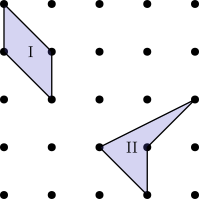
Consider these two geoboard quadrilaterals. Which of the following statements is true?
El área del cuadrilátero es mayor que el área del cuadrilátero
The area of quadrilateral is more than the area of quadrilateral
El área del cuadrilátero es menor que el área del cuadrilátero
The area of quadrilateral is less than the area of quadrilateral
Los cuadriláteros tienen la misma área y el mismo perímetro.
The quadrilaterals have the same area and the same perimeter.
Los cuadriláteros tienen la misma área, pero el perímetro de es mayor que el perímetro de
The quadrilaterals have the same area, but the perimeter of is more than the perimeter of
Los cuadriláteros tienen la misma área, pero el perímetro de es menor que el perímetro de
The quadrilaterals have the same area, but the perimeter of is less than the perimeter of
Pista pequeña:
Descompón ambos cuadriláteros en triángulos rectángulos unitarios.
Decompose both quadrilaterals into unit right triangles
Pista grande:
Calcula las longitudes de los cuatro lados de cada cuadrilátero.
Compute all four side lengths of each quadrilateral
Solución:
Supón que las clavijas de esta cuadrícula están separadas por unidad.
Observa que la región es un paralelogramo con base y altura lo que hace que su área sea
Podemos dividir la región en triángulos, ambos con base y altura Esto hace que la suma de las áreas sea Esto muestra que ambas regiones tienen la misma área.
Observa que cada región tiene lados de longitud La región tiene lados unitarios, mientras que la región solo tiene
El otro lado de la región es claramente mayor que lo que muestra que la región tiene el mayor perímetro.
Así, E es la respuesta correcta.
Assume that the pegs on this grid are separated by unit.
Note that region is a parallelogram with base and height making its area
We can split region into triangles, both with base and height This makes the sum of the areas This shows that both regions have the same area.
Note that each region has sides that are of length Region has unit sides, whereas region only has
The other side of region is clearly greater than which shows that region has the greater perimeter.
Thus, E is the correct answer.
19.
Tres arcos circulares de radio unidades delimitan la región mostrada. Los arcos y son cuartos de círculo, y el arco es un semicírculo. ¿Cuál es el área, en unidades cuadradas, de la región?
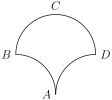
Three circular arcs of radius units bound the region shown. Arcs and are quarter-circles, and arc is a semicircle. What is the area, in square units, of the region?
Pista pequeña:
Mueve las piezas curvas para formar un rectángulo.
Move the curved pieces to make a rectangle
Pista grande:
El rectángulo reorganizado tiene dimensiones y
The rearranged rectangle has dimensions and
Solución:
Crea un rectángulo que cubra la mitad inferior de la figura, como se muestra a continuación.
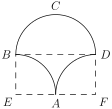
Entonces, obtenemos
También sabemos que
y son ambos cuartos de círculo que forman un semicírculo con la misma área que
Esto significa que y
Así, C es la respuesta correcta.
Create a rectangle that covers the bottom half of the figure as shown below.
Then, we get that
We also know that
and are both quarter-circles that form a semicircle with the same area as
This means that and
Thus, C is the correct answer.
20.
Tienes nueve monedas: una colección de monedas de un centavo, monedas de cinco centavos, monedas de diez centavos y monedas de veinticinco centavos con un valor total de con al menos una moneda de cada tipo. ¿Cuántas monedas de diez centavos debes tener?
You have nine coins: a collection of pennies, nickels, dimes, and quarters having a total value of with at least one coin of each type. How many dimes must you have?
Pista pequeña:
Usa los centavos módulo para hallar el número de monedas de un centavo.
Use cents modulo to find the number of pennies
Pista grande:
Después de las monedas de un centavo, resuelve para las monedas de cinco, diez y veinticinco centavos.
After the pennies, solve for nickels, dimes, and quarters
Solución:
El número de monedas de un centavo debe tener el mismo residuo que módulo así que hay o monedas de un centavo. Siete de estas monedas dejarían solo dos monedas para las de cinco, diez y veinticinco centavos, lo cual es imposible porque se necesita al menos una de cada tipo.
Entonces hay monedas de un centavo. Las monedas restantes valen centavos. Si y son los números de monedas de cinco, diez y veinticinco centavos, entonces y
Dividiendo la ecuación del valor entre y restando la ecuación del número de monedas se obtiene La única solución positiva es y
Por lo tanto, debe haber moneda de diez centavos.
Así, A es la respuesta correcta.
The number of pennies must have the same remainder as modulo so there are either or pennies. Seven pennies would leave only two coins for nickels, dimes, and quarters, impossible because at least one of each type is needed.
So there are pennies. The remaining coins are worth cents. If and are the numbers of nickels, dimes, and quarters, then and
Dividing the value equation by and subtracting the coin-count equation gives The only positive solution is and
Thus there must be dime.
Thus, A is the correct answer.
21.
Keiko lanza una moneda de un centavo y Ephraim lanza dos monedas de un centavo. La probabilidad de que Ephraim obtenga el mismo número de caras que Keiko es
Keiko tosses one penny and Ephraim tosses two pennies. The probability that Ephraim gets the same number of heads that Keiko gets is
Pista pequeña:
Enumera el resultado de Keiko y el resultado de las dos monedas de un centavo de Ephraim.
List Keiko’s result and Ephraim’s two-coin result
Pista grande:
Cuenta los totales de caras que coinciden entre los resultados igualmente probables.
Count matching head totals among the equally likely outcomes
Solución:
Hay resultados igualmente probables si registramos la moneda de Keiko y las dos monedas de Ephraim.
Si Keiko obtiene cara, Ephraim debe obtener exactamente una cara; esto ocurre en resultados. Si Keiko obtiene cruz, Ephraim no debe obtener ninguna cara; esto ocurre en resultado.
Así que de los resultados igualmente probables funcionan y la probabilidad es
Así, B es la respuesta correcta.
There are equally likely outcomes if we record Keiko’s coin and Ephraim’s two coins.
If Keiko gets heads, Ephraim must get exactly one head; this happens in outcomes. If Keiko gets tails, Ephraim must get no heads; this happens in outcome.
So of the equally likely outcomes work, and the probability is
Thus, B is the correct answer.
22.
Un cubo tiene arista de longitud Supón que pegamos un cubo de arista sobre el cubo grande de modo que una de sus caras descanse por completo sobre la cara superior del cubo mayor. El aumento porcentual del área de superficie (lados, parte superior y parte inferior) del cubo original al nuevo sólido formado es más cercano a

A cube has edge length Suppose that we glue a cube of edge length on top of the big cube so that one of its faces rests entirely on the top face of the larger cube. The percent increase in the surface area (sides, top, and bottom) from the original cube to the new solid formed is closest to
Pista pequeña:
El cubo original tiene área de superficie
The original cube has surface area
Pista grande:
El cubo pequeño oculta un cuadrado unitario pero agrega cinco.
The small cube hides one unit square but adds five
Solución:
El área de superficie original es simplemente
Observa que la cara superior del cubo unitario más el área visible de la cara superior del cubo mayor es igual al área de una cara del cubo mayor.
Esto significa que el cuadrado unitario de arriba solo agrega cuadrados unitarios al área de superficie total, por lo que el aumento es
El aumento porcentual es, por lo tanto,
Así, C es la respuesta correcta.
The original surface area is just
Note that the top face of the unit cube plus the visible area of the top face of the larger cube is the same as the area of one face of the larger cube.
This means that the unit square on top only adds unit squares to the total surface area, making the increase
The percent increase is therefore
Thus, C is the correct answer.
23.
Hay una lista de siete números. El promedio de los primeros cuatro números es y el promedio de los últimos cuatro números es Si el promedio de los siete números es entonces el número común a ambos conjuntos de cuatro números es
There is a list of seven numbers. The average of the first four numbers is and the average of the last four numbers is If the average of all seven numbers is then the number common to both sets of four numbers is
Pista pequeña:
Convierte cada promedio en una suma.
Convert each average into a sum
Pista grande:
El número compartido se cuenta dos veces en las dos sumas de cuatro números.
The shared number is counted twice in the two four-number sums
Solución:
La suma de los primeros cuatro números es La suma de los últimos cuatro números es
La suma de los siete números es Sabemos que el número común a ambos conjuntos está incluido en las dos primeras sumas.
Esto significa que la suma de las dos primeras sumas incluye cada número una vez, excepto el número común, que se incluye dos veces.
La tercera suma, sin embargo, solo incluye cada número una vez. Esto significa que la suma de las dos primeras sumas menos la tercera suma da el número deseado.
Por lo tanto, el número común es
Así, B es la respuesta correcta.
The sum of the first four numbers is The sum of the last four numbers is
The sum of all seven numbers is We know that the number common to both sets is included in both of the first two sums.
This means that the sum of the first two sums includes every number once, except for the common number which is included twice.
The third sum, however, only includes every number once. This means that the sum of the first two sums minus the third sum yields our desired number.
Therefore, the common number is
Thus, B is the correct answer.
24.
Si y entonces
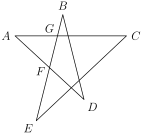
If and then
Pista pequeña:
Usa primero el triángulo isósceles
Use the isosceles triangle first
Pista grande:
Luego usa la suma de los ángulos de
Then use the angle sum of
Solución:
En los dos ángulos de la base son iguales y así que
Como y forman un ángulo llano,
En
Así, D es la respuesta correcta.
In the two base angles are equal and so
Since and form a straight angle,
In
Thus, D is the correct answer.
25.
El área del rectángulo es unidades cuadradas. Si el punto y los puntos medios de y se unen para formar un triángulo, el área de ese triángulo es
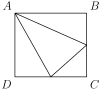
The area of rectangle is square units. If point and the midpoints of and are joined to form a triangle, the area of that triangle is
Pista pequeña:
Sean los lados del rectángulo y
Let the rectangle sides be and
Pista grande:
Resta del rectángulo los tres triángulos rectángulos exteriores.
Subtract the three outside right triangles from the rectangle
Solución:
Sea el rectángulo con lados y de modo que su área es y
Los tres triángulos rectángulos fuera del triángulo deseado tienen áreas y
Su área total es Por lo tanto, el triángulo deseado tiene área
Así, B es la respuesta correcta.
Let the rectangle have side lengths and so its area is and
The three right triangles outside the desired triangle have areas and
Their total area is Therefore the desired triangle has area
Thus, B is the correct answer.