
2000 AMC 8 详解
向下滚动即可查看来自 LIVE by Po-Shen Loh 的精心整理的解答,打印PDF 解答,查看答案,或参加完整限时模拟考试。
所有题目均经美国数学协会(MAA)官方合法授权使用。
1.
Anna 阿姨 岁。Caitlin 比 Brianna 小 岁,而 Brianna 的年龄是 Anna 阿姨的一半。Caitlin 几岁?
Aunt Anna is years old. Caitlin is years younger than Brianna, and Brianna is half as old as Aunt Anna. How old is Caitlin?
小提示:
先求 Brianna 的年龄。
Find Brianna’s age first
大提示:
Caitlin 比 Brianna 小 岁。
Caitlin is years younger than Brianna
解答:
Brianna 的年龄是 岁。因此 Caitlin 是 岁。
所以正确答案是 B。
Brianna is years old. Caitlin is therefore years old.
Thus, B is the correct answer.
2.
下列哪个数小于它的倒数?
Which of these numbers is less than its reciprocal?
小提示:
检查 是否有倒数。
Check whether has a reciprocal
大提示:
比较 和 。
Compare with
解答:
没有倒数, 和 的倒数都是它们本身。
的倒数是 ,但 不小于 。
因为 ,所以 是唯一小于其倒数的选项。
所以正确答案是 A。
has no reciprocal, and and are their own reciprocals.
The reciprocal of is but is not less than
Therefore, as we know that is the only one of the answer choices that is less than its reciprocal.
Thus, A is the correct answer.
3.
在 和 之间有多少个整数?
How many whole numbers lie in the interval between and
无限多个
infinitely many
小提示:
判断 和 分别位于哪些整数之间。
Locate and between whole numbers
大提示:
只数严格位于区间内部的整数。
Count the whole numbers strictly inside the interval
解答:
大于 的最小整数是 。小于 的最大整数是 。
在这个范围内的整数是
所以正确答案是 D。
The smallest whole number greater than is The greatest whole number less than is
The whole numbers within this range are
Thus, D is the correct answer.
4.
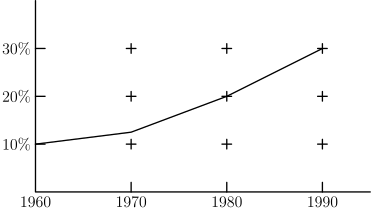
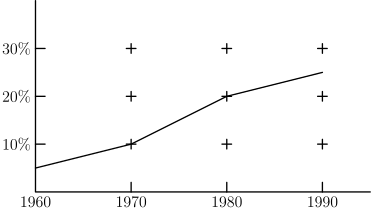
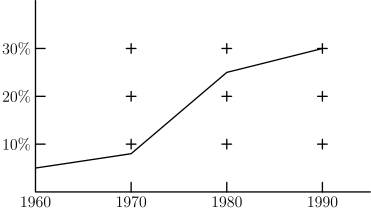
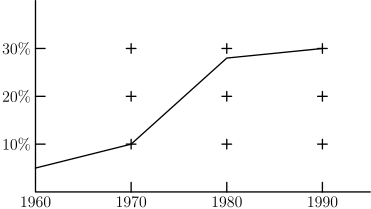
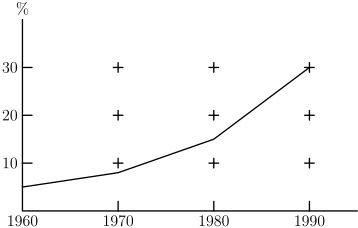
年,卡林市只有 的在职成年人在家工作。到 年,在家工作的劳动力增加到 。 年约有 在家工作, 年有 。最能表示这些数据的图是
In only of the working adults in Carlin City worked at home. By the “at-home” work force had increased to In there were approximately working at home, and in there were The graph that best illustrates this is
小提示:
将四个百分比与四个年份对应起来。
Match the four percentages to the four years
大提示:
图上的数值应从大约 上升到 。
The plotted values should rise from about to
解答:
唯一显示所有数据点的图是图 E。
所以正确答案是 E。
The only graph that shows all the data points is graph E .
Thus, E is the correct answer.
5.
Lincoln High School 的每位校长任期恰好为 年。在一段 年期间,这所学校最多可能有多少位校长?
Each principal of Lincoln High School serves exactly one -year term. What is the maximum number of principals this school could have during an -year period?
小提示:
让这段 年期从某位校长任期的最后一年开始。
Let the -year window start at the end of a term
大提示:
一位校长可以只在这段 年期内任职一部分时间。
A principal can appear for only part of the -year period
解答:
为了让校长人数最多,假设这段时间的第一年是某位校长任期的最后一年。
接着可以有 位校长完成接下来的 年,然后再有一位校长任最后一年。
总共是 位校长。
所以正确答案是 C。
To maximize the number of principals, assume that the first year of this period is the final year of some principal’s term.
Then, there can be more principals for years, followed by another principal who works the final year.
This is principals.
Thus, C is the correct answer.
6.
图形 是一个正方形。在这个正方形内画了三个较小的正方形,其边长如图所示。阴影的 L 形区域面积是
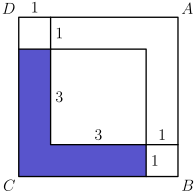
Figure is a square. Inside this square three smaller squares are drawn with side lengths as labeled. The area of the shaded L-shaped region is
小提示:
把阴影 L 形分成矩形。
Break the shaded L into rectangles
大提示:
也可以用一个 正方形减去一个 正方形。
A square minus a square also works
解答:
可以从大正方形中减去上方的单位正方形、右下角的单位正方形,以及右上方的 正方形。
的阴影面积为
所以正确答案是 A。
We can subtract out the areas of the top unit square, the bottom right unit square, and the top right square.
The shaded area in is therefore
Thus, A is the correct answer.
7.
从下面的集合中取三个不同的数,它们的乘积最小可能是多少?这个集合是
What is the minimum possible product of three different numbers of the set
小提示:
负乘积需要奇数个负因数。
A negative product needs an odd number of negative factors
大提示:
比较三个负数相乘和一个负数配两个正数相乘的情况。
Compare using three negatives versus one negative and two positives
解答:
负乘积可能来自三个负因数,也可能来自一个负因数和两个正因数。
选三个负因数时,最小乘积为 选一个负因数时,应选最小的负数和最大的两个正数,得到 因为 ,所以最小可能乘积是 。
所以正确答案是 B。
A negative product comes either from three negative factors or from one negative factor and two positive factors.
With three negative factors, the minimum is With one negative factor, use the most negative number and the two largest positive numbers to get Since the minimum possible product is
Thus, B is the correct answer.
8.
三个面上编号为 到 的骰子如图堆叠。十八个面中有七个面可见,剩下十一个面被隐藏(背面、底面、相接面)。从这个视角看不到的点数总和是
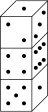
Three dice with faces numbered through are stacked as shown. Seven of the eighteen faces are visible, leaving eleven faces hidden (back, bottom, between). The total number of dots NOT visible in this view is
小提示:
每个骰子的总点数是 。
Each die has total dots
大提示:
从三个骰子的总点数中减去可见点数。
Subtract the visible dots from the total on all three dice
解答:
一个骰子各面的点数和为 因此 个骰子的总点数是 。
可见点数之和为 所以不可见点数之和是 。
所以正确答案是 D。
The sum of the numbers on one die is Therefore, the sum of the numbers on all dice is
The visible numbers add up to This makes the sum of the unseen numbers
Thus, D is the correct answer.
9.
这个“数字填字”题中使用了三位数的 的幂和 的幂。带框方格中唯一可能的数字是什么?
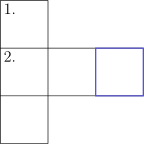
Three-digit powers of and are used in this “cross-number” puzzle. What is the only possible digit for the outlined square?
小提示:
列出三位数的 的幂。
List the three-digit powers of
大提示:
横向条目是以 开头的三位数 的幂。
The across entry is a three-digit power of starting with
解答:
位数的 的幂只有 和 。这说明标为 的位置填的是 。
唯一的 位数且以 开头的 的幂是 ,所以带框方格填 。
所以正确答案是 D。
The only -digit powers of are and This means that the spot is filled with a
The only -digit power of beginning with a is so the outlined square is filled with a
Thus, D is the correct answer.
10.
Ara 和 Shea 曾经一样高。此后 Shea 长高了 ,而 Ara 长高的英寸数是 Shea 的一半。Shea 现在高 英寸。Ara 现在高多少英寸?
Ara and Shea were once the same height. Since then Shea has grown while Ara has grown half as many inches as Shea. Shea is now inches tall. How tall, in inches, is Ara now?
小提示:
由 Shea 现在的身高求出原来的共同身高。
Recover the original common height from Shea’s new height
大提示:
Ara 长高的英寸数是 Shea 的一半。
Ara grew half as many inches as Shea
解答:
设 Ara 和 Shea 原来的身高为 。则
Shea 长高了 英寸,所以 Ara 长高了 英寸,她现在高 英寸。
所以正确答案是 E。
Let be Ara and Shea’s initial height. Then we get that
This means that Shea grew inches, which means that Ara grew inches, making her inches tall.
Thus, E is the correct answer.
11.
数 有一个性质:它能被自己的个位数字整除。 到 之间有多少个整数具有这个性质?
The number has the property that it is divisible by its unit digit. How many whole numbers between and have this property?
小提示:
按个位数字分组。
Group numbers by their units digit
大提示:
记住以 结尾的数不行。
Remember numbers ending in do not work
解答:
以 、 或 结尾的数都满足条件,分别为 、、、;、、、;以及 、、、。这共有 个数。
其余满足条件的数是 、、、、。以 结尾的数不行,因为除以 没有定义。
因此共有 个这样的数。
所以正确答案是 C。
Numbers ending in or all work in the lists and and and and This gives numbers.
The remaining working numbers are and Numbers ending in do not work because division by is undefined.
Thus there are such numbers.
Thus, C is the correct answer.
12.
要建造一面长 英尺、高 英尺的砌块墙,使用的砌块高 英尺,长度可以是 英尺或 英尺(不得切割砌块)。砌块的竖缝必须如图所示错开,且墙两端必须齐平。建造这面墙最少需要多少块砌块?

A block wall feet long and feet high will be constructed using blocks that are foot high and either feet long or foot long (no blocks may be cut). The vertical joins in the blocks must be staggered as shown, and the wall must be even on the ends. What is the smallest number of blocks needed to build this wall?
小提示:
从全部使用 英尺砌块开始考虑。
Start with all -foot blocks
大提示:
为了错开竖缝,只需每隔一行多用砌块。
Only every other row needs an extra block to stagger joins
解答:
墙共有 行,每行高 英尺。
为了使用最少砌块,第 、、 和 行可采用图中底行的模式,每行需要 块砌块。
第 、 和 行采用图中上行的模式,中间有 块 英尺砌块,两端各有一块 英尺砌块,共 块砌块。
将 行 块和 行 块相加,得到 块砌块。
所以正确答案是 D。
The total number of rows in the wall is with each row being foot high.
To use the minimum number of bricks, rows and will have the same pattern as the bottom row in the picture, which requires bricks to construct.
Rows and will have the same pattern as the upper row in the picture, which has -foot bricks in the middle and one -foot brick on each end, for a total of bricks.
When you add up rows of bricks and rows of bricks, you get a total of bricks.
Thus, D is the correct answer.
13.
在三角形 中,,且 。如果 平分 ,那么
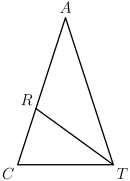
In triangle we have and If bisects then
14.
的个位数字是多少?
What is the units digit of
小提示:
只需要考虑个位数字。
Only the units digit matters
大提示:
以 结尾的数的奇次幂以 结尾。
Odd powers of a number ending in end in
解答:
幂的个位数字只取决于底数的个位数字。
观察可知, 的偶次幂个位是 ,奇次幂个位是 。
因此 个位是 , 个位也是 。相加后的个位为 。
所以正确答案是 D。
Note that the units digit of a power depends only upon the units digit of the base.
Experimenting, we get that to an even power ends with a and to an odd power ends with a
Therefore, ends with a and also ends with a Adding them together yields a number that ends in
Thus, D is the correct answer.
15.
三角形 、 和 都是等边三角形。点 和 分别是 和 的中点。如果 ,图形 的周长是多少?
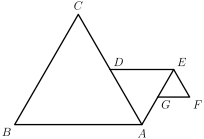
Triangles and are all equilateral. Points and are midpoints of and respectively. If what is the perimeter of figure
小提示:
利用中点信息求较小等边三角形的边长。
Use the midpoint information to find smaller equilateral side lengths
大提示:
只相加外边界上的长度。
Add the outside boundary lengths only
解答:
大等边三角形边长为 ,中等边三角形边长为 ,小等边三角形边长为 。
周长为
所以正确答案是 C。
The large equilateral triangle has side length the middle one has side length and the smaller one has side length
The perimeter is therefore
Thus, C is the correct answer.
16.
为了在他的长方形后院里走一千米( 米),Mateen 必须沿着长走 次,或者沿着周长走 次。Mateen 后院的面积是多少平方米?
In order for Mateen to walk a kilometer ( meters) in his rectangular backyard, he must walk the length times or walk its perimeter times. What is the area of Mateen’s backyard in square meters?
小提示:
后院的长来自走 次的距离。
The length comes from walking it times
大提示:
周长来自走 次的距离。
The perimeter comes from walking it times
解答:
长为 米,周长为 米。
周长是长与宽之和的 倍。
因此宽为 米,面积为 平方米。
所以正确答案是 C。
We can see that the length is meters, and the perimeter is meters.
Note that the perimeter is times the sum of the length and width.
This means that the width is meters, and the area is square meters.
Thus, C is the correct answer.
17.
对所有非零数,运算 定义为
求
The operation is defined for all nonzero numbers by
Determine
18.
考虑这两个钉板四边形。下列哪一项正确?
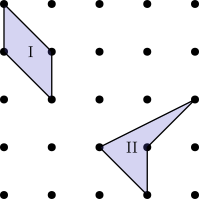
Consider these two geoboard quadrilaterals. Which of the following statements is true?
四边形 的面积大于四边形 的面积。
The area of quadrilateral is more than the area of quadrilateral
四边形 的面积小于四边形 的面积。
The area of quadrilateral is less than the area of quadrilateral
两个四边形面积相同,周长也相同。
The quadrilaterals have the same area and the same perimeter.
两个四边形面积相同,但 的周长大于 的周长。
The quadrilaterals have the same area, but the perimeter of is more than the perimeter of
两个四边形面积相同,但 的周长小于 的周长。
The quadrilaterals have the same area, but the perimeter of is less than the perimeter of
小提示:
将两个四边形都分解成单位直角三角形。
Decompose both quadrilaterals into unit right triangles
大提示:
计算每个四边形四条边的长度。
Compute all four side lengths of each quadrilateral
解答:
假设这个网格上相邻钉点相距 个单位。
区域 是底为 、高为 的平行四边形,所以面积为 。
区域 可以分成 个三角形,每个底为 、高为 。面积总和为 因此两个区域面积相同。
每个区域都有 条长度为 的边。区域 有 条单位边,而区域 只有 条单位边。
区域 的另一条边显然大于 ,所以区域 的周长更大。
所以正确答案是 E。
Assume that the pegs on this grid are separated by unit.
Note that region is a parallelogram with base and height making its area
We can split region into triangles, both with base and height This makes the sum of the areas This shows that both regions have the same area.
Note that each region has sides that are of length Region has unit sides, whereas region only has
The other side of region is clearly greater than which shows that region has the greater perimeter.
Thus, E is the correct answer.
19.
半径为 个单位的三段圆弧围成了图示区域。弧 和 是四分之一圆,弧 是半圆。这个区域的面积是多少平方单位?
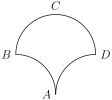
Three circular arcs of radius units bound the region shown. Arcs and are quarter-circles, and arc is a semicircle. What is the area, in square units, of the region?
小提示:
移动弯曲部分,拼成一个矩形。
Move the curved pieces to make a rectangle
大提示:
重排后的矩形尺寸是 和 。
The rearranged rectangle has dimensions and
解答:
如下图,作一个覆盖图形下半部分的矩形。
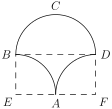
于是
还知道
和 都是四分之一圆,它们合起来形成一个半圆,面积与 相同。
因此 并且
所以正确答案是 C。
Create a rectangle that covers the bottom half of the figure as shown below.
Then, we get that
We also know that
and are both quarter-circles that form a semicircle with the same area as
This means that and
Thus, C is the correct answer.
20.
你有九枚硬币:包括一美分硬币、五美分硬币、十美分硬币和二十五美分硬币,总价值为 ,且每种硬币至少有一枚。你必须有多少枚十美分硬币?
You have nine coins: a collection of pennies, nickels, dimes, and quarters having a total value of with at least one coin of each type. How many dimes must you have?
小提示:
用模 的分值确定一美分硬币的数量。
Use cents modulo to find the number of pennies
大提示:
去掉一美分硬币后,再求五美分硬币、十美分硬币和二十五美分硬币的数量。
After the pennies, solve for nickels, dimes, and quarters
解答:
一美分硬币的数量必须与 模 的余数相同,所以可能有 枚或 枚一美分硬币。如果有七枚,只剩两枚硬币给五美分硬币、十美分硬币和二十五美分硬币,不可能每种至少一枚。
所以有 枚一美分硬币。剩下 枚硬币价值 分。设五美分硬币、十美分硬币和二十五美分硬币的数量分别为 、、,则 ,且 。
将价值方程除以 ,再减去硬币数量方程,得到 。唯一正整数解是 、、。
因此必须有 枚十美分硬币。
所以正确答案是 A。
The number of pennies must have the same remainder as modulo so there are either or pennies. Seven pennies would leave only two coins for nickels, dimes, and quarters, impossible because at least one of each type is needed.
So there are pennies. The remaining coins are worth cents. If and are the numbers of nickels, dimes, and quarters, then and
Dividing the value equation by and subtracting the coin-count equation gives The only positive solution is and
Thus there must be dime.
Thus, A is the correct answer.
21.
Keiko 抛一枚一美分硬币,Ephraim 抛两枚一美分硬币。Ephraim 得到的正面数与 Keiko 得到的正面数相同的概率是
Keiko tosses one penny and Ephraim tosses two pennies. The probability that Ephraim gets the same number of heads that Keiko gets is
小提示:
列出 Keiko 的结果和 Ephraim 两枚一美分硬币的结果。
List Keiko’s result and Ephraim’s two-coin result
大提示:
在等可能结果中数正面总数相同的情况。
Count matching head totals among the equally likely outcomes
解答:
若记录 Keiko 的硬币和 Ephraim 的两枚硬币,共有 个等可能结果。
如果 Keiko 得到正面,Ephraim 必须恰好得到一个正面,这有 种结果。如果 Keiko 得到反面,Ephraim 必须没有正面,这有 种结果。
所以有 个满足条件的结果,共有 个等可能结果,所求概率为 。
所以正确答案是 B。
There are equally likely outcomes if we record Keiko’s coin and Ephraim’s two coins.
If Keiko gets heads, Ephraim must get exactly one head; this happens in outcomes. If Keiko gets tails, Ephraim must get no heads; this happens in outcome.
So of the equally likely outcomes work, and the probability is
Thus, B is the correct answer.
22.
一个立方体的棱长为 。现在把一个棱长为 的立方体粘在大立方体的上方,使它的一个面完全贴在大立方体的上表面上。从原立方体到新形成的立体,其表面积(侧面、顶面和底面)的百分比增加最接近

A cube has edge length Suppose that we glue a cube of edge length on top of the big cube so that one of its faces rests entirely on the top face of the larger cube. The percent increase in the surface area (sides, top, and bottom) from the original cube to the new solid formed is closest to
小提示:
原立方体表面积为 。
The original cube has surface area
大提示:
小立方体遮住一个单位正方形,但增加五个单位正方形。
The small cube hides one unit square but adds five
解答:
原来的表面积为
注意单位立方体的顶面加上大立方体顶面仍可见的部分,面积与大立方体一个面相同。
因此放在上方的单位立方体只让总表面积增加 个单位正方形,增加量为 。
百分比增加为
所以正确答案是 C。
The original surface area is just
Note that the top face of the unit cube plus the visible area of the top face of the larger cube is the same as the area of one face of the larger cube.
This means that the unit square on top only adds unit squares to the total surface area, making the increase
The percent increase is therefore
Thus, C is the correct answer.
23.
有一个包含七个数的列表。前四个数的平均数是 ,后四个数的平均数是 。如果全部七个数的平均数是 ,那么两组四个数中共同的那个数是
There is a list of seven numbers. The average of the first four numbers is and the average of the last four numbers is If the average of all seven numbers is then the number common to both sets of four numbers is
小提示:
把每个平均数转化为总和。
Convert each average into a sum
大提示:
共同的数在两个四数总和中被计算了两次。
The shared number is counted twice in the two four-number sums
解答:
前四个数的和是 。后四个数的和是 。
全部七个数的和是 。共同的数包含在前两个和中。
也就是说,前两个和相加会把每个数计算一次,但共同的数计算两次。
而全部七个数的和只把每个数计算一次。因此用前两个和的总和减去七个数的总和,就得到共同的数。
所以共同的数为
所以正确答案是 B。
The sum of the first four numbers is The sum of the last four numbers is
The sum of all seven numbers is We know that the number common to both sets is included in both of the first two sums.
This means that the sum of the first two sums includes every number once, except for the common number which is included twice.
The third sum, however, only includes every number once. This means that the sum of the first two sums minus the third sum yields our desired number.
Therefore, the common number is
Thus, B is the correct answer.
24.
25.
长方形 的面积是 平方单位。若连接点 、 的中点和 的中点形成一个三角形,那么该三角形的面积是
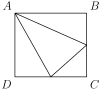
The area of rectangle is square units. If point and the midpoints of and are joined to form a triangle, the area of that triangle is
小提示:
设长方形边长为 和 。
Let the rectangle sides be and
大提示:
从长方形中减去外侧三个直角三角形。
Subtract the three outside right triangles from the rectangle
解答:
设长方形边长为 和 ,所以面积为 ,即 。
目标三角形外侧的三个直角三角形面积分别为 、 和 。
它们的总面积为 。因此目标三角形面积为 。
所以正确答案是 B。
Let the rectangle have side lengths and so its area is and
The three right triangles outside the desired triangle have areas and
Their total area is Therefore the desired triangle has area
Thus, B is the correct answer.