
2014 AMC 10B 详解
向下滚动即可查看来自 LIVE by Po-Shen Loh 的精心整理的解答,打印PDF 解答,查看答案,或参加完整限时模拟考试。
所有题目均经美国数学协会(MAA)官方合法授权使用。
1.
Leah 有 枚硬币,全部是一美分硬币和五美分硬币。如果她再多一枚五美分硬币,那么两种硬币的数量就相同。Leah 的硬币共值多少美分?
Leah has coins, all of which are pennies and nickels. If she had one more nickel than she has now, then she would have the same number of pennies and nickels. In cents, how much are Leah’s coins worth?
小提示:
把“再多一枚五美分硬币”转化成关于两种硬币数量的方程。
Translate the nickel condition into an equation for pennies and nickels
大提示:
求出两种硬币数量后,使用总数 。
Use the total of coins after finding the two counts
解答:
设一美分硬币有 枚,则五美分硬币有 枚;按题意,五美分硬币数也等于 ,所以 。因此有 枚一美分硬币和 枚五美分硬币。
硬币的总价值为 美分。
所以正确答案是 C。
Let the number of pennies be Then, the number of nickels is and so This means we have pennies and nickels.
Therefore, the number of cents is
Thus, the correct answer is C .
2.
求 ?
What is
小提示:
分子和分母都提取公因数 。
Factor the common from the numerator and denominator
大提示:
同底数 的幂相除时,指数相减。
Dividing powers of means subtracting exponents
解答:
所以正确答案是 E。
Thus, the correct answer is E .
3.
Randy 旅程的前三分之一是在碎石路上行驶,接着在铺装路上行驶 英里,剩下的五分之一在土路上行驶。Randy 的旅程总长多少英里?
Randy drove the first third of his trip on a gravel road, the next miles on pavement, and the remaining one-fifth on a dirt road. In miles, how long was Randy’s trip?
4.
Susie 买了 个松饼和 根香蕉。Calvin 买了 个松饼和 根香蕉,花费是 Susie 的两倍。一个松饼的价格是香蕉的多少倍?
Susie pays for muffins and bananas. Calvin spends twice as much paying for muffins and bananas. A muffin is how many times as expensive as a banana?
小提示:
设松饼和香蕉的价格为变量。
Let the muffin and banana prices be variables
大提示:
先使用 Calvin 花费是 Susie 两倍这个条件,再求价格比。
Use Calvin spent twice Susie’s amount before solving the ratio
解答:
设一个松饼价格为 ,一根香蕉价格为 。
所以正确答案是 B。
Let the price for a muffin be and let the price for a banana be Then,
Thus, the correct answer is B .
5.
Doug 用 块大小相同的玻璃片制作一个正方形窗户,如图所示。每块玻璃片的高宽比为 ,玻璃片周围和之间的边框宽度都是 英寸。这个正方形窗户的边长是多少英寸?

Doug constructs a square window using equal-size panes of glass, as shown. The ratio of the height to width for each pane is and the borders around and between the panes are inches wide. In inches, what is the side length of the square window?
小提示:
把每块玻璃片的尺寸写成 和 。
Write the pane dimensions as by
大提示:
分别数横向和纵向的边框宽度,并令正方形两边相等。
Count border widths horizontally and vertically and set the square sides equal
解答:
设每块玻璃的高为 ,宽为 。竖直方向上,窗户包含两块玻璃的高度和三条横框,所以高度为 。水平方向上,它包含四块玻璃的宽度和五条竖框,所以宽度为 。
因为窗户是正方形,,所以 。
因此边长为 英寸。
所以正确答案是 A。
Let each pane have height and width . Vertically, the window contains two pane heights and three horizontal borders, so its height is . Horizontally, it contains four pane widths and five vertical borders, so its width is .
Because the window is square, , so .
Therefore, the side length is inches.
Thus, the correct answer is A .
6.
Orvin 去商店时带的钱刚好够买 个气球。到店后,他发现气球正在促销:按原价买 个气球,第二个可减价 。Orvin 最多可以买多少个气球?
Orvin went to the store with just enough money to buy balloons. When he arrived, he discovered that the store had a special sale on balloons: buy balloon at the regular price and get a second at off the regular price. What is the greatest number of balloons Orvin could buy?
小提示:
把每个原价气球和一个折扣气球配成一组。
Pair each full-price balloon with its discounted companion
大提示:
两个气球的促销组合花费等于 个原价气球。
A two-balloon sale pair costs regular balloons
解答:
每一对气球的价格是一个气球原价的 倍。
因此,带着刚好够买 个原价气球的钱,Orvin 可以买 个气球。
所以正确答案是 C。
Each pair of balloons costs times the regular price of one balloon.
Thus, with the money for regular-price balloons, Orvin can buy balloons.
Thus, the correct answer is C .
7.
8.
一辆卡车每 秒行驶 英尺。 英尺等于一码。这辆卡车在 分钟内行驶多少码?
A truck travels feet every seconds. There are feet in a yard. How many yards does the truck travel in minutes?
小提示:
先把英尺换成码,再按时间放大。
Convert feet to yards before scaling the time
大提示:
三分钟是 秒。
Three minutes is seconds
解答:
卡车每 秒行驶 码,因为 英尺等于一码;所以卡车每秒行驶 码。
分钟为 秒,因此行驶
所以正确答案是 E。
This means it travels yards in seconds since a yard is feet. Then, in one second, it travels yards.
Therefore, in minutes which is seconds, it travels
Thus, the correct answer is E .
9.
10.
在下面的加法中,、、 和 是互不相同的数字。 可以有多少个不同的值?
In the addition shown below and are distinct digits. How many different values are possible for
小提示:
竖式加法会迫使 。
Column addition forces
大提示:
然后判断哪些数字能作为 。
After that, identify which digits can appear as
解答:
最左列没有产生第六位进位,所以 。
个位列也是 ,所以个位列也没有进位。十位列给出 ,因此 。
因为 和 是不同的非零数字, 可以是从 到 的任意数字。例如,、、、、、、 分别给出 。
所以 有 个可能值,正确答案是 C。
From the leftmost column, there is no carry into a sixth digit, so .
The units column is , so it also has no carry. The tens column then gives , hence .
Since and are distinct nonzero digits, can be any digit from through . For example, give .
Thus there are possible values of , and the correct answer is C .
11.
对消费者来说,单次 折扣比下面任何一种折扣都更划算:
连续两次 折扣;
连续三次 折扣;
先 折扣,再 折扣。
的最小正整数值是多少?
For the consumer, a single discount of is more advantageous than any of the following discounts:
Two successive discounts.
Three successive discounts.
A discount followed by a discount.
What is the smallest possible positive integer value of
小提示:
把每组叠加折扣转化为最终支付原价的比例。
Convert each stacked discount into the final fraction of the price paid
大提示:
单次折扣必须超过三种有效折扣中的最大者。
The single discount must exceed the largest of the three effective discounts
解答:
三种连续折扣方案分别使顾客支付标价的 倍。因此它们的实际折扣分别为 、 和 。
单次 折扣必须大于这三个折扣,所以 。符合条件的最小正整数是 。
所以正确答案是 C。
The three successive-discount plans leave the customer paying times the listed price. Their effective discounts are therefore , , and .
A single discount must exceed all three, so . The smallest positive integer that works is .
Thus, the correct answer is C .
12.
数 的最大因数是它本身。它的第五大因数是多少?
The largest divisor of is itself. What is its fifth-largest divisor?
小提示:
第五大因数与第五小因数配对。
The fifth largest divisor pairs with the fifth smallest divisor
大提示:
从素因数分解中列出最小的几个因数。
List the smallest divisors from the prime factorization
解答:
第五大因数等于 除以第五小因数。
的素因数分解为 最小的 个因数是 。所以第五小因数为 ,第五大因数为
所以正确答案是 C。
The fifth-largest divisor is divided by the fifth smallest divisor.
The prime factorization of is: This makes the first smallest divisors Therefore, the fifth smallest divisor is and the fifth largest divisor must be:
Thus, the correct answer is C .
13.
六个正六边形围绕一个边长为 的正六边形,如图所示。求 的面积。
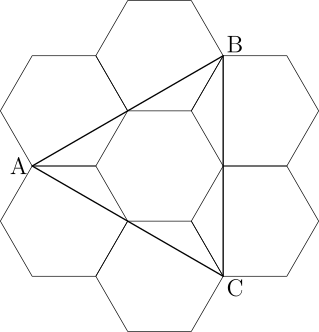
Six regular hexagons surround a regular hexagon of side length as shown. What is the area of
小提示:
利用正六边形的角度求出 的边长。
Use the regular hexagon angles to find the side of
大提示:
得到的三角形是等边三角形。
The resulting triangle is equilateral
解答:
沿着单位正六边形构成的 网格建立坐标,取 。于是图中标出的另外两个顶点可以写成 和 。
因此 ,且 于是 是等边三角形,面积为
所以正确答案是 B。
Follow the grid formed by the unit hexagons and place . The marked vertices may then be written as and .
Thus , and Hence is equilateral, with area
Thus, the correct answer is B .
14.
Danica 开着新车旅行了整数小时,平均速度为 英里每小时。旅行开始时,里程表显示 英里,其中 是 位数,,且 。旅行结束时,里程表显示 英里。求 的值。
Danica drove her new car on a trip for a whole number of hours, averaging miles per hour. At the beginning of the trip, miles was displayed on the odometer, where is a -digit number with and At the end of the trip, the odometer showed miles. What is
小提示:
里程表变化为 。
The odometer change is
大提示:
这个变化也必须是 的倍数。
It must also be a multiple of
解答:
里程表读数 与 之差为 而这个差必须是 的倍数。因为 为 ,所以 是 的倍数,且 。
在 的限制下,唯一可能是 ,其他组合都会有 。因此 。
所以正确答案是 D。
We know that the difference of the numbers and is equal to: We know that this number also must be a multiple of As is we know that is a multiple of and
This makes the only possible value with as every other combination has As such,
Thus, the correct answer is D .
15.
在长方形 中,,点 和 在 上,使得 和 如图三等分 。求 的面积与长方形 面积之比。
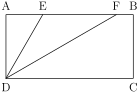
In rectangle and points and lie on so that and trisect as shown. What is the ratio of the area of to the area of rectangle
小提示:
使用从 出发的 和 射线。
Use the and rays from
大提示:
求出 ,再比较三角形和长方形面积。
Find , then compare triangle and rectangle areas
解答:
设 。因为 ,所以长方形 的面积为 。
射线 和 与 的夹角分别为 和 。
因此 且
于是 的面积为
所求面积比为 所以正确答案是 A。
Let Since the area of rectangle is
The rays and make angles of and respectively, with
Therefore, and
Hence The area of is
The desired ratio is Thus, the correct answer is A.
16.
掷四枚公平的六面骰子。至少三枚骰子显示相同点数的概率是多少?
Four fair six-sided dice are rolled. What is the probability that at least three of the four dice show the same value?
小提示:
分别计数恰好三枚相同和四枚全相同。
Count exactly three equal dice and four equal dice separately
大提示:
恰好三枚相同时,选择不同骰子的位置。
For exactly three equal dice, choose the odd die position
解答:
共有 个等可能有序结果。
恰好三枚相同时,重复点数有 种,不同点数有 种,不同骰子的位置有 种,共 种。
四枚全相同有 种。
所求概率为 。
所以正确答案是 B。
There are equally likely ordered outcomes.
If exactly three dice show the same value, choose the repeated value in ways, the different value in ways, and the position of the different die in ways. This gives outcomes.
If all four dice match, there are outcomes.
The probability is .
Thus, the correct answer is B .
17.
的因数中,最大的 的幂是多少?
What is the greatest power of that is a factor of
小提示:
先提取 。
Factor out
大提示:
判断 中含有的精确 的幂。
Determine the exact power of in
解答:
先提取明显的 的幂:。
因为 ,且 为奇数,所以 可被 整除但不能被 整除,而 可被 整除但不能被 整除。
因此 正好贡献 ,整个表达式可被 整除,但不能被 整除。
所以正确答案是 D。
Factor out the obvious power of : .
Since , and is odd, is divisible by but not by , while is divisible by but not by .
Thus contributes exactly , so the whole expression is divisible by but not .
Thus, the correct answer is D .
18.
一个由 个正整数组成的列表平均数为 ,中位数为 ,且唯一众数为 。列表中整数的最大可能值是多少?
A list of positive integers has a mean of a median of and a unique mode of What is the largest possible value of an integer in the list?
小提示:
列表总和为 。
The total sum of the list is
大提示:
在保持 是唯一众数且 是中位数的条件下,尽量减小前十项之和。
Minimize the first ten entries while keeping the unique mode and the median
解答:
总和为 。
要最大化最大项,应最小化其余十项之和。按非递减顺序排列时,第六项为 ,且 必须是唯一众数。若 出现两次,前十项最小和为 ,最大项为 。
若 出现三次,前十项可取 ,其和为 ,最大项可为 。
若 出现四次或五次,前十项最小和至少为 ,最大项至多为 。
因此最大可能值为 ,正确答案是 E。
The list has total sum . To maximize the largest entry, minimize the sum of the other ten entries.
In nondecreasing order, the sixth entry is , and must be the unique mode. If appears twice, the least possible first ten entries sum to , giving largest entry .
If appears three times, the least possible first ten entries are , with sum , giving largest entry .
If appears four or five times, the least possible sum of the first ten entries is at least , so the largest entry is at most .
Therefore the largest possible entry is , and the correct answer is E .
19.
两个同心圆半径分别为 和 。在外圆上独立且均匀随机选取两点。连接这两点的弦与内圆相交的概率是多少?
Two concentric circles have radii and Two points on the outer circle are chosen independently and uniformly at random. What is the probability that the chord joining the two points intersects the inner circle?
小提示:
固定外圆上的一个端点。
Fix one endpoint on the outer circle
大提示:
临界弦与内圆相切。
The limiting chords are tangent to the inner circle
解答:
在外圆上固定第一个端点 。从 作两条与内圆相切的弦,并把它们的另一个端点记为 和 。从 出发的弦与内圆相交,当且仅当它的另一个端点位于小弧 上。
设 为两圆的共同圆心, 为一个切点,则 是直角三角形,其中 ,。所以 。两条切线弦在 处所成角为 ,因此所截小弧 的度数为 。
所以所求概率为
所以正确答案是 D。
Fix the first endpoint on the outer circle. Draw the two chords from that are tangent to the inner circle, and call their other endpoints and . A chord from meets the inner circle exactly when its second endpoint lies on the minor arc .
If is the common center and is a tangency point, then is right, with and . Hence . The two tangent chords therefore make a angle at , so the intercepted minor arc measures .
Therefore, the probability is
Thus, the correct answer is D .
20.
有多少个整数 使 为负?
For how many integers is the number negative?
小提示:
把表达式看作关于 的乘积并因式分解。
Factor the expression as a product in
大提示:
找出两个因子异号的范围。
Find where the two factors have opposite signs
解答:
首先注意到
乘积为负,当且仅当两个因子异号。由于 ,必须有 。所以 ,即 。正整数解有 个,负整数解也有 个,共有 个。
所以正确答案是 C。
First, note that
The product is negative exactly when its two factors have opposite signs. Since , this requires . Thus , or . There are positive and negative integer solutions, for a total of .
Thus, the correct answer is C .
21.
梯形 有一组平行边: 长 , 长 。另外两边长为 和 。角 和角 都是锐角。求梯形 的较短对角线长度。
Trapezoid has parallel sides of length and of length The other two sides are of lengths and The angles and are acute. What is the length of the shorter diagonal of
小提示:
从短底的端点向长底作垂线。
Drop perpendiculars from the shorter base to the longer base
大提示:
用两条腰长求水平偏移量。
Use the two leg lengths to find the horizontal offsets
解答:
从 和 向 作垂线,垂足分别为 和 。如图,不妨取 、;交换两腰只会把梯形翻转。
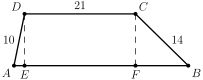
设 ,高为 。由于 ,且 ,所以 。
由两个直角三角形可得 和 两式相减得 ,所以 ,且 。
较短的对角线是 ,它的水平位移为 。因此
所以正确答案是 B。
Let the feet of the perpendiculars from and to be and , respectively. As drawn, take and ; interchanging the two legs only reflects the trapezoid.
Let and let the altitude be . Since and , we have .
The two right triangles give and Subtracting yields , so and .
The shorter diagonal is , whose horizontal displacement is . Therefore
Thus, the correct answer is B .
22.
八个半圆如图沿边长为 的正方形内侧排列。与所有这些半圆相切的圆的半径是多少?

Eight semicircles line the inside of a square with side length as shown. What is the radius of the circle tangent to all of these semicircles?
小提示:
连接小圆圆心和一个半圆圆心。
Connect the center of the small circle to a semicircle center
大提示:
所求半径是两个圆心间距离减去 。
The needed radius is a center distance minus
解答:
从正方形中心到一个半圆圆心的距离可由直角三角形的斜边求出。
一条直角边是从正方形中心到边中点的距离,长度为 。
另一条直角边是从边中点到半圆圆心的距离,长度为 。这也说明半圆半径为 。
因此正方形中心到半圆圆心的距离为 再减去半圆半径 ,得到小圆半径
所以正确答案是 B。
The distance from the center of the square to the center of the semicircles can be found as a hypotenuse of a right triangle.
One of the legs is from the center of the square to the center of one of the sides which is of distance
The other leg is from the center of the side to the center of one of the semicircles which is of distance This also shows that the radius of the semicircles is
Therefore, the distance from the center of the square to the center of the semicircle is Then we subtract for the radius of the semicircle. This makes the radius of the circle
Thus, the correct answer is B .
23.
一个球内切于如图所示的截头正圆锥。截头圆锥的体积是球体积的两倍。截头圆锥下底半径与上底半径之比是多少?
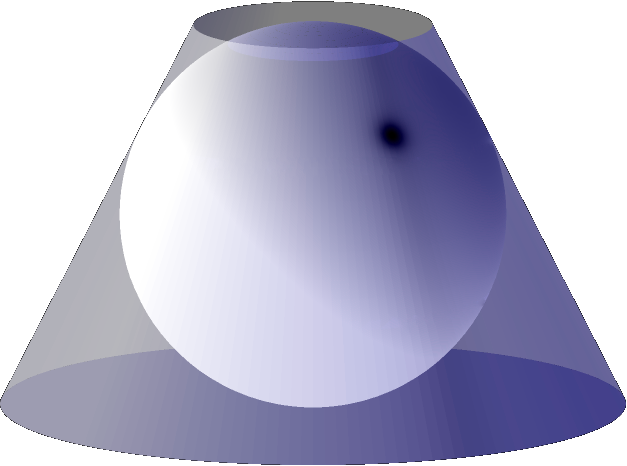
A sphere is inscribed in a truncated right circular cone as shown. The volume of the truncated cone is twice that of the sphere. What is the ratio of the radius of the bottom base of the truncated cone to the radius of the top base of the truncated cone?
小提示:
把上底半径缩放为 。
Scale the top radius to
大提示:
用截面图把球半径和下底半径联系起来。
Use a cross-section to relate the sphere radius to the bottom radius
解答:
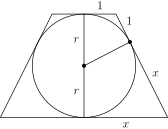
设上底半径为 ,下底半径为 ,内切球半径为 。
在截面中,球与两个底面相切,所以截锥的高为 。若以球心为原点,一条斜边连接 与 。它的方程是 因为这条直线与半径为 的圆相切,它到原点的距离为 。所以 化简得 。
截锥的体积为 。
它等于球体积 的两倍。约去公因子可得 ,所以 。
由于下底半径大于上底半径,。因此 ,正确答案是 E。
Let the top radius be , the bottom radius be , and the inscribed sphere radius be .
In the cross-section, the sphere is tangent to the two bases, so the frustum height is . A slanted side joins to , if the sphere’s center is the origin. Its equation is Because this line is tangent to the circle of radius , its distance from the origin is . Thus which simplifies to .
The frustum volume is .
This is twice the sphere volume, . Cancelling gives , so .
Since the bottom radius is larger than the top radius, . Thus , and the correct answer is E .
24.
数字 ,,,, 要排成一个圆。若并非对每个 到 的 ,都能找到圆上一段连续出现的数字使其和为 ,则称这种排列为 。只相差旋转或翻转的排列视为相同。有多少种不同的坏排列?
The numbers are to be arranged in a circle. An arrangement is if it is not true that for every from to one can find a subset of the numbers that appear consecutively on the circle that sum to Arrangements that differ only by a rotation or a reflection are considered the same. How many different bad arrangements are there?
小提示:
只需要确保连续和能得到 和 。
It is enough to make consecutive sums and
大提示:
分类讨论无法得到 或无法得到 的排列。
Classify arrangements where or is impossible
解答:
单个数字给出 到 ,它们的补集给出 到 ,全部五个数给出 。因此只需要检查能否得到和 与 。
若无法得到和 ,则 不与 相邻。通过旋转和翻转,可写成 。相邻块 不能是 或 ,因为 且 。于是 ,再避免连续块 ,得到坏排列 。
若无法得到 ,则 不与 相邻,可写成 。此时 不能是 或 ,所以 。再避免连续块 ,得到 ,即坏排列 。
这两个排列确实都是坏排列,分别无法得到和 与和 。因此共有 种坏排列。
所以正确答案是 B。
Single numbers give sums through , complements give sums through , and all five numbers give . So an arrangement is good exactly when consecutive blocks can make sums and .
If sum is impossible, then is not adjacent to . By rotating and reflecting, write the arrangement as . The adjacent pair cannot be or , since and . Thus , and avoiding the consecutive block forces the bad arrangement .
If sum is impossible, then is not adjacent to . Similarly write the arrangement as . Now cannot be or , so . To avoid the consecutive block , the remaining order must be , giving .
These two arrangements are indeed bad, one missing sum and the other missing sum . Hence there are bad arrangements.
Thus, the correct answer is B .
25.
一个小池塘中有十一片睡莲叶排成一行,标号为 到 。一只青蛙坐在 号叶上。当青蛙在 号叶上且 时,它以概率 跳到 号叶,以概率 跳到 号叶。每次跳跃相互独立。
若青蛙到达 号叶,它会被一条耐心等待的蛇吃掉。若青蛙到达 号叶,它会离开池塘且不再回来。青蛙不被蛇吃掉而逃脱的概率是多少?
In a small pond there are eleven lily pads in a row labeled through A frog is sitting on pad When the frog is on pad where it will jump to pad with probability and to pad with probability Each jump is independent of the previous jumps.
If the frog reaches pad it will be eaten by a patiently waiting snake. If the frog reaches pad it will exit the pond, never to return. What is the probability that the frog will escape without being eaten by the snake?
小提示:
设 为从第 片叶开始最终逃脱的概率。
Let be the escape probability starting on pad
大提示:
利用第 片叶的对称性,再倒推到 。
Use symmetry at pad and solve backward to
解答:
设 为从第 片叶开始最终逃脱的概率。边界条件为 、,由对称性 。
对 ,有递推式 。
从 向下推,得到 和 。
接着可得 ,而 。
代入 的表达式,得到 ,所以 。
所以正确答案是 C。
Let be the probability that the frog eventually escapes starting from pad . Then , , and by symmetry .
For , .
Working downward from , we get , then .
Next . Finally .
Substituting the expression for gives , so .
Thus, the correct answer is C .