
2011 AMC 10B 详解
向下滚动即可查看来自 LIVE by Po-Shen Loh 的精心整理的解答,打印PDF 解答,查看答案,或参加完整限时模拟考试。
所有题目均经美国数学协会(MAA)官方合法授权使用。
1.
2.
Josanna 到目前为止的考试分数为 、、、 和 。她的目标是在下一次考试后把考试平均分至少提高 分。她至少需要在下一次考试中得到多少分?
Josanna’s test scores to date are and Her goal is to raise her test average at least points with her next test. What is the minimum test score she would need to accomplish this goal?
小提示:
求当前总分和目标平均分。
Find the current total score and target average
大提示:
第六次考试后总分必须达到 。
The sixth score must bring the total to
解答:
她当前的平均分为 而总分为 。目标平均分为 ,所以六次考试所需的总分为 。因此下一次考试至少需要得
所以正确答案是 E。
Her current average is and the sum of her scores is The desired average is then so the sum of scores required is Therefore, the answer is
Thus, the correct answer is E .
3.
在一家商店中,若长度标为 英寸,则实际长度至少为 英寸,至多为 英寸。若一个长方形瓷砖的尺寸标为 英寸乘 英寸,则它的最小面积是多少平方英寸?
At a store, when a length is reported as inches that means it is at least inches and at most inches. Suppose the dimensions of a rectangular tile are reported as inches by inches. In square inches, what is the minimum area for the rectangle?
4.
LeRoy 和 Bernardo 一起进行了一周旅行,并同意平分费用。一周中,两人分别支付了一些共同费用,例如汽油和租车。旅行结束时,LeRoy 支付了 美元,Bernardo 支付了 美元,其中 。LeRoy 应给 Bernardo 多少美元,才能使两人平分费用?
LeRoy and Bernardo went on a week-long trip together and agreed to share the costs equally. Over the week, each of them paid for various joint expenses such as gasoline and car rental. At the end of the trip it turned out that LeRoy had paid dollars and Bernardo had paid dollars, where How many dollars must LeRoy give to Bernardo so that they share the costs equally?
小提示:
比较 Bernardo 比 LeRoy 多付了多少。
Compare how much more Bernardo paid than LeRoy
大提示:
只需转移差额的一半。
Only half of the difference has to be transferred
解答:
两人每人应承担 ,而 LeRoy 已支付 。因此他还需向 Bernardo 支付 美元。
所以正确答案是 C。
The amount they each would have to pay is and LeRoy paid Thus, he has to pay more.
Thus, the correct answer is C .
5.
在计算两个正整数 和 的乘积时,Ron 把两位数 的数字顺序颠倒了。他错误得到的乘积是 。 与 的正确乘积是多少?
In multiplying two positive integers and Ron reversed the digits of the two-digit number His erroneous product was What is the correct value of the product of and
小提示:
分解 。
Factor
大提示:
唯一的两位因数给出 颠倒后的值。
The only two-digit factor tells you the reversed value of
解答:
数 等于 。 除了 外没有其他因数对,所以 是唯一的两位因数。因此 是颠倒后的数,原来的乘法应为 ,结果是 。
所以正确答案是 E。
The number is equal to There are no other pairs of numbers that multiply to besides so is the only two digit factor. Thus, is the number reversed, so he meant to get which is
Thus, the correct answer is E .
6.
万圣节时 Casper 吃掉了自己糖果的 ,然后给了弟弟 颗。第二天,他吃掉剩余糖果的 ,然后给了妹妹 颗。第三天,他吃掉最后的 颗糖果。Casper 一开始有多少颗糖果?
On Halloween Casper ate of his candies and then gave candies to his brother. The next day he ate of his remaining candies and then gave candies to his sister. On the third day he ate his final candies. How many candies did Casper have at the beginning?
小提示:
从最后的 颗糖果倒推。
Work backward from the final candies
大提示:
给妹妹 颗之前有 颗,这是前一数量的三分之二。
Before giving away , Casper had , which was two thirds of the previous amount
解答:
倒推。给妹妹 颗之前,Casper 有 颗糖果,因为第二天结束时剩 颗。
这 颗是第一天结束后糖果数的 ,所以第一天结束后有 颗。
给弟弟 颗之前有 颗。这是原来糖果数的 ,所以一开始有 颗。
所以正确答案是 A。
Work backward. Before giving candies to his sister, Casper had candies, because he ended the second day with .
Those candies were of what he had after the first day, so after the first day he had candies.
Before giving candies to his brother, he had candies. This was of his original amount, so he began with candies.
Thus, A is the correct answer.
7.
一个三角形中两个角的和是直角的 ,且这两个角中的一个比另一个大 。这个三角形最大角的度数是多少?
The sum of two angles of a triangle is of a right angle, and one of these two angles is larger than the other. What is the degree measure of the largest angle in the triangle?
小提示:
将直角的 换算成度数。
Convert of a right angle to degrees
大提示:
比较第三个角与那两个已知和与差的角。
Compare the third angle with the two angles whose sum and difference are known
解答:
这两个角之和为 。所以第三个角为 。若这两个角中较大的为 ,较小的为 ,则 ,所以 。
没有角大于 ,因此最大角是 。
所以正确答案是 B。
The two angles add to This makes the other angle Then, if the larger of the two angles is then the smaller of them is so their sum is making
This means no angle is larger than making the largest equal to
Thus, the correct answer is B .
8.
某海滩在气温至少为 且晴朗时会很拥挤。六月 日该海滩不拥挤。关于六月 日的天气条件,可以推出什么?
At a certain beach if it is at least and sunny, then the beach will be crowded. On June the beach was not crowded. What can be concluded about the weather conditions on June
气温低于 F,且天气不晴朗。
The temperature was cooler than F and it was not sunny.
气温低于 F,或者天气不晴朗。
The temperature was cooler than F or it was not sunny.
如果气温至少为 F,那么那天晴朗。
If the temperature was at least F, then it was sunny.
如果气温低于 F,那么那天晴朗。
If the temperature was cooler than F, then it was sunny.
如果气温低于 F,那么那天不晴朗。
If the temperature was cooler than F, then it was not sunny.
小提示:
使用“炎热且晴朗则拥挤”的逆否命题。
Use the contrapositive of “hot and sunny implies crowded”
大提示:
不拥挤表示两个条件中至少有一个不成立。
Not crowded means at least one of the two conditions failed
解答:
原命题是:若气温至少 且晴朗,则海滩拥挤。
因为海滩不拥挤,这两个条件不可能同时成立。因此气温低于 ,或者天气不晴朗,或者两者都成立。
所以正确答案是 B。
The statement says that if the weather was at least and sunny, then the beach was crowded.
Because the beach was not crowded, the two conditions could not both have been true. Therefore the temperature was cooler than , or it was not sunny, or both.
Thus, B is the correct answer.
9.
的面积是 -- 三角形 面积的三分之一。线段 垂直于线段 。 是多少?
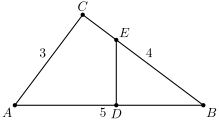
The area of is one third of the area of the -- triangle Segment is perpendicular to segment What is
小提示:
使用 与 的相似。
Use similarity between and
大提示:
面积比 给出边长比 。
Area ratio gives side-length ratio
解答:
由角角相似,。
面积比为 ,所以对应边长比为 。
因此 从而
所以正确答案是 D。
By angle angle similarity, we have
Then, since the ratio of the areas is the ratio of the sidelengths is
As such, making
Thus, the correct answer is D .
10.
考虑集合 。该集合最大元素与其他十个元素之和的比值最接近哪个整数?
Consider the set of numbers The ratio of the largest element of the set to the sum of the other ten elements of the set is closest to which integer?
11.
一个房间里有 人。使“这个房间中至少有 人的生日在同一个月份”这一陈述总为真的最大 是多少?
There are people in a room. What is the largest value of such that the statement “At least people in this room have birthdays falling in the same month” is always true?
小提示:
对 个月使用抽屉原理。
Use the pigeonhole principle with months
大提示:
尝试把 个生日尽量平均分配。
Try distributing birthdays as evenly as possible
解答:
不一定成立,因为可以让 人的生日落在前 个月中的每个月,而其余八个月各有 人生日。
但一定有某个月至少 人生日,因为平均每月人数为 ,大于 。
所以正确答案是 D。
It isn’t necessarily true for as we could have people born in the first months and people born in the subsequent months.
However, one month must be greater than or equal to as the average of the number of people born in each month is which is greater than and some month must be above average.
Thus, the correct answer is D .
12.
Keiko 每天以完全相同的恒定速度绕跑道走一圈。跑道两侧为直线,两端为半圆。跑道宽 米,她沿外侧边缘走一圈比沿内侧边缘走一圈多用 秒。Keiko 的速度是多少米每秒?
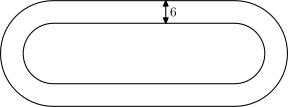
Keiko walks once around a track at exactly the same constant speed every day. The sides of the track are straight, and the ends are semicircles. The track has a width of meters, and it takes her seconds longer to walk around the outside edge of the track than around the inside edge. What is Keiko’s speed in meters per second?
小提示:
比较内外路径时,直线部分抵消。
The straight portions cancel when comparing outside and inside paths
大提示:
只有两个半圆端增加了额外距离。
Only the two semicircular ends add extra distance
解答:
设内侧半圆半径为 。
内外路径的直线部分总长相同,所以距离差只来自两个半圆端。两个内侧半圆总长为 ,两个外侧半圆总长为 ,差为 。
Keiko 多用 秒走了 米,所以速度为 米每秒。
所以正确答案是 A。
Let the inner semicircle radius be . The straight parts of the inside and outside paths have the same total length, so only the semicircular ends change the distance.
The two inner semicircles have total length , while the two outer semicircles have total length . The outside path is therefore meters longer.
Keiko takes more seconds to walk more meters, so her speed is meters per second.
Thus, A is the correct answer.
13.
从区间 中独立随机选择两个实数。它们的乘积大于零的概率是多少?
Two real numbers are selected independently at random from the interval What is the probability that the product of those numbers is greater than zero?
小提示:
乘积为正当且仅当两个数同号。
The product is positive when both numbers have the same sign
大提示:
区间中负数部分长度为 ,正数部分长度为 。
The interval has negative units and positive units
解答:
选中的数为负数的概率是 ,为正数的概率是 。(恰好选中 的概率为 。)乘积为正当且仅当两个数同号,所以所求概率为
所以正确答案是 D。
A selected number is negative with probability and positive with probability (Selecting exactly has probability ) The product is positive exactly when both numbers have the same sign, so the probability is
Thus, the correct answer is D .
14.
一个长方形停车场的对角线长 米,面积为 平方米。该停车场的周长是多少米?
A rectangular parking lot has a diagonal of meters and an area of square meters. In meters, what is the perimeter of the parking lot?
15.
令 表示“与……取平均”的运算:。下列哪些分配律对所有数 、 和 都成立?
I.
II.
III.
Let denote the “averaged with” operation: Which of the following distributive laws hold for all numbers and
I.
II.
III.
仅
only
仅
only
仅
only
仅 和
and only
仅 和
and only
小提示:
用 展开每一边。
Expand each side using
大提示:
分别用代数检验 I、II、III。
Test each of I, II, and III symbolically
解答:
I 的左边为 ,右边为 ,不恒相等。
II 的左右两边都等于 ,所以恒成立。
III 的左右两边都等于 ,所以也恒成立。
所以正确答案是 E。
In statement I, the left-hand side equals and the right-hand side equals so they are not always equal.
In statement II, both sides equal so it holds.
In statement III, both sides equal so it also holds.
Thus, the correct answer is E .
16.
一个飞镖靶是如图所示分区的正八边形。假设飞镖落在靶上任意位置的概率相同。飞镖落在中心正方形内的概率是多少?
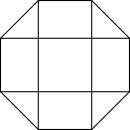
A dart board is a regular octagon divided into regions as shown. Suppose that a dart thrown at the board is equally likely to land anywhere on the board. What is the probability that the dart lands within the center square?
小提示:
设中心正方形边长为 。
Let each side of the center square be
大提示:
把中心正方形、四个长方形和四个角上的三角形的面积相加,求出八边形的面积。
Find the octagon area by adding the center square, four rectangles, and four corner triangles
解答:
设中心正方形边长为 。则中心面积为 。
八边形可看作一个大正方形去掉 个等腰直角三角形。大正方形边长为 所以面积为
这些直角三角形的直角边长为 ,每个面积为 四个总面积为 ,所以八边形面积为 。
因此比值为
所以正确答案是 A。
Let the side length be Then, the area of the center is
Then, we must find the area of the octagon. It can be found as a square with isosceles right triangles taken out. The side length of this square is It has an area of
Then, the side length of the right triangles is making the area of one equal to This makes them have a total combined area of so the area of the octagon is
Thus, the ratio is
Thus, the correct answer is A .
17.
在给定圆中,直径 平行于 ,且 平行于 。角 与 的比为 。角 的度数是多少?
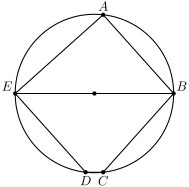
In the given circle, the diameter is parallel to and is parallel to The angles and are in the ratio What is the degree measure of angle
小提示:
使用直径所对圆周角为直角。
Use the fact that an angle subtending a diameter is right
大提示:
平行弦形成等腰梯形中的相等底角。
Parallel chords create equal base angles in an isosceles trapezoid
解答:
因为 是直径,。由 ,得 ,。
因为 ,所以 。又 ,四边形 是等腰梯形,所以 。
角 与 互补,所以 ,因此 。
所以正确答案是 C。
Since is a diameter, . The ratio then gives and .
Because , . Since , quadrilateral is an isosceles trapezoid, so .
Angles and are supplementary, so . Hence .
Thus, C is the correct answer.
18.
长方形 中,,。点 在边 上,使得 。 的度数是多少?
Rectangle has and Point is chosen on side so that What is the degree measure of
小提示:
用 把一个角转移到 。
Use to transfer one angle to
大提示:
三角形 会成为等腰三角形。
Triangle becomes isosceles
解答:
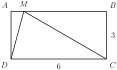
角 与 相等,因为 。
因此 ,所以三角形 为等腰三角形,。
在直角三角形中,由边长比例可得 ,因此 。
因此 。由于 是它的一半,。
所以正确答案是 E。
The angles and are equal since
As such, making isosceles and
As we can see, making
Therefore, Since is half of that,
Thus, the correct answer is E .
19.
下列方程所有根的乘积是多少?
What is the product of all the roots of the equation below?
小提示:
检查根号有定义后,将两边平方。
Square both sides after checking the radicals are defined
大提示:
用 写出方程。
Write the equation in terms of
解答:
因为 ,将方程两边平方可得 在代数上可能为 或 ,但绝对值不能为负。因此 ,两个根为 和 ,乘积为 。
所以正确答案是 A。
Because squaring the equation gives The algebraic possibilities for are and but an absolute value cannot be negative. Hence so the roots are and , with product
Thus, the correct answer is A .
20.
菱形 的边长为 ,且 。区域 由菱形内所有比到其他三个顶点更接近顶点 的点组成。 的面积是多少?
Rhombus has side length and . Region consists of all points inside the rhombus that are closer to vertex than any of the other three vertices. What is the area of
小提示:
使用垂直平分线来确定更接近 的点。
Use perpendicular bisectors to locate points closer to
大提示:
所求区域是由两个全等小三角形切去后的中心部分。
The desired region is the central pentagon cut out by two congruent small triangles
解答:
比到其他顶点更接近 的点由 、、 的垂直平分线围定。 的垂直平分线是对角线 ,所以所求区域位于 中。
三角形 面积为 。 和 的垂直平分线切去两个全等的 -- 三角形,每个面积为 。
所求面积为 。
所以正确答案是 C。
The points closer to than to another vertex are bounded by the perpendicular bisectors of , , and . The bisector of is diagonal , so the desired region lies in .
Triangle has area . The perpendicular bisectors of and cut off two congruent -- triangles, each with area .
Therefore the desired area is .
Thus, C is the correct answer.
21.
Brian 写下四个整数 ,它们的和为 。这些数两两之间的正差为 、、、、 和 。 的所有可能值之和是多少?
Brian writes down four integers whose sum is The pairwise positive differences of these numbers are and What is the sum of the possible values for
小提示:
最大差必须是 。
The largest difference must be
大提示:
剩余成对差必须把 分成 或 。
The remaining paired differences must split as or
解答:
最大差为 ,所以 。对任一中间数 ,差 与 的和必须为 。
可用的和为 的配对为 和 ,剩下两个中间数之间的差为 。
一种集合为 ,给出 ,所以 。另一种为 ,给出 ,所以 。
可能的 之和为 。
所以正确答案是 B。
The largest difference is , so . For either middle number , the two differences and must add to .
The available pairs of differences that add to are and , and the remaining difference between the two middle numbers is .
One possible set is , giving and . The other is , giving and .
The sum of the possible values of is .
Thus, B is the correct answer.
22.
一个金字塔有边长为 的正方形底面,侧面都是等边三角形。一个立方体放在金字塔内,使其一个面在金字塔底面上,而相对的面所有边都位于金字塔侧面上。这个立方体的体积是多少?
A pyramid has a square base with sides of length and has lateral faces that are equilateral triangles. A cube is placed within the pyramid so that one face is on the base of the pyramid and its opposite face has all its edges on the lateral faces of the pyramid. What is the volume of this cube?
小提示:
使用穿过金字塔和立方体的对角垂直截面。
Use a diagonal cross-section through the pyramid and cube
大提示:
立方体在截面中对应一个高为 、宽为 的长方形。
The cube contributes a rectangle of height and width
解答:
设立方体边长为 。作金字塔的一个竖直对角截面,它经过正方形底面的两个相对顶点。
这个截面是斜边为 的等腰直角三角形。立方体在其中表现为高 、宽 的长方形,两侧留下两个全等的、直角边为 的等腰直角三角形。
因此 ,所以 ,立方体体积为 。
所以正确答案是 A。
Let the cube have side length . Take a vertical diagonal cross-section of the pyramid through opposite vertices of the square base.
This cross-section is an isosceles right triangle with hypotenuse . The cube appears as a rectangle of height and width , leaving two congruent right isosceles triangles of leg .
Thus , so . The cube volume is .
Thus, A is the correct answer.
23.
的百位数字是多少?
What is the hundreds digit of
小提示:
在模 下计算。
Work modulo
大提示:
在 中,含 或更高次幂的项不影响最后三位。
In , terms with or higher do not affect the last three digits
解答:
因为 ,只需计算 在模 下的值。
含 或更高幂的项都能被 整除,所以只需前三项:
模 下,这等于
因此百位数字为 。
所以正确答案是 D。
Because , it is enough to find modulo .
All terms with or higher are divisible by , so only the first three terms matter:
Modulo , this is .
The hundreds digit is therefore .
Thus, D is the correct answer.
24.
在 坐标系中,格点是指 中 和 都为整数的点。直线 不经过任何满足 的格点,且对所有 ,若 ,这一结论都成立。 的最大可能值是多少?
A lattice point in an -coordinate system is any point where both and are integers. The graph of passes through no lattice point with for all such that What is the maximum possible value of
小提示:
当 为整数时,向下平移 后的直线会经过格点。
A lattice point occurs when is an integer after shifting down by
大提示:
检查大于 的最小整数,其中 。
Check the nearest integer above for each
解答:
将图像下移 。问题等价于找最小的 ,使直线 经过某个满足 的格点。
对固定整数 ,最小整数 必须满足 。它为 (若 为偶数),以及 (若 为奇数)。
候选斜率为 (当 为偶数),在 时最小为 。候选斜率为 (若 为奇数),在 时最小为 。
两类中较小的端点是 。因此当 满足 时不会经过这些格点,而这个上端点已经是可能的最大值。
所以正确答案是 B。
Shift the graph down by . The problem is equivalent to finding the smallest slope for which passes through a lattice point with .
For a fixed integer , the smallest integer with is when is even, and when is odd.
Thus the candidate slopes are for even , minimized at as , and for odd , minimized at as .
The smaller of these is , so every with avoids such lattice points, and this upper endpoint is best possible.
Thus, B is the correct answer.
25.
设 是边长为 、 和 的三角形。对 ,若 ,且 、 和 分别是 的内切圆与边 、 和 的切点,则若存在, 是边长为 、 和 的三角形。数列 中最后一个三角形的周长是多少?
Let be a triangle with side lengths and For if and and are the points of tangency of the incircle of to the sides and respectively, then is a triangle with side lengths and if it exists. What is the perimeter of the last triangle in the sequence
小提示:
从同一顶点引出的切线段相等。
Tangent lengths from the same vertex are equal
大提示:
对边长 ,下一个三角形的中间边为 。
For side lengths , the next middle side is
解答:
对边长 、、 的三角形,同一顶点到内切圆的切线段相等,所以下一个三角形边长为
若当前边长为 ,则下一组边长为 。因此这种形式会一直保持,而中间边每次减半。
对 ,中间边为 。形如 的三角形存在,当且仅当 。
最后一个有效三角形满足 ,但下一次不满足。此时 ,中间边为 。
周长为 。
所以正确答案是 D。
For a triangle with side lengths , , and , equal tangents from the same vertex give the next side lengths
If the current side lengths are , then the next side lengths are . Thus the same form persists while the middle side halves each time.
For , the middle side is . A triangle of the form exists exactly when .
The last valid triangle has , but the next one does not. This gives , with middle side .
The perimeter is .
Thus, D is the correct answer.