
Soluciones del 2001 AMC 8
Desplázate hacia abajo para ver las soluciones preparadas profesionalmente de LIVE by Po-Shen Loh, imprime las soluciones en PDF, consulta la clave de respuestas, o haz el examen cronometrado completo.
Todos los problemas se usan con el permiso legal oficial de la Mathematical Association of America (MAA).
1.
La clase de taller de Casey está haciendo un trofeo de golf. Él tiene que pintar hoyuelos en una pelota de golf. Si le toma segundos pintar un hoyuelo, ¿cuántos minutos necesitará para terminar su trabajo?
Casey’s shop class is making a golf trophy. He has to paint dimples on a golf ball. If it takes him seconds to paint one dimple, how many minutes will he need to do his job?
Pista pequeña:
Primero convierte el tiempo total de pintado a segundos
Convert the total painting time to seconds first
Pista grande:
Hay segundos en un minuto
There are seconds in one minute
Solución:
A Casey le tomará segundos hacer el trabajo. Como segundos forman un minuto, esto son minutos.
Por lo tanto, D es la respuesta correcta.
It will take Casey seconds to do the job. Since seconds make one minute, this is minutes.
Thus, D is the correct answer.
2.
Estoy pensando en dos números enteros. Su producto es y su suma es ¿Cuál es el número mayor?
I’m thinking of two whole numbers. Their product is and their sum is What is the larger number?
Pista pequeña:
Enumera los pares de factores de
List the factor pairs of
Pista grande:
Encuentra el par cuya suma es
Find the pair whose sum is
Solución:
Los pares de factores de son y .
El único par con suma es , así que el número mayor es .
Por lo tanto, D es la respuesta correcta.
The factor pairs of are and .
The only pair with sum is , so the larger number is .
Thus, D is the correct answer.
3.
Granny Smith tiene Elberta tiene más que Anjou y Anjou tiene un tercio de lo que tiene Granny Smith. ¿Cuántos dólares tiene Elberta?
Granny Smith has Elberta has more than Anjou and Anjou has one-third as much as Granny Smith. How many dollars does Elberta have?
Pista pequeña:
Encuentra un tercio del dinero de Granny Smith
Find one-third of Granny Smith’s money
Pista grande:
Elberta tiene más que Anjou
Elberta has more than Anjou
Solución:
Anjou tiene . Elberta tiene más que Anjou, así que Elberta tiene .
Por lo tanto, E es la respuesta correcta.
Anjou has . Elberta has more than Anjou, so Elberta has .
Thus, E is the correct answer.
4.
Los dígitos y se usan cada uno una vez para formar el menor número de cinco cifras par posible. El dígito en la posición de las decenas es
The digits and are each used once to form the smallest possible even five-digit number. The digit in the tens place is
Pista pequeña:
El número debe terminar en o
The number must end in or
Pista grande:
Haz que los dígitos anteriores sean lo más pequeños posible
Make the earlier digits as small as possible
Solución:
La cifra de las unidades debe ser o . Si es , al ordenar las cifras restantes para obtener el menor número posible se obtiene . Si es , la menor disposición es , que es menor. Por tanto, el menor número par es , cuya cifra de las decenas es .
Así, E es la respuesta correcta.
The units digit must be or . If it is , arranging the remaining digits as small as possible gives . If it is , the smallest arrangement is , which is smaller. Therefore the smallest even number is , whose tens digit is .
Thus, E is the correct answer.
5.
En una noche oscura y tormentosa, Snoopy vio de repente un relámpago. Diez segundos después escuchó el sonido del trueno. La velocidad del sonido es pies por segundo y una milla es pies. Estima, redondeando a la media milla más cercana, a qué distancia estaba Snoopy del relámpago.
On a dark and stormy night Snoopy suddenly saw a flash of lightning. Ten seconds later he heard the sound of thunder. The speed of sound is feet per second and one mile is feet. Estimate, to the nearest half-mile, how far Snoopy was from the flash of lightning.
Pista pequeña:
Usa distancia igual a velocidad por tiempo
Use distance equals rate times time
Pista grande:
Compara la distancia con millas
Compare the distance with miles
Solución:
En segundos, el trueno pudo recorrer pies.
Observa que millas son aproximadamente pies, lo cual es cercano a lo que encontramos arriba.
Por lo tanto, C es la respuesta correcta.
In seconds, the thunder was able to travel feet.
Note that miles is about feet, which is close to what we found above.
Thus, C is the correct answer.
6.
Seis árboles están igualmente espaciados a lo largo de un lado de un camino recto. La distancia del primer árbol al cuarto es pies. ¿Cuál es la distancia en pies entre el primer y el último árbol?
Six trees are equally spaced along one side of a straight road. The distance from the first tree to the fourth is feet. What is the distance in feet between the first and last trees?
Pista pequeña:
Del primer al cuarto árbol hay tres espacios iguales
The first to fourth trees contain three equal gaps
Pista grande:
Del primero al último árbol hay cinco espacios iguales
The first to last trees contain five equal gaps
Solución:
Hay espacios entre el primer y el cuarto árbol, lo que significa que un espacio mide pies.
Hay espacios entre el primero y el último árbol. Esto significa que están separados pies.
Por lo tanto, B es la respuesta correcta.
There are gaps between the first and fourth trees, which means that one gap is feet long.
There are gaps between the first and last trees. This means that they are feet apart.
Thus, B is the correct answer.
7.
Los problemas y tratan sobre estas cometas.
Para promover las Olimpiadas de Cometas anuales de su escuela, Genevieve hace una cometa pequeña y una cometa grande para una exhibición en el tablero de anuncios. Las cometas se parecen a la del diagrama. Para su cometa pequeña, Genevieve dibuja la cometa en una cuadrícula de una pulgada. Para la cometa grande, triplica tanto la altura como el ancho de toda la cuadrícula.
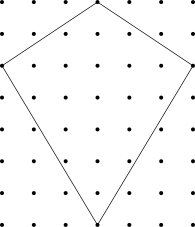
¿Cuál es el número de pulgadas cuadradas del área de la cometa pequeña?
Problems and are about these kites.
To promote her school’s annual Kite Olympics, Genevieve makes a small kite and a large kite for a bulletin board display. The kites look like the one in the diagram. For her small kite Genevieve draws the kite on a one-inch grid. For the large kite she triples both the height and width of the entire grid.
What is the number of square inches in the area of the small kite?
Pista pequeña:
Usa las diagonales de la cometa en la cuadrícula
Use the kite diagonals on the grid
Pista grande:
El área es la mitad del producto de las diagonales
The area is half the product of the diagonals
Solución:
Recuerda que el área de una cometa es el producto de sus diagonales dividido entre
Por lo tanto, el área de la cometa pequeña es
Por lo tanto, A es la respuesta correcta.
Recall that the area of a kite is the product of its diagonals divided by
Therefore, the area of the small kite is
Thus, A is the correct answer.
8.
Genevieve coloca refuerzos en su cometa grande en forma de una cruz que conecta las esquinas opuestas de la cometa. ¿Cuántas pulgadas de material de refuerzo necesita?
Genevieve puts bracing on her large kite in the form of a cross connecting opposite corners of the kite. How many inches of bracing material does she need?
Pista pequeña:
El refuerzo es la suma de las dos diagonales
The bracing is the sum of the two diagonals
Pista grande:
Triplicar la cuadrícula triplica las longitudes de ambas diagonales
Tripling the grid triples both diagonal lengths
Solución:
La diagonal larga mide unidades, y la corta mide unidades.
En la cometa grande, una unidad son pulgadas, así que la cantidad total de material de refuerzo necesaria es
Por lo tanto, E es la respuesta correcta.
The long diagonal is units, and the short one is units.
In the large kite, one unit is inches, so the total amount of bracing material needed is
Thus, E is the correct answer.
9.
La cometa grande se cubre con lámina de oro. La lámina se corta de una pieza rectangular que cubre exactamente toda la cuadrícula. ¿Cuántas pulgadas cuadradas de material de desperdicio se cortan de las cuatro esquinas?
The large kite is covered with gold foil. The foil is cut from a rectangular piece that just covers the entire grid. How many square inches of waste material are cut off from the four corners?
Pista pequeña:
Triplicar ambas dimensiones multiplica el área por
Tripling both dimensions multiplies area by
Pista grande:
El área de desperdicio es igual al área de la cometa grande
The waste area equals the large kite area
Solución:
El área de toda la cuadrícula sería Por la fórmula del área de una cometa, el área de la cometa es la mitad del área de la cuadrícula, así que el material desperdiciado es
Por lo tanto, D es la respuesta correcta.
The area of the entire grid would be The area of the kite is one-half this area from the formula for the area of the kite, so the wasted material is
Thus, D is the correct answer.
10.
Un coleccionista ofrece comprar monedas de veinticinco centavos conmemorativas de los estados por el de su valor nominal. A ese precio, ¿cuánto obtendrá Bryden por sus cuatro monedas conmemorativas de los estados?
A collector offers to buy state quarters for of their face value. At that rate how much will Bryden get for his four state quarters?
Pista pequeña:
Cuatro monedas de veinticinco centavos tienen un valor nominal de
Four quarters have face value
Pista grande:
significa veces el valor nominal
means times face value
Solución:
Cuatro monedas conmemorativas de los estados tienen un valor nominal de .
Como , el coleccionista paga veces el valor nominal, es decir, .
Por lo tanto, A es la respuesta correcta.
Four state quarters have face value .
Since , the collector pays times face value, or .
Thus, A is the correct answer.
11.
Los puntos y tienen estas coordenadas: y ¿Cuál es el área del cuadrilátero ?
Points and have these coordinates: and What is the area of quadrilateral
Pista pequeña:
Considera como un trapecio
View as a trapezoid
Pista grande:
Los lados verticales paralelos tienen longitudes y
The parallel vertical sides have lengths and
Solución:
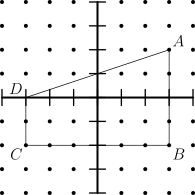
Podemos ver que es un trapecio ya que
Recuerda que la fórmula del área de un trapecio es
Sustituyendo y obtenemos
Por lo tanto, C es la respuesta correcta.
We can see that is a trapezoid since
Recall that the formula for the area of a trapezoid is
Plugging in and we get that
Thus, C is the correct answer.
12.
Si entonces
If then
Pista pequeña:
Primero evalúa
Evaluate first
Pista grande:
Luego usa el resultado como la primera entrada con
Then use the result as the first input with
Solución:
Podemos evaluarlo de la siguiente manera
Por lo tanto, A es la respuesta correcta.
We can evaluate it as follows
Thus, A is the correct answer.
13.
De los estudiantes de la clase de Richelle, prefieren pastel de chocolate, prefieren de manzana y prefieren de arándano. La mitad de los estudiantes restantes prefieren pastel de cereza y la otra mitad prefieren de limón. Para la gráfica circular de Richelle que muestra estos datos, ¿cuántos grados debería usar para el pastel de cereza?
Of the students in Richelle’s class, prefer chocolate pie, prefer apple, and prefer blueberry. Half of the remaining students prefer cherry pie and half prefer lemon. For Richelle’s pie graph showing this data, how many degrees should she use for cherry pie?
Pista pequeña:
Encuentra cuántos estudiantes quedan después de los primeros tres pasteles
Find how many students remain after the first three pies
Pista grande:
La cereza es la mitad del grupo restante
Cherry is half of the remaining group
Solución:
El número de estudiantes que prefieren pastel de cereza o de limón es La mitad de estos prefieren pastel de cereza, es decir,
Entonces el número de grados para el pastel de cereza sería
Por lo tanto, D es la respuesta correcta.
The number of students that prefer cherry or lemon pie is Half of these like cherry pie, which is
The number of degrees for cherry pie would then be
Thus, D is the correct answer.
14.
Tyler ha entrado en una fila de bufé en la que elige un tipo de carne, dos verduras diferentes y un postre. Si el orden de los alimentos no importa, ¿cuántas comidas diferentes podría elegir?
Carne: res, pollo, cerdo
Verduras: frijoles horneados, maíz, papas, tomates
Postre: brownies, pastel de chocolate, pudín de chocolate, helado
Tyler has entered a buffet line in which he chooses one kind of meat, two different vegetables and one dessert. If the order of food items is not important, how many different meals might he choose?
Meat: beef, chicken, pork
Vegetables: baked beans, corn, potatoes, tomatoes
Dessert: brownies, chocolate cake, chocolate pudding, ice cream
Pista pequeña:
Elige las dos verduras como un par sin orden
Choose the two vegetables as an unordered pair
Pista grande:
Multiplica las opciones de carne, los pares de verduras y las opciones de postre
Multiply meat choices, vegetable pairs, and dessert choices
Solución:
Tiene opciones para la carne y opciones para el postre.
Debe elegir de las verduras. Como el orden no importa, hay opciones de verduras.
Esto da comidas posibles.
Por lo tanto, C es la respuesta correcta.
He has choices for the meat and choices for dessert.
He must choose of the vegetables. Since order does not matter, there are vegetable choices.
This gives possible meals.
Thus, C is the correct answer.
15.
Homer empezó a pelar una pila de papas a una velocidad de papas por minuto. Cuatro minutos después Christen se unió a él y peló a una velocidad de papas por minuto. Cuando terminaron, ¿cuántas papas había pelado Christen?
Homer began peeling a pile of potatoes at the rate of potatoes per minute. Four minutes later Christen joined him and peeled at the rate of potatoes per minute. When they finished, how many potatoes had Christen peeled?
Pista pequeña:
Encuentra cuántas papas quedan cuando Christen empieza
Find how many potatoes remain when Christen starts
Pista grande:
Después de eso, su velocidad combinada es de por minuto
After that, their combined rate is per minute
Solución:
Homer había pelado papas para cuando Christen se le unió, dejando papas.
Juntos, Homer y Christen pelan papas por minuto, tomándoles minutos pelar el resto.
En minutos, Christen peló papas.
Por lo tanto, A es la respuesta correcta.
Homer had peeled potatoes by the time Christen joined him, leaving potatoes.
Together, Homer and Christen peel potatoes per minute, taking them minutes to peel the rest.
In minutes, Christen peeled potatoes.
Thus, A is the correct answer.
16.
Una hoja de papel cuadrada, de pulgadas por lado, se dobla por la mitad verticalmente. Luego ambas capas se cortan por la mitad de forma paralela al doblez. Se forman tres nuevos rectángulos, uno grande y dos pequeños. ¿Cuál es la razón entre el perímetro de uno de los rectángulos pequeños y el perímetro del rectángulo grande?

A square piece of paper, inches on a side, is folded in half vertically. Both layers are then cut in half parallel to the fold. Three new rectangles are formed, a large one and two small ones. What is the ratio of the perimeter of one of the small rectangles to the perimeter of the large rectangle?
Pista pequeña:
Después de doblar, el papel es un rectángulo
After folding, the paper is a rectangle
Pista grande:
Los rectángulos pequeños son
The small rectangles are
Solución:
El cuadrado se dobla por la mitad para crear un rectángulo .
Cortar el papel doblado por la mitad de forma paralela al doblez da dos rectángulos pequeños y un rectángulo grande .
La razón entre el perímetro de un rectángulo pequeño y el perímetro del rectángulo grande es
Por lo tanto, E es la respuesta correcta.
The square is folded in half to create a rectangle.
Cutting the folded paper in half parallel to the fold gives two small rectangles and one large rectangle.
The ratio of the perimeter of a small rectangle to the perimeter of the large rectangle is
Thus, E is the correct answer.
17.
Para el concurso ¿Quién quiere ser millonario?, los valores en dólares de cada pregunta se muestran en la siguiente tabla (donde ). ¿Entre qué dos preguntas es menor el aumento porcentual del valor?
For the game show Who Wants To Be a Millionaire? the dollar values of each question are shown in the following table (where ). Between which two questions is the percent increase of the value the smallest?
De a
From to
De a
From to
De a
From to
De a
From to
De a
From to
Pista pequeña:
La mayoría de los aumentos listados son duplicaciones
Most listed increases are doublings
Pista grande:
Compara los pocos aumentos que no son exactamente
Compare the few increases that are not exactly
Solución:
La mayoría de los aumentos listados son duplicaciones, que son aumentos del .
Las excepciones entre las opciones de respuesta son de a , de a , y de a .
Estos aumentos porcentuales son , , y , que es aproximadamente .
El menor es de la pregunta a la pregunta .
Por lo tanto, B es la respuesta correcta.
Most of the listed increases are doublings, which are increases.
The exceptions among the answer choices are from to , from to , and from to .
These percent increases are , , and , which is about .
The smallest is from question to question .
Thus, B is the correct answer.
18.
Se lanzan dos dados. ¿Cuál es la probabilidad de que el producto de los dos números sea un múltiplo de ?
Two dice are thrown. What is the probability that the product of the two numbers is a multiple of
Pista pequeña:
El producto es un múltiplo de exactamente cuando un dado muestra
The product is a multiple of exactly when a die shows
Pista grande:
Es más fácil contar cuando ningún dado muestra
It is easier to count no die showing
Solución:
La única manera de que el producto sea un múltiplo de es que al menos uno de los lanzamientos sea
Podemos hacer conteo complementario. La probabilidad de que ninguno de los lanzamientos sea es
Por lo tanto, la probabilidad de que al menos un lanzamiento sea es
Por lo tanto, D es la respuesta correcta.
The only way for the product to be a multiple of is if at least one of the rolls is
We can do complementary counting. The probability that neither rolls is a is
Therefore, the probability that at least one roll is a is
Thus, D is the correct answer.
19.
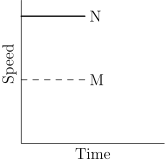
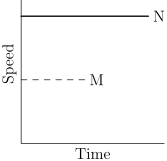
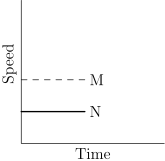
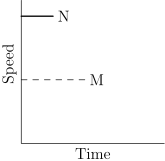
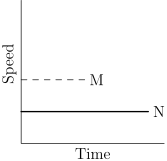
El auto viajó a velocidad constante durante un tiempo dado. Esto se muestra con la línea punteada. El auto viajó al doble de la velocidad por la misma distancia. Si la velocidad y el tiempo del auto se muestran como una línea sólida, ¿qué gráfica ilustra esto?
Car traveled at a constant speed for a given time. This is shown by the dashed line. Car traveled at twice the speed for the same distance. If Car ’s speed and time are shown as a solid line, which graph illustrates this?
Pista pequeña:
El doble de velocidad significa la mitad del tiempo para la misma distancia
Twice the speed means half the time for the same distance
Pista grande:
La línea sólida debe ser más alta y más corta
The solid line should be higher and shorter
Solución:
El auto viaja al doble de la velocidad del auto así que se representa con un punto que está el doble de alto en el eje de velocidad que el auto
Como el auto recorre la misma distancia que el auto pero a mayor velocidad, tarda la mitad del tiempo en completar el viaje.
Por lo tanto, la línea que representa la velocidad del auto tiene la mitad de la longitud de la línea que representa la velocidad del auto .
Ambas líneas son horizontales porque las velocidades son constantes. Al examinar las gráficas dadas, la única que cumple estas condiciones es la gráfica D.
Por lo tanto, D es la respuesta correcta.
Car travels at twice the speed of car so it is represented by a point that is twice as high on the speed axis as car
Since car travels at the same distance as car but at a faster speed, it takes half the time to complete the trip.
Therefore, the line representing car ’s speed is half the length of the line representing car ’s speed.
Both lines are horizontal because the speeds are constant. Examining the given graphs, the only one that meets these conditions is graph D .
Thus, D is the correct answer.
20.
Kaleana muestra su puntaje del examen a Quay, Marty y Shana, pero los demás mantienen los suyos ocultos. Quay piensa: «Al menos dos de nosotros tenemos el mismo puntaje». Marty piensa: «Yo no obtuve el puntaje más bajo». Shana piensa: «Yo no obtuve el puntaje más alto». Ordena los puntajes de menor a mayor para Marty (), Quay () y Shana ().
Kaleana shows her test score to Quay, Marty and Shana, but the others keep theirs hidden. Quay thinks, “At least two of us have the same score.” Marty thinks, “I didn’t get the lowest score.” Shana thinks, “I didn’t get the highest score.” List the scores from lowest to highest for Marty (), Quay () and Shana ().
Pista pequeña:
Quay solo ve el puntaje de Kaleana
Quay only sees Kaleana’s score
Pista grande:
Usa cada afirmación de puntaje oculto en relación con Kaleana
Use each hidden-score statement relative to Kaleana
Solución:
Como Quay solo conoce el puntaje de Kaleana, obtenemos que Quay y Kaleana tienen el mismo puntaje, así que
Marty sabe que su puntaje es mayor que el de Kaleana, así que Shana sabe que su puntaje es menor que el de Kaleana, así que
Sustituyendo por obtenemos la siguiente desigualdad:
Por lo tanto, A es la respuesta correcta.
Since Quay only knows Kaleana’s score, we get that Quay and Kaleana have the same score, so
Marty knows that his score is higher than Kaleana’s, so Shana knows that her score is lower than Kaleana’s, so
Substituting for we get the following inequality:
Thus, A is the correct answer.
21.
La media de un conjunto de cinco enteros positivos diferentes es La mediana es El máximo valor posible del mayor de estos cinco enteros es
The mean of a set of five different positive integers is The median is The maximum possible value of the largest of these five integers is
Pista pequeña:
Los cinco números suman
The five numbers sum to
Pista grande:
Haz que los otros cuatro números sean lo más pequeños posible
Make the other four numbers as small as possible
Solución:
La mediana del conjunto de números es el tercer número más grande, que es Hay dos números menores que y dos números mayores que él.
La media del conjunto es así que la suma de todos los números es Para maximizar el número más grande con esta suma, los demás números deben ser lo más pequeños posible.
Los dos números menores que deben ser positivos y distintos, así que deben ser y
El número inmediatamente después de también debe ser lo más pequeño posible, así que debe ser
Por lo tanto, el número restante, el máximo valor posible del conjunto, es
Por lo tanto, D es la respuesta correcta.
The median of the set of numbers is the third largest number, which is There are two numbers less than and two numbers greater than it.
The mean of the set is so the sum of all the numbers is In order to maximize the largest number with this sum, the other numbers must be as small as possible.
The two numbers less than must be positive and distinct, so they must be and
The number immediately after must also be as small as possible, so it must be
Therefore, the remaining number, the maximum possible value in the set, is
Thus, D is the correct answer.
22.
En un examen de veinte preguntas, cada respuesta correcta vale puntos, cada pregunta sin responder vale punto y cada respuesta incorrecta vale puntos. ¿Cuál de los siguientes puntajes NO es posible?
On a twenty-question test, each correct answer is worth points, each unanswered question is worth point and each incorrect answer is worth points. Which of the following scores is NOT possible?
Pista pequeña:
Revisa los puntajes cercanos a
Check scores near
Pista grande:
Con respuestas correctas, solo dos puntajes son posibles
With correct answers, only two scores are possible
Solución:
Con respuestas correctas, el puntaje es .
Con respuestas correctas, el puntaje es o , dependiendo de si la pregunta restante es incorrecta o sin responder.
Con respuestas correctas, las dos preguntas restantes pueden aportar , o puntos, dando , o .
Así, los puntajes listados son posibles, mientras que no lo es.
Por lo tanto, E es la respuesta correcta.
With correct answers, the score is .
With correct answers, the score is either or , depending on whether the remaining question is incorrect or unanswered.
With correct answers, the remaining two questions can contribute , , or points, giving , , or .
Thus the listed scores are possible, while is not.
Thus, E is the correct answer.
23.
Los puntos y son vértices de un triángulo equilátero, y los puntos y son puntos medios de sus lados. ¿Cuántos triángulos no congruentes se pueden dibujar usando tres cualesquiera de estos seis puntos como vértices?

Points and are vertices of an equilateral triangle, and points and are midpoints of its sides. How many noncongruent triangles can be drawn using any three of these six points as vertices?
Pista pequeña:
Clasifica los triángulos por longitudes de lados
Classify triangles by side lengths
Pista grande:
Usa la simetría para evitar contar de nuevo los casos congruentes
Use symmetry to avoid recounting congruent cases
Solución:
Usando la longitud del lado de los triángulos equiláteros pequeños como una unidad, los posibles patrones de longitudes de lados de triángulo son:
equilátero con lados ; equilátero con lados ; isósceles pequeño con lados ; e isósceles más grande con lados .
Estos cuatro patrones aparecen en la figura, y la simetría muestra que todo triángulo formado por tres de los seis puntos es congruente con uno de ellos.
En total, hay triángulos no congruentes.
Por lo tanto, D es la respuesta correcta.
Using the side length of the small equilateral triangles as one unit, the possible triangle side-length patterns are:
equilateral with sides ; equilateral with sides ; small isosceles with sides ; and larger isosceles with sides .
These four patterns all occur in the figure, and symmetry shows every triangle formed by three of the six points matches one of them.
Thus there are noncongruent triangles.
Thus, D is the correct answer.
24.
Cada mitad de esta figura está compuesta por triángulos rojos, triángulos azules y triángulos blancos. Cuando la mitad superior se dobla hacia abajo sobre la línea central, pares de triángulos rojos coinciden, al igual que pares de triángulos azules. Hay pares rojo-blanco. ¿Cuántos pares blancos coinciden?
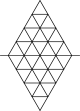
Each half of this figure is composed of red triangles, blue triangles and white triangles. When the upper half is folded down over the centerline, pairs of red triangles coincide, as do pairs of blue triangles. There are red-white pairs. How many white pairs coincide?
Pista pequeña:
Primero contabiliza todos los triángulos rojos
Account for all red triangles first
Pista grande:
Luego sigue cómo deben emparejarse los triángulos azules no emparejados
Then track how the unmatched blue triangles must pair
Solución:
Cada mitad tiene triángulos rojos, azules y blancos.
Los pares rojo-rojo usan triángulos rojos de cada mitad, así que el triángulo rojo restante de cada mitad se usa en los pares rojo-blanco. Así, todos los triángulos rojos quedan contabilizados.
Los pares azul-azul usan triángulos azules de cada mitad, dejando triángulos azules de cada mitad. Como no ocurren más pares azul-azul, esos triángulos azules deben emparejarse con triángulos blancos.
Así que en cada mitad, blanco se usa con rojo y blancos se usan con azul, dejando triángulos blancos para emparejar con triángulos blancos.
Por lo tanto, B es la respuesta correcta.
Each half has red, blue, and white triangles.
The red-red pairs use red triangles from each half, so the remaining red triangle from each half is used in the red-white pairs. Thus all red triangles are accounted for.
The blue-blue pairs use blue triangles from each half, leaving blue triangles from each half. Since no more blue-blue pairs occur, those blue triangles must pair with white triangles.
So on each half, white is used with red and whites are used with blue, leaving white triangles to pair with white triangles.
Thus, B is the correct answer.
25.
Hay números enteros de cuatro cifras que usan cada uno de los cuatro dígitos y exactamente una vez. Solo uno de estos números de cuatro cifras es múltiplo de otro. ¿Cuál de los siguientes es ese múltiplo?
There are four-digit whole numbers that use each of the four digits and exactly once. Only one of these four-digit numbers is a multiple of another one. Which of the following is it?
Pista pequeña:
Un múltiplo debe ser el doble o el triple de una permutación menor
A multiple must be twice or three times a smaller permutation
Pista grande:
Divide cada opción de respuesta entre o cuando sea posible
Divide each answer choice by or when possible
Solución:
Un número en el rango de , o no puede multiplicarse por o más y seguir siendo una de las permutaciones de cuatro cifras dadas. Así que el número menor debe empezar con , y el número mayor debe ser su doble o su triple.
Para los dobles, solo pueden funcionar las opciones que terminan en . Pero y , y ninguno usa exactamente los dígitos .
Para los triples, las posibles opciones son las divisibles entre : . Al dividir se obtiene , y solo usa exactamente los dígitos requeridos.
Por lo tanto es el único múltiplo listado.
Por lo tanto, D es la respuesta correcta.
A number in the , , or range cannot be multiplied by or more and remain one of the given four-digit permutations. So the smaller number must start with , and the larger number must be either double or triple it.
For doubles, only answer choices ending in can work. But and , neither of which uses exactly the digits .
For triples, the possible answer choices are those divisible by : . Dividing gives , and only uses exactly the required digits.
Therefore is the unique listed multiple.
Thus, D is the correct answer.