
Soluciones del 1992 AMC 12
Desplázate hacia abajo para ver las soluciones preparadas profesionalmente de LIVE by Po-Shen Loh, imprime las soluciones en PDF, consulta la clave de respuestas, o haz el examen cronometrado completo.
Todos los problemas se usan con el permiso legal oficial de la Mathematical Association of America (MAA).
1.
Si entonces
If then
Pista pequeña:
Compara con
Compare with
Pista grande:
Ten en cuenta por separado el cambio dentro de los paréntesis y el cambio en el coeficiente exterior
Account separately for the change inside the parentheses and the change in the outside coefficient
Solución:
Tenemos de modo que
Por lo tanto, la respuesta correcta es B.
We have so
Thus the correct answer is B.
2.
Una urna contiene monedas y cuentas, todas de plata o de oro. El veinte por ciento de los objetos de la urna son cuentas. El cuarenta por ciento de las monedas de la urna son de plata. ¿Qué porcentaje de los objetos de la urna son monedas de oro?
An urn is filled with coins and beads, all of which are either silver or gold. Twenty percent of the objects in the urn are beads. Forty percent of the coins in the urn are silver. What percent of the objects in the urn are gold coins?
Pista pequeña:
Primero halla el porcentaje de todos los objetos que son monedas
First find the percent of all objects that are coins
Pista grande:
Entre esas monedas, usa el complemento del porcentaje de monedas de plata
Of those coins, use the complement of the silver percentage
Solución:
Las monedas constituyen el de los objetos, y el de las monedas son de oro. Por tanto, las monedas de oro constituyen de todos los objetos.
Por lo tanto, la respuesta correcta es B.
Coins make up of the objects, and of the coins are gold. Thus gold coins make up of all the objects.
Thus the correct answer is B.
3.
Si y los puntos y están en una recta de pendiente entonces
If and the points and lie on a line with slope then
Pista pequeña:
Escribe la pendiente entre los dos puntos dados
Write the slope between the two given points
Pista grande:
Iguala y usa la condición de positividad
Set and use the positivity condition
Solución:
La condición sobre la pendiente da Por tanto, así que Como obtenemos
Por lo tanto, la respuesta correcta es C.
The slope condition gives Therefore so Since we obtain
Thus the correct answer is C.
4.
Si y son enteros positivos, y y son impares, entonces es
If and are positive integers and and are odd, then is
impar para todo valor de
odd for all choices of
par para todo valor de
even for all choices of
impar si es par; par si es impar
odd if is even; even if is odd
impar si es impar; par si es par
odd if is odd; even if is even
impar si no es múltiplo de ; par si es múltiplo de
odd if is not a multiple of ; even if is a multiple of
Pista pequeña:
Determina la paridad de cada uno de los dos términos
Determine the parity of each of the two terms
Pista grande:
Como es impar, es par
Because is odd, is even
Solución:
La potencia es impar. Como es par, es par para todo entero positivo La suma de un entero impar y un entero par siempre es impar.
Por lo tanto, la respuesta correcta es A.
The power is odd. Since is even, is even for every positive integer The sum of an odd integer and an even integer is always odd.
Thus the correct answer is A.
5.
Pista pequeña:
Saca como factor el sumando repetido
Factor the repeated summand
Pista grande:
Hay exactamente seis términos idénticos
There are exactly six identical terms
Solución:
Al factorizar se obtiene
Por lo tanto, la respuesta correcta es B.
Factoring gives
Thus the correct answer is B.
6.
Si entonces
If then
Pista pequeña:
Agrupa por separado las potencias de y las potencias de
Collect the powers of and the powers of separately
Pista grande:
Reescribe usando una sola razón
Rewrite using a single ratio
Solución:
Al agrupar las bases iguales,
Por lo tanto, la respuesta correcta es D.
Combining like bases,
Thus the correct answer is D.
7.
La razón entre y es la razón entre y es y la razón entre y es ¿Cuál es la razón entre y ?
The ratio of to is of to is and of to is What is the ratio of to
Pista pequeña:
Expresa tanto como como múltiplos de
Express both and as multiples of
Pista grande:
Usa
Use
Solución:
Al multiplicar las razones dadas, Por tanto,
Por lo tanto, la respuesta correcta es B.
Multiplying the given ratios, Thus
Thus the correct answer is B.
8.
Un piso cuadrado está cubierto con baldosas cuadradas congruentes. Las baldosas de las dos diagonales del piso son negras y las demás son blancas. Si hay baldosas negras, entonces el número total de baldosas es
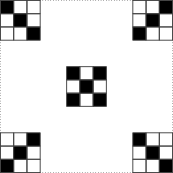
A square floor is tiled with congruent square tiles. The tiles on the two diagonals of the floor are black. The rest of the tiles are white. If there are black tiles, then the total number of tiles is
Pista pequeña:
Si el piso tiene baldosas por lado, cuenta las baldosas de ambas diagonales
If the floor has tiles on a side, count the tiles on both diagonals
Pista grande:
Como el número total de baldosas negras es impar, las dos diagonales comparten una baldosa central
Because the total number of black tiles is odd, the two diagonals share one center tile
Solución:
Para un impar, cada diagonal contiene baldosas y las dos diagonales solo comparten la baldosa central. Por tanto, de modo que El piso contiene entonces baldosas.
Por lo tanto, la respuesta correcta es E.
For an odd each diagonal contains tiles and the two diagonals share only the center tile. Hence so The floor therefore contains tiles.
Thus the correct answer is E.
9.
Cinco triángulos equiláteros, cada uno de lado están dispuestos en el mismo lado de una recta que contiene un lado de cada triángulo. A lo largo de esta recta, el punto medio de la base de un triángulo es un vértice del siguiente. El área de la región del plano cubierta por la unión de las cinco regiones triangulares es
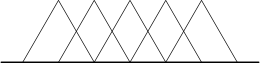
Five equilateral triangles, each with side are arranged so they are all on the same side of a line containing one side of each. Along this line, the midpoint of the base of one triangle is a vertex of the next. The area of the region of the plane that is covered by the union of the five triangular regions is
Pista pequeña:
Suma las áreas de los cinco triángulos grandes y luego resta sus intersecciones
Add the areas of the five large triangles, then subtract their overlaps
Pista grande:
Cada intersección de triángulos adyacentes es un triángulo equilátero con la mitad del lado original
Each adjacent overlap is an equilateral triangle with half the original side length
Solución:
Cada triángulo grande tiene área Cada una de las cuatro intersecciones es un triángulo equilátero de lado y por tanto de área No hay intersecciones triples, así que la unión tiene área
Por lo tanto, la respuesta correcta es E.
Each large triangle has area Each of the four overlaps is an equilateral triangle of side hence area There are no triple overlaps, so the union has area
Thus the correct answer is E.
10.
El número de enteros positivos para los cuales la ecuación tiene una solución entera para es
The number of positive integers for which the equation has an integer solution for is
Pista pequeña:
Despeja en función de
Solve the equation for in terms of
Pista grande:
La expresión es entera exactamente cuando es un divisor positivo de
The expression is integral exactly when is a positive divisor of
Solución:
Al despejar se obtiene Así, es entero precisamente cuando es un divisor positivo de Las posibilidades son y para un total de
Por lo tanto, la respuesta correcta es D.
Solving gives Thus is an integer precisely when is a positive divisor of The possibilities are and for a total of
Thus the correct answer is D.
11.
La razón entre los radios de dos círculos concéntricos es Si es un diámetro del círculo mayor, es una cuerda del círculo mayor tangente al círculo menor, y entonces el radio del círculo mayor es
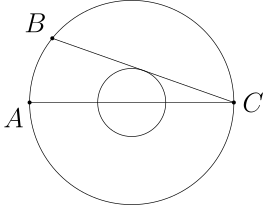
The ratio of the radii of two concentric circles is If is a diameter of the larger circle, is a chord of the larger circle that is tangent to the smaller circle, and then the radius of the larger circle is
Pista pequeña:
Traza el radio hasta el punto donde toca el círculo menor
Draw the radius to the point where touches the smaller circle
Pista grande:
Usa los triángulos rectángulos semejantes formados por el radio al punto de tangencia y el diámetro
Use the similar right triangles formed by the tangent radius and the diameter
Solución:
Sea el centro común y el punto de tangencia en Como y los triángulos y son semejantes. Si el radio mayor es entonces y Por tanto, De aquí, y
Por lo tanto, la respuesta correcta es B.
Let be the common center and the tangency point on Since and triangles and are similar. If the larger radius is then and Thus Hence and
Thus the correct answer is B.
12.
Sea la imagen de la recta al reflejarla respecto del eje . El valor de es
Let be the image when the line is reflected across the -axis. The value of is
Pista pequeña:
La reflexión respecto del eje cambia cada coordenada por su opuesto
Reflection across the -axis replaces each -coordinate by its negative
Pista grande:
Sustituye por en la ecuación original y luego despeja
Replace by in the original equation, then solve for
Solución:
Un punto está en la recta reflejada exactamente cuando está en la recta original. Por tanto, es decir, Entonces
Por lo tanto, la respuesta correcta es C.
A point is on the reflected line exactly when is on the original line. Hence or Therefore
Thus the correct answer is C.
13.
¿Cuántos pares de enteros positivos con satisfacen la ecuación
How many pairs of positive integers with satisfy the equation
Pista pequeña:
Multiplica el numerador y el denominador por
Multiply the numerator and denominator by
Pista grande:
Después de simplificar, expresa como múltiplo de y aplica la cota sobre
After simplifying, write as a multiple of and apply the bound on
Solución:
Al multiplicar el numerador y el denominador por se obtiene Por tanto, La condición se convierte en así que puede ser cualquier entero de a Hay pares.
Por lo tanto, la respuesta correcta es C.
Multiplying the numerator and denominator by gives Thus The condition becomes so may be any integer from through There are pairs.
Thus the correct answer is C.
14.
¿Cuáles de las siguientes ecuaciones tienen la misma gráfica?
Which of the following equations have the same graph?
solo y
and only
solo y
and only
solo y
and only
y
and
ninguna; todas las ecuaciones tienen gráficas diferentes
None. All the equations have different graphs
Pista pequeña:
Presta especial atención a lo que ocurre cuando
Pay special attention to what happens when
Pista grande:
La ecuación II omite un punto, mientras que la ecuación III incluye una recta vertical adicional completa
Equation II omits one point, while equation III includes an entire extra vertical line
Solución:
La ecuación I es toda la recta La ecuación II se simplifica a esa recta solo cuando por lo que omite En la ecuación III, todo punto con satisface para los demás valores de se obtiene Por tanto, III es la recta junto con toda la recta vertical Las tres gráficas son diferentes.
Por lo tanto, la respuesta correcta es E.
Equation I is the whole line Equation II simplifies to that line only when so it omits In equation III, every point with satisfies for other it gives Thus III is the line together with the entire vertical line The three graphs are different.
Thus the correct answer is E.
15.
Sea Para se define una sucesión de números complejos mediante En el plano complejo, ¿a qué distancia del origen está ?
Let For define a sequence of complex numbers by In the complex plane, how far from the origin is
Pista pequeña:
Calcula los primeros términos en lugar de intentar desarrollar
Compute the first few terms rather than trying to expand
Pista grande:
Busca un ciclo que comience con
Look for a cycle beginning with
Solución:
Los primeros términos son Por tanto, desde la sucesión alterna entre en los índices impares y en los índices pares. Así, cuya distancia al origen es
Por lo tanto, la respuesta correcta es B.
The first terms are Hence the sequence alternates between at odd indices and at even indices from onward. Therefore whose distance from the origin is
Thus the correct answer is B.
16.
Si tres números positivos y distintos y satisfacen entonces
If for three positive numbers and all different, then
Pista pequeña:
Sea y expresa usando la razón central
Let and express using the middle ratio
Pista grande:
Sustituye en la primera razón
Substitute into the first ratio
Solución:
Sea De se obtiene Entonces Por tanto, o Así, o y la positividad da
Por lo tanto, la respuesta correcta es E.
Let From we get Then Thus or Hence or and positivity gives
Thus the correct answer is E.
17.
Los enteros de dos cifras desde hasta se escriben consecutivamente para formar el entero grande Si es la mayor potencia de que divide a entonces
The two-digit integers from to are written consecutively to form the large integer If is the highest power of that is a factor of then
más de
more than
Pista pequeña:
Usa las pruebas de la suma de cifras para la divisibilidad por y por
Use the digit-sum tests for divisibility by and
Pista grande:
Módulo la suma de cifras de la concatenación equivale a
Modulo the digit sum of the concatenation equals
Solución:
Módulo un número es congruente con la suma de sus cifras, así que Por tanto, es divisible por pero no por de modo que la mayor potencia de que lo divide es
Por lo tanto, la respuesta correcta es B.
Modulo a number is congruent to its digit sum, so Thus is divisible by but not by so the highest power of dividing it is
Thus the correct answer is B.
18.
La sucesión creciente de enteros positivos cumple, para todo Si entonces es
The increasing sequence of positive integers has the property that, for every If then is
Pista pequeña:
Expresa y en función de y
Write and in terms of and
Pista grande:
A partir de usa congruencias y
From use congruences and
Solución:
Sean y Al usar repetidamente la recurrencia se obtiene Módulo la primera ecuación muestra que es múltiplo de Las posibilidades positivas son o Las condiciones solo permiten y Por tanto,
Por lo tanto, la respuesta correcta es D.
Let and Repeated use of the recurrence gives Modulo the first equation shows that is a multiple of The positive possibilities are or The conditions leave only and Hence
Thus the correct answer is D.
19.
Para cada vértice de un cubo macizo, considera el tetraedro determinado por el vértice y los puntos medios de las tres aristas que concurren en él. La parte del cubo que queda al cortar estos ocho tetraedros se llama cuboctaedro. ¿A cuál de los siguientes valores se aproxima más la razón entre el volumen del cuboctaedro y el volumen del cubo original?
For each vertex of a solid cube, consider the tetrahedron determined by the vertex and the midpoints of the three edges that meet at that vertex. The portion of the cube that remains when these eight tetrahedra are cut away is called a cuboctahedron. The ratio of the volume of the cuboctahedron to the volume of the original cube is closest to which of these?
Pista pequeña:
Elige una longitud de arista conveniente para el cubo y calcula el volumen de un tetraedro de esquina eliminado
Choose a convenient side length for the cube and compute one removed corner tetrahedron
Pista grande:
Cada tetraedro eliminado tiene tres aristas mutuamente perpendiculares de longitud igual a la mitad de la arista del cubo
Each removed tetrahedron has three mutually perpendicular edges equal to half the cube’s side
Solución:
Toma la longitud de la arista del cubo como Su volumen es Cada tetraedro de esquina tiene tres aristas perpendiculares de longitud así que su volumen es Los ocho tetraedros eliminados tienen volumen total y queda La razón es que se aproxima más a
Por lo tanto, la respuesta correcta es D.
Take the cube’s side length to be Its volume is Each corner tetrahedron has three perpendicular edges of length so its volume is The eight removed tetrahedra have total volume leaving The ratio is which is closest to
Thus the correct answer is D.
20.
Se muestra parte de una “estrella regular de puntas”. Es un polígono simple cerrado en el cual las aristas son congruentes, los ángulos son congruentes y los ángulos son congruentes. Si el ángulo agudo en mide menos que el ángulo agudo en entonces
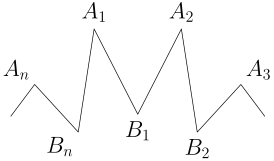
Part of an “-pointed regular star” is shown. It is a simple closed polygon in which all edges are congruent, angles are congruent, and angles are congruent. If the acute angle at is less than the acute angle at then
Pista pequeña:
Sean los ángulos agudos en los vértices de tipo y iguales a y , respectivamente
Let the acute angles at the - and -vertices be and
Pista grande:
En cada vértice entrante de tipo , el ángulo interior del polígono es
At each inward -vertex, the polygon’s interior angle is
Solución:
Sean y los ángulos agudos en las puntas y las muescas, respectivamente, de modo que El polígono de lados tiene ángulos interiores y ángulos interiores reflejos Por tanto, Al sustituir se obtiene así que
Por lo tanto, la respuesta correcta es D.
Let the acute angles at the tips and notches be and respectively, so The -gon has interior angles and reflex interior angles Therefore Substituting gives so
Thus the correct answer is D.
21.
Para una sucesión finita de números , la suma de Cesàro de se define como donde Si la suma de Cesàro de la sucesión de términos es ¿cuál es la suma de Cesàro de la sucesión de términos ?
For a finite sequence of numbers, the Cesàro sum of is defined to be where If the Cesàro sum of the -term sequence is what is the Cesàro sum of the -term sequence
Pista pequeña:
Convierte la primera suma de Cesàro en el valor de
Convert the first Cesàro sum into the value of
Pista grande:
Cada nueva suma parcial es más una suma parcial anterior, y hay una suma parcial inicial igual a
Each new partial sum is plus an old partial sum, with one initial partial sum equal to
Solución:
La condición dada afirma que Para la nueva sucesión, las sumas parciales son Su suma es Al dividir entre se obtiene la nueva suma de Cesàro
Por lo tanto, la respuesta correcta es A.
The given condition says For the new sequence, the partial sums are Their sum is Dividing by gives the new Cesàro sum
Thus the correct answer is A.
22.
Se seleccionan diez puntos en el semieje positivo de , y cinco puntos en el semieje positivo de , Se trazan los cincuenta segmentos que conectan los diez puntos seleccionados de con los cinco puntos seleccionados de ¿Cuál es el máximo número posible de puntos de intersección de estos cincuenta segmentos que pueden estar en el interior del primer cuadrante?
Ten points are selected on the positive -axis, and five points are selected on the positive -axis, The fifty segments connecting the ten selected points on to the five selected points on are drawn. What is the maximum possible number of points of intersection of these fifty segments that could lie in the interior of the first quadrant?
Pista pequeña:
Una intersección interior queda determinada al elegir dos puntos de cada eje
An interior crossing is determined by choosing two points from each axis
Pista grande:
Para cada par seleccionado en cada eje, exactamente un par de los cuatro segmentos conectores se cruza
For each selected pair on each axis, exactly one pair of the four connecting segments crosses
Solución:
Elige dos de los puntos del eje y dos de los puntos del eje . Entre los cuatro segmentos conectores, los dos cuyos extremos están en orden inverso se cruzan exactamente una vez. Los puntos se pueden elegir de modo que no haya tres segmentos que pasen por el mismo punto interior, por lo que el máximo es
Por lo tanto, la respuesta correcta es B.
Choose two of the points on the -axis and two of the points on the -axis. Among the four connecting segments, the two with reversed endpoint order cross exactly once. The points can be chosen so no three segments meet at one interior point, so the maximum is
Thus the correct answer is B.
23.
¿Cuál es el tamaño del mayor subconjunto de tal que ningún par de elementos distintos de tiene suma divisible por ?
What is the size of the largest subset of such that no pair of distinct elements of has a sum divisible by
Pista pequeña:
Agrupa los enteros según sus residuos módulo
Group the integers by their residues modulo
Pista grande:
Empareja la clase residual con la la con la y la con la ; trata por separado la clase residual
Pair residue classes with with and with ; treat residue separately
Solución:
Las clases residuales contienen números, respectivamente. Podemos tomar números de, a lo sumo, una clase de cada par complementario y como máximo un múltiplo de Por tanto, Tomar todos los números cuyo residuo módulo es o junto con un múltiplo de alcanza
Por lo tanto, la respuesta correcta es E.
The residue classes contain numbers, respectively. We may take numbers from at most one class in each complementary pair and at most one multiple of Thus Taking every number whose residue modulo is or together with one multiple of attains
Thus the correct answer is E.
24.
Sea un paralelogramo de área , con y Sitúa y en los segmentos y respectivamente, de modo que La recta que pasa por y es paralela a corta a en El área del cuadrilátero es
Let be a parallelogram of area with and Locate and on segments and respectively, with Let the line through parallel to intersect at The area of the quadrilateral is
Pista pequeña:
Usa y como base de coordenadas afines
Use and as an affine coordinate basis
Pista grande:
En esa base, y ; usa la condición de paralelismo para ubicar
In that basis, and ; use the parallel condition to locate
Solución:
Usa y como vectores base. Entonces La recta que pasa por y es paralela a corta a en La fórmula del área por coordenadas da el área de como Las coordenadas afines multiplican todas las áreas por el área de así que
Por lo tanto, la respuesta correcta es C.
Use and as basis vectors. Then A line from parallel to meets at The shoelace formula gives the coordinate area of as Affine coordinates scale all areas by the area of so
Thus the correct answer is C.
25.
En el triángulo y Si las perpendiculares a por y a por se cortan en entonces
In triangle and If perpendiculars constructed to at and to at meet at then
Pista pequeña:
Coloca y
Place and
Pista grande:
Usa el ángulo de para ubicar y luego parametriza la recta que pasa por y es perpendicular a
Use the angle to locate then parametrize the line through perpendicular to
Solución:
Sean y Entonces La perpendicular a por es Un vector perpendicular a es así que la otra perpendicular es Su coordenada es cuando Como
Por lo tanto, la respuesta correcta es E.
Set and Then The perpendicular to at is A vector perpendicular to is so the other perpendicular is Its -coordinate is when Since
Thus the correct answer is E.
26.
El semicírculo tiene centro y radio El punto está en y Prolonga y hasta y respectivamente, de modo que los arcos circulares y tengan centros y respectivamente. El arco circular tiene centro El área de la “sonrisa” sombreada es
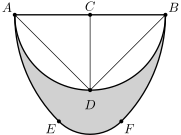
Semicircle has center and radius Point is on and Extend and to and respectively, so that circular arcs and have and as their respective centers. Circular arc has center The area of the shaded “smile,” is
Pista pequeña:
Usa para identificar dos triángulos rectángulos isósceles y determinar los radios pertinentes
Use to identify two isosceles right triangles and determine the relevant radii
Pista grande:
Expresa la sonrisa como un sector de más dos sectores de , y luego resta el triángulo y el semicírculo
Express the smile as one sector plus two sectors, then subtract triangle and semicircle
Solución:
Los triángulos y son rectángulos isósceles, así que y La sonrisa es el sector de más los sectores congruentes de y menos el triángulo y el semicírculo original. Su área es
Por lo tanto, la respuesta correcta es B.
Triangles and are isosceles right triangles, so and The smile is the sector plus the congruent sectors and minus triangle and the original semicircle. Its area is
Thus the correct answer is B.
27.
Un círculo de radio tiene cuerdas de longitud y de longitud Al prolongar más allá de y más allá de se cortan en un punto exterior al círculo. Si y entonces
A circle of radius has chords of length and of length When and are extended through and respectively, they intersect at which is outside the circle. If and then
Pista pequeña:
Aplica el teorema de las dos secantes para hallar y
Apply the secant-secant theorem to find and
Pista grande:
Una vez que tengas y identifica un triángulo de --
Once and identify a -- triangle
Solución:
La potencia de da Aquí y así que Por tanto, y Como y el triángulo es rectángulo en con Por tanto, es un diámetro, y De aquí,
Por lo tanto, la respuesta correcta es D.
Power of gives Here and so Thus and Since and triangle is right at with Therefore is a diameter, and Hence
Thus the correct answer is D.
28.
Sea El producto de las partes reales de las raíces de es
Let The product of the real parts of the roots of is
Pista pequeña:
Aplica la fórmula cuadrática y escribe
Apply the quadratic formula and write
Pista grande:
Resuelve y para determinar las partes reales de las dos raíces
Solve and to determine the real parts of the two roots
Solución:
La fórmula cuadrática da Como las raíces son Sus partes reales tienen producto
Por lo tanto, la respuesta correcta es B.
The quadratic formula gives Since the roots are Their real parts have product
Thus the correct answer is B.
29.
Una moneda “sesgada” tiene probabilidad de caer cara. Si se lanza esta moneda veces, ¿cuál es la probabilidad de que el número total de caras sea par?
An “unfair” coin has a probability of turning up heads. If this coin is tossed times, what is the probability that the total number of heads is even?
Pista pequeña:
Sigue la diferencia entre las probabilidades de obtener un número par y un número impar de caras
Track the difference between the probabilities of an even and an odd number of heads
Pista grande:
Un lanzamiento multiplica esa diferencia por
One toss multiplies that difference by
Solución:
Sean y las probabilidades de obtener un número par e impar de caras, respectivamente, después de lanzamientos. Entonces mientras que Como tenemos Al resolver las ecuaciones de suma y diferencia se obtiene
Por lo tanto, la respuesta correcta es D.
Let and be the probabilities of an even and odd number of heads after tosses. Then while Since we have Solving the sum and difference equations gives
Thus the correct answer is D.
30.
Sea un trapecio isósceles con bases y Supón que y que un círculo cuyo centro está en es tangente a los segmentos y Si es el menor valor posible de entonces
Let be an isosceles trapezoid with bases and Suppose and a circle with center on is tangent to segments and If is the smallest possible value of then
Pista pequeña:
Por simetría, coloca el trapecio con los centros de sus bases en el mismo eje vertical y sitúa el centro del círculo en el punto medio de
By symmetry, place the trapezoid with its bases centered on the same vertical axis and put the circle’s center at the midpoint of
Pista grande:
Escribe la distancia del centro a un lado no paralelo y exige que el punto de tangencia esté en el segmento; el mínimo ocurre en el caso límite de un extremo
Write the distance from the center to a leg and require the tangency point to lie on the leg segment; the minimum occurs at an endpoint case
Solución:
Coloca y La simetría obliga a que el centro del círculo sea El desplazamiento horizontal a lo largo de cada lado no paralelo es así que La perpendicular desde a un lado no paralelo empieza a tener su pie en el segmento cuando este alcanza el extremo superior; esta condición límite es Por tanto, Entonces
Por lo tanto, la respuesta correcta es B.
Place and Symmetry forces the circle’s center to be The horizontal offset along each leg is so The perpendicular from to a leg first has its foot on the segment when the foot reaches the upper endpoint; this boundary condition is Thus Therefore
Thus the correct answer is B.