
Soluciones del 1987 AMC 12
Desplázate hacia abajo para ver las soluciones preparadas profesionalmente de LIVE by Po-Shen Loh, imprime las soluciones en PDF, consulta la clave de respuestas, o haz el examen cronometrado completo.
Todos los problemas se usan con el permiso legal oficial de la Mathematical Association of America (MAA).
1.
es igual a
equals
Pista pequeña:
Distribuye cada término del primer binomio sobre el segundo
Distribute each term of the first binomial across the second
Pista grande:
El producto aporta el término de mayor grado
The product contributes the highest-degree term
Solución:
Al desarrollar obtenemos
Por lo tanto, la respuesta correcta es D.
Expanding gives
Thus the correct answer is D.
2.
Como muestra la figura, se corta una esquina triangular con de un triángulo equilátero de lado El perímetro del cuadrilátero restante es
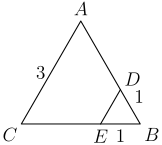
As shown in the figure, a triangular corner with side lengths is cut from equilateral triangle of side length The perimeter of the remaining quadrilateral is
Pista pequeña:
Determina el ángulo entre y
Determine the angle between and
Pista grande:
Parte del perímetro original, resta y y suma
Start from the original perimeter, remove and and add
Solución:
Como y el triángulo es equilátero, así que El perímetro original es Al cortar la esquina se eliminan dos segmentos unitarios y se añade uno:
Por lo tanto, la respuesta correcta es E.
Since and triangle is equilateral, so The original perimeter is Cutting off the corner removes two unit segments and adds one:
Thus the correct answer is E.
3.
¿Cuántos primos menores que tienen como cifra de las unidades? (Supón la representación usual en base .)
How many primes less than have as the ones digit? (Assume the usual base representation.)
Pista pequeña:
Enumera todos los enteros positivos menores que cuya cifra de las unidades es
List every positive integer below whose ones digit is
Pista grande:
Para números menores que basta probar divisibilidad por primos que no excedan su raíz cuadrada
For numbers below trial division only requires primes through their square roots
Solución:
Los primos son Los demás candidatos son compuestos: y Por tanto, hay primos de este tipo.
Por lo tanto, la respuesta correcta es C.
The primes are The other candidates are composite: and Hence there are such primes.
Thus the correct answer is C.
4.
es igual a
equals
Pista pequeña:
Reescribe cada potencia negativa de como un recíproco
Rewrite every negative power of as a reciprocal
Pista grande:
Compara los términos correspondientes del numerador y el denominador mediante un factor común
Compare corresponding numerator and denominator terms by a common factor
Solución:
El numerador es mientras que el denominador es Su cociente es
Por lo tanto, la respuesta correcta es B.
The numerator is while the denominator is Their quotient is
Thus the correct answer is B.
5.
Un estudiante registró la distribución exacta de frecuencias porcentuales de un conjunto de mediciones, como se muestra abajo. Sin embargo, olvidó indicar el número total de mediciones. ¿Cuál es el menor valor posible de ?
valor medido frecuencia porcentual
A student recorded the exact percentage frequency distribution for a set of measurements, as shown below. However, the student neglected to indicate the total number of measurements. What is the smallest possible value of
measured value percent frequency
Pista pequeña:
Expresa cada porcentaje no nulo como una fracción reducida del total
Express each nonzero percentage as a reduced fraction of the total
Pista grande:
Cada frecuencia resultante debe ser un número entero
Every resulting frequency must be a whole number
Solución:
Como el total debe ser divisible por Al tomar se obtienen las frecuencias todas enteras. Por tanto, el menor total posible es
Por lo tanto, la respuesta correcta es B.
Since the total must be divisible by Taking gives frequencies all whole numbers. Thus the smallest possible total is
Therefore the correct answer is B.
6.
En el mostrado, es un punto interior, y son las medidas de los ángulos en grados. Expresa en función de y
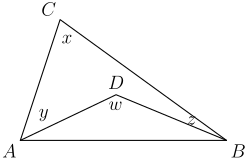
In the shown, is some interior point, and are the measures of angles in degrees. Solve for in terms of and
Pista pequeña:
Nombra los dos ángulos no marcados en y dentro del triángulo
Name the two unlabelled angles at and inside triangle
Pista grande:
Resta la suma de los ángulos de de la de
Subtract the angle sum of from that of
Solución:
Sean los ángulos no marcados del triángulo en y iguales a y respectivamente. Entonces La suma de los ángulos del triángulo da Al restar obtenemos por lo que
Por lo tanto, la respuesta correcta es A.
Let the unlabelled angles of triangle at and be and Then The angle sum of triangle gives Subtracting yields so
Thus the correct answer is A.
7.
Si ¿cuál de las cuatro cantidades es la mayor?
If which of the four quantities is the largest?
ninguna es siempre la mayor
no one is always largest
Pista pequeña:
Iguala las cuatro expresiones a un mismo valor
Set all four expressions equal to one common value
Pista grande:
Despeja cada variable como el valor común más o menos una constante
Solve each variable as the common value plus or minus a constant
Solución:
Si el valor común es entonces Por tanto, es siempre la mayor.
Por lo tanto, la respuesta correcta es C.
If the common value is then Therefore is always the largest.
Thus the correct answer is C.
8.
En la figura, la suma de las distancias y está
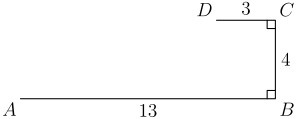
In the figure the sum of the distances and is
entre y
between and
entre y
between and
entre y
between and
Pista pequeña:
Usa el triángulo rectángulo -- para hallar
Use the -- right triangle to find
Pista grande:
Los desplazamientos horizontal y vertical de a son y
The horizontal and vertical displacements from to are and
Solución:
El triángulo es un triángulo rectángulo -- así que De a el desplazamiento horizontal es y el vertical es por lo que Como la suma está entre y
Por lo tanto, la respuesta correcta es C.
Triangle is a -- right triangle, so From to the horizontal displacement is and the vertical displacement is hence Since the sum is between and
Thus the correct answer is C.
9.
Los primeros cuatro términos de una sucesión aritmética son La razón de a es
The first four terms of an arithmetic sequence are The ratio of to is
Pista pequeña:
Escribe los cuatro términos usando y una diferencia común
Write all four terms using and a common difference
Pista grande:
Usa la ecuación que relaciona el segundo término con el cuarto término
Use the equation relating the second term to the fourth term
Solución:
Sea la diferencia común. Entonces y Por tanto, así que y En consecuencia,
Por lo tanto, la respuesta correcta es B.
Let the common difference be Then and Thus so and Therefore
Thus the correct answer is B.
10.
¿Cuántas ternas ordenadas de números reales no nulos tienen la propiedad de que cada número es el producto de los otros dos?
How many ordered triples of nonzero real numbers have the property that each number is the product of the other two?
Pista pequeña:
Traduce la condición en
Translate the condition into
Pista grande:
Multiplica las ecuaciones y usa la condición de que los números son no nulos para determinar sus magnitudes posibles
Multiply the equations and use the nonzero condition to determine the possible magnitudes
Solución:
Al multiplicar obtenemos Como ninguna variable es cero, Además, así que cada variable es o Para que el producto sea puede no haber signos negativos o puede haber exactamente dos, lo que da ternas ordenadas.
Por lo tanto, la respuesta correcta es D.
Multiplying gives Since none of the variables is zero, Also so each variable is or Product allows either no negative signs or exactly two, giving ordered triples.
Thus the correct answer is D.
11.
Sea una constante. Las ecuaciones simultáneas tienen una solución dentro del primer cuadrante si y solo si
Let be a constant. The simultaneous equations have a solution inside Quadrant I if and only if
Pista pequeña:
Resuelve las dos ecuaciones para y en función de
Solve the two equations for and in terms of
Pista grande:
El primer cuadrante exige que ambas coordenadas sean estrictamente positivas
Quadrant I requires both coordinates to be strictly positive
Solución:
Al resolver el sistema obtenemos La condición exige Con este denominador positivo, equivale a Por tanto,
Por lo tanto, la respuesta correcta es E.
Solving the system gives The condition requires With this positive denominator, is equivalent to Hence
Thus the correct answer is E.
12.
En una oficina, varias veces durante el día el jefe entrega a la secretaria una carta para mecanografiar y cada vez la coloca encima de la pila de la bandeja de entrada. Cuando tiene tiempo, la secretaria retira la carta superior y la mecanografía. Si hay cinco cartas en total y el jefe las entrega en el orden ¿cuál de los siguientes no podría ser el orden en que la secretaria las mecanografía?
In an office, at various times during the day the boss gives the secretary a letter to type, each time putting the letter on top of the pile in the secretary’s in-box. When there is time, the secretary takes the top letter off the pile and types it. If there are five letters in all, and the boss delivers them in the order which of the following could not be the order in which the secretary types them?
Pista pequeña:
Las cartas que permanecen en la pila siempre conservan el orden creciente de abajo hacia arriba
Letters still in the pile always remain in increasing order from bottom to top
Pista grande:
Después de mecanografiar la carta examina qué carta menor debe estar encima antes de poder mecanografiar la
After letter is typed, examine which smaller letter must be on top before can be typed
Solución:
Para mecanografiar primero la carta en la opción D, las cartas ya deben haberse entregado, por lo que queda encima después de retirar Entonces puede entregarse y mecanografiarse la carta pero todavía está sobre así que no puede ser la siguiente. Por tanto, es imposible. Cada uno de los otros órdenes puede producirse intercalando entregas y mecanografiado.
Por lo tanto, la respuesta correcta es D.
To type first in choice D, letters must all have been delivered, leaving on top after is removed. Letter can then be delivered and typed, but is still above so cannot be typed next. Thus is impossible. Each other listed order can be produced by interleaving deliveries and typings.
Therefore the correct answer is D.
13.
Una tira larga de papel de cm de ancho se enrolla veces alrededor de un tubo de cartón de cm de diámetro, formando un rollo de caja registradora de cm de diámetro. Aproxima la longitud del papel en metros. (Supón que el papel forma círculos concéntricos con diámetros uniformemente espaciados entre cm y cm.)
A long piece of paper cm wide is made into a roll for cash registers by wrapping it times around a cardboard tube of diameter cm, forming a roll cm in diameter. Approximate the length of the paper in meters. (Pretend the paper forms concentric circles with diameters evenly spaced from cm to cm.)
Pista pequeña:
Los diámetros forman una sucesión aritmética
The diameters form an arithmetic sequence
Pista grande:
Usa el diámetro promedio para hallar la suma de las circunferencias
Use the average diameter to find the sum of all circumferences
Solución:
El promedio de los diámetros primero y último es Por tanto, la longitud total es aproximadamente cm, es decir, metros.
Por lo tanto, la respuesta correcta es A.
The average of the first and last diameters is Hence the total length is approximately cm, or meters.
Thus the correct answer is A.
14.
es un cuadrado, y y son los puntos medios de y respectivamente. Entonces
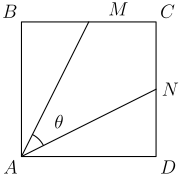
is a square and and are the midpoints of and respectively. Then
ninguna de estas
none of these
Pista pequeña:
Asigna coordenadas al cuadrado y escribe los vectores y
Assign coordinates to the square and write vectors and
Pista grande:
Usa la fórmula del determinante para el seno del ángulo entre dos vectores
Use the determinant formula for the sine of the angle between two vectors
Solución:
Toma un cuadrado de lado con y Entonces
Por lo tanto, la respuesta correcta es B.
Take the square to have side with and Then
Thus the correct answer is B.
15.
Si es una solución del sistema halla
If is a solution to the system find
Pista pequeña:
Factoriza la segunda ecuación usando
Factor the second equation using
Pista grande:
Usa
Use
Solución:
La segunda ecuación se convierte en Como obtenemos Por tanto,
Por lo tanto, la respuesta correcta es D.
The second equation becomes Since we get Therefore
Thus the correct answer is D.
16.
Un criptógrafo idea el siguiente método para codificar enteros positivos. Primero, el entero se expresa en base Segundo, se establece una correspondencia de a entre los dígitos que aparecen en las expresiones en base y los elementos del conjunto Con esta correspondencia, el criptógrafo descubre que tres enteros consecutivos en orden creciente se codifican como respectivamente. ¿Cuál es la expresión en base del entero codificado como ?
A cryptographer devises the following method for encoding positive integers. First, the integer is expressed in base Second, a -to- correspondence is established between the digits that appear in the expressions in base and the elements of the set Using this correspondence, the cryptographer finds that three consecutive integers in increasing order are coded as respectively. What is the base- expression for the integer coded as
Pista pequeña:
Compara los últimos dígitos de y
Compare the final digits of and
Pista grande:
El cambio de a obliga a que haya un acarreo en base
The change from to forces a base- carry
Solución:
Como es uno más que el dígito correspondiente a es uno más que el correspondiente a El siguiente incremento cambia a por lo que y El acarreo cambia a de modo que Así,
Por lo tanto, la respuesta correcta es D.
Because is one more than the digit for is one more than the digit for The next increment changes to so and The carry changes to leaving Thus
Thus the correct answer is D.
17.
En una competencia de matemáticas, la suma de las puntuaciones de Bill y Dick fue igual a la suma de las de Ann y Carol. Si se hubieran intercambiado las puntuaciones de Bill y Carol, la suma de las puntuaciones de Ann y Carol habría excedido la suma de las de los otros dos. Además, la puntuación de Dick excedió la suma de las puntuaciones de Bill y Carol. Determina el orden en que terminaron los cuatro concursantes, del mayor al menor. Supón que todas las puntuaciones fueron no negativas.
In a mathematics competition, the sum of the scores of Bill and Dick equalled the sum of the scores of Ann and Carol. If the scores of Bill and Carol had been interchanged, then the sum of the scores of Ann and Carol would have exceeded the sum of the scores of the other two. Also, Dick’s score exceeded the sum of the scores of Bill and Carol. Determine the order in which the four contestants finished, from highest to lowest. Assume all scores were nonnegative.
Dick, Ann, Carol, Bill
Dick, Ann, Bill, Carol
Dick, Carol, Bill, Ann
Ann, Dick, Carol, Bill
Ann, Dick, Bill, Carol
Pista pequeña:
Representa las cuatro puntuaciones por en el orden de los nombres
Represent the four scores by in name order
Pista grande:
Suma y resta la igualdad y la desigualdad
Add and subtract the equality and the inequality
Solución:
Sean las puntuaciones de Ann, Bill, Carol y Dick. Las condiciones son Al sumar las dos primeras comparaciones obtenemos Al restar la igualdad de la desigualdad obtenemos Finalmente, Por tanto,
Por lo tanto, la respuesta correcta es E.
Let be the scores of Ann, Bill, Carol, and Dick. The conditions are Adding the first two comparisons gives Subtracting the equality from the inequality gives Finally, Hence
Thus the correct answer is E.
18.
Se necesitan libros de álgebra (todos del mismo grosor) y libros de geometría (todos del mismo grosor, mayor que el de un libro de álgebra) para llenar por completo cierto estante. También libros de álgebra y libros de geometría llenarían el mismo estante. Por último, libros de álgebra por sí solos llenarían este estante. Dado que son enteros positivos distintos, se deduce que es
It takes algebra books (all the same thickness) and geometry books (all the same thickness, which is greater than that of an algebra book) to completely fill a certain shelf. Also, of the algebra books and of the geometry books would fill the same shelf. Finally, of the algebra books alone would fill this shelf. Given that are distinct positive integers, it follows that is
Pista pequeña:
Sean y los dos grosores de los libros y normaliza la longitud del estante a
Let and be the two book thicknesses and normalize the shelf length to
Pista grande:
Elimina el grosor del libro de geometría de y
Eliminate the geometry-book thickness from and
Solución:
Sea la longitud del estante, y sean los grosores de los libros de álgebra y de geometría. Entonces Al multiplicar la primera ecuación por la segunda por y restar, obtenemos Por tanto,
Por lo tanto, la respuesta correcta es D.
Let the shelf length be and let be the algebra- and geometry-book thicknesses. Then Multiplying the first equation by the second by and subtracting gives Hence
Thus the correct answer is D.
19.
¿Cuál de los siguientes valores es el más cercano a ?
Which of the following is closest to
Pista pequeña:
Racionaliza la diferencia de las dos raíces cuadradas
Rationalize the difference of the two square roots
Pista grande:
Compara con para decidir de qué lado de queda el resultado
Compare with to decide which side of the result lies on
Solución:
Al racionalizar obtenemos El denominador es menor que porque su cuadrado es Por tanto, el valor es mayor que Además, cada radical es mayor que así que el valor es menor que Por consiguiente, está más cerca de que de cualquier otra opción.
Por lo tanto, la respuesta correcta es B.
Rationalizing gives The denominator is less than because its square is Thus the value is greater than Also each radical exceeds so the value is less than It is therefore closer to than to any other choice.
Thus the correct answer is B.
20.
Evalúa
Evaluate
ninguna de estas
none of these
Pista pequeña:
Empareja el término del ángulo con el del ángulo
Pair the term at angle with the term at angle
Pista grande:
Usa antes de combinar los logaritmos
Use before combining logarithms
Solución:
Para cada Así, cada suma emparejada de logaritmos es El término central restante es Por tanto, la suma completa es
Por lo tanto, la respuesta correcta es A.
For each Thus each paired sum of logarithms is The remaining middle term is Hence the whole sum is
Thus the correct answer is A.
21.
Hay dos maneras naturales de inscribir un cuadrado en un triángulo rectángulo isósceles dado. Si se hace como en la Figura de abajo, se obtiene que el área del cuadrado es ¿Cuál es el área (en ) del cuadrado inscrito en el mismo , como se muestra en la Figura de abajo?
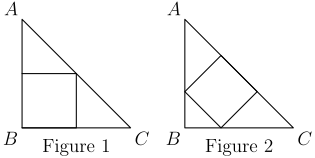
There are two natural ways to inscribe a square in a given isosceles right triangle. If it is done as in Figure below, then one finds that the area of the square is What is the area (in ) of the square inscribed in the same as shown in Figure below?
Pista pequeña:
Usa la Figura para determinar la longitud de los catetos del triángulo rectángulo isósceles
Use Figure to determine the leg length of the isosceles right triangle
Pista grande:
En la Figura compara el lado del cuadrado inclinado con los dos segmentos iguales que su lado opuesto determina sobre los catetos
In Figure compare the side of the tilted square with the two equal leg segments cut off by its opposite side
Solución:
El primer cuadrado tiene lado así que los catetos del triángulo tienen longitud Sea el lado del cuadrado inclinado. Su lado sobre la hipotenusa es paralelo al lado opuesto que une los catetos. Ese lado opuesto tiene extremos y por lo que La distancia entre las rectas paralelas y también es de modo que Por tanto, y su área es
Por lo tanto, la respuesta correcta es B.
The first square has side so the triangle’s legs have length Let be the side of the tilted square. Its side on the hypotenuse is parallel to the opposite side joining the legs. That opposite side has endpoints and so The distance between the parallel lines and is also giving Hence and its area is
Thus the correct answer is B.
22.
Una pelota flotaba en un lago cuando este se congeló. La pelota se retiró sin romper el hielo, dejando un agujero de cm de ancho en la superficie y cm de profundidad. ¿Cuál era el radio de la pelota, en centímetros?
A ball was floating in a lake when the lake froze. The ball was removed (without breaking the ice), leaving a hole cm across at the top and cm deep. What was the radius of the ball (in centimeters)?
Pista pequeña:
Toma una sección transversal vertical que pase por el centro del agujero circular
Take a vertical cross-section through the center of the circular hole
Pista grande:
La semichorda mide mientras que la distancia del centro al plano del hielo es
The half-chord is while the center-to-ice distance is
Solución:
En una sección transversal vertical, la mitad del agujero de cm es un segmento de cuerda de longitud Si el radio de la esfera es la distancia desde su centro hasta el plano del hielo es El triángulo rectángulo resultante da Al resolver, se obtiene así que
Por lo tanto, la respuesta correcta es C.
In a vertical cross-section, half the -cm hole is a chord segment of length If the sphere radius is the distance from its center to the ice plane is The resulting right triangle gives Solving yields so
Thus the correct answer is C.
23.
Si es primo y las dos raíces de son enteras, entonces
If is a prime and both roots of are integers, then
Pista pequeña:
Para una raíz entera reescribe la ecuación como
For an integer root rewrite the equation as
Pista grande:
Como es primo, escribe y factoriza
Since is prime, write and factor
Solución:
Una raíz entera satisface Por tanto, es divisible por así que escribimos Al sustituir, se obtiene La condición sobre el producto de enteros consecutivos solo se cumple con para el cual o Las raíces son y de modo que
Por lo tanto, la respuesta correcta es D.
An integer root satisfies Thus is divisible by so write Substitution gives The consecutive product condition works only with for which or The roots are and so
Thus the correct answer is D.
24.
¿Cuántas funciones polinómicas de grado satisfacen
How many polynomial functions of degree satisfy
una cantidad finita, pero mayor que
finitely many but more than
una cantidad infinita
infinitely many
Pista pequeña:
Compara los grados y los coeficientes principales de los tres polinomios
Compare the degrees and leading coefficients of the three polynomials
Pista grande:
Después de demostrar que es un polinomio cuadrático mónico, compara coeficientes en
After proving is a monic quadratic, compare coefficients in
Solución:
Sea de grado y coeficiente principal Las tres expresiones tienen grados por lo que y, en consecuencia, Al comparar los coeficientes principales en , se obtiene de donde
Escribamos Entonces El coeficiente cúbico obliga a que y luego el coeficiente cuadrático obliga a que Por tanto, la única candidata es que en efecto satisface las tres expresiones. Hay exactamente una función.
Por lo tanto, la respuesta correcta es B.
Let have degree and leading coefficient The three expressions have degrees so and therefore Comparing leading coefficients in gives hence
Write Then The cubic coefficient forces and then the quadratic coefficient forces Thus the only candidate is which indeed satisfies all three expressions. There is exactly one function.
Thus the correct answer is B.
25.
es un triángulo: y las dos coordenadas de son enteras. ¿Cuál es el área mínima que puede tener ?
is a triangle: and both the coordinates of are integers. What is the minimum area can have?
no existe un mínimo
there is no minimum
Pista pequeña:
Escribe y usa la fórmula del determinante para el área de un triángulo
Write and use the determinant formula for triangle area
Pista grande:
Halla el menor valor positivo de usando
Find the smallest positive value of using
Solución:
Para el área es Como el menor valor positivo posible del determinante es al menos Este se alcanza, por ejemplo, con pues Por lo tanto, el área mínima es
Por lo tanto, la respuesta correcta es C.
For the area is Since the smallest possible positive value of the determinant is at least It is attained, for example, by since Therefore the minimum area is
Thus the correct answer is C.
26.
La cantidad se divide uniformemente al azar en dos números reales no negativos; por ejemplo, en y o en y Después, cada número se redondea al entero más cercano; por ejemplo, a y en el primer caso, y a y en el segundo. ¿Cuál es la probabilidad de que los dos enteros sumen ?
The amount is split into two nonnegative real numbers uniformly at random, for instance, into and or into and Then each number is rounded to its nearest integer, for instance, and in the first case above, and in the second. What is the probability that the two integers sum to
Pista pequeña:
Sea el primer número , distribuido uniformemente en
Let the first number be uniformly distributed on
Pista grande:
Halla los intervalos en los que y se redondean a enteros cuya suma es
Find the intervals on which and round to integers whose sum is
Solución:
Sea la primera parte de modo que la segunda es Ignorando los extremos, que tienen probabilidad cero, los valores redondeados suman exactamente cuando Estos intervalos tienen longitud total dentro de un intervalo muestral de longitud Por consiguiente, la probabilidad es
Por lo tanto, la respuesta correcta es B.
Let the first part be so the second is Ignoring endpoints of probability zero, the rounded values sum to exactly when These intervals have total length out of a sample interval of length The probability is therefore
Thus the correct answer is B.
27.
Un cubo de queso se corta por los planos y ¿Cuántas piezas se obtienen? (No se mueve el queso hasta haber realizado los tres cortes.)
A cube of cheese is cut along the planes and How many pieces are there? (No cheese is moved until all three cuts are made.)
Pista pequeña:
Dentro de una misma pieza, el orden relativo de no puede cambiar
Within one piece, the relative order of cannot change
Pista grande:
Cuenta los ordenamientos estrictos de tres coordenadas distintas
Count the strict orderings of three distinct coordinates
Solución:
Los tres planos son precisamente las fronteras donde dos coordenadas son iguales. Fuera de ellos, cada pieza queda determinada por un orden estricto de como Cada uno de los ordenamientos aparece dentro del cubo, así que hay piezas.
Por lo tanto, la respuesta correcta es B.
The three planes are precisely the boundaries where two coordinates are equal. Away from them, each piece is determined by a strict ordering of such as Every one of the orderings occurs inside the cube, so there are pieces.
Thus the correct answer is B.
28.
Sean números reales. Supongamos que todas las raíces de son números complejos situados sobre una circunferencia del plano complejo con centro en y radio La suma de los recíprocos de las raíces es necesariamente
Let be real numbers. Suppose that all the roots of are complex numbers lying on a circle in the complex plane centered at and having radius The sum of the reciprocals of the roots is necessarily
Pista pequeña:
Para un número complejo sobre la circunferencia unitaria, compara con
For a complex number on the unit circle, compare with
Pista grande:
Los coeficientes reales del polinomio hacen que la suma de las raíces sea real
Real polynomial coefficients make the sum of the roots real
Solución:
Si entonces Por tanto, la suma de los recíprocos es el conjugado de la suma de las raíces. Por las fórmulas de Vieta, la suma de las raíces es que es real. Su conjugado sigue siendo
Por lo tanto, la respuesta correcta es D.
If then Therefore the sum of the reciprocals is the conjugate of the sum of the roots. By Vieta’s formulas, the sum of the roots is which is real. Its conjugate is still
Thus the correct answer is D.
29.
Considera la sucesión definida recursivamente por y, para por cuando es par y por cuando es impar. Dado que la suma de los dígitos de es
Consider the sequence of numbers defined recursively by and for by when is even and by when is odd. Given that the sum of the digits of is
Pista pequeña:
Los valores mayores que provienen de índices pares; los valores entre y provienen de índices impares
Values greater than come from even indices; values between and come from odd indices
Pista grande:
Invierte la recurrencia: resta a los valores mayores que y toma el recíproco de los valores menores que
Reverse the recursion by subtracting from values above and taking reciprocals of values below
Solución:
Sea el índice en el que aparece el valor . Al invertir la recurrencia, se obtiene para y para
Partiendo de el uso repetido de estas relaciones da y Al continuar, se obtiene y
Luego, y Finalmente, y Así, cuya suma de dígitos es
Por lo tanto, la respuesta correcta es A.
Let be the index at which the value occurs. Reversing the recursion gives for and for
Starting with repeated use gives and Continuing gives and
Next, and Finally, and Thus whose digit sum is
Therefore the correct answer is A.
30.
En la figura, tiene y Una recta con sobre y divide en dos partes de igual área. (Nota: la figura puede no ser exacta; quizá esté sobre en lugar de ) La razón es
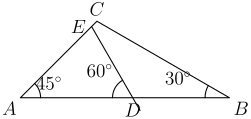
In the figure, has and A line with on and divides into two pieces of equal area. (Note: the figure may not be accurate; perhaps is on instead of ) The ratio is
Pista pequeña:
Escala de modo que y coloca
Scale so and place
Pista grande:
Halla la altura de y la de en términos de ; luego iguala la mitad del área total al área de
Find the height of and the height of in terms of , then equate half the total area to the area of
Solución:
Tomemos y Como el lado se encuentra sobre La recta que pasa por y forma un ángulo de con la interseca a la altura Sea El rayo tiene pendiente así que su intersección con tiene altura La igualdad de las áreas exige Por lo tanto, Así,
Por lo tanto, la respuesta correcta es E.
Set and Since side lies on The line through making angle with meets it at height Let The ray has slope so its intersection with has height Equal areas require Therefore Hence
Thus the correct answer is E.