
2013 AMC 10B 详解
向下滚动即可查看来自 LIVE by Po-Shen Loh 的精心整理的解答,打印PDF 解答,查看答案,或参加完整限时模拟考试。
所有题目均经美国数学协会(MAA)官方合法授权使用。
1.
求下式的值:
What is the value of the following expression?
小提示:
分别计算偶数和与奇数和。
Compute the even and odd sums separately
大提示:
化简后通分相减。
Convert both fractions to a common denominator after simplifying
解答:
所以正确答案是 C。
Thus, the correct answer is C.
2.
Green 先生通过走过矩形花园的两条边来测量花园,发现它是 步乘 步。Green 先生每一步长 英尺。他预计花园每平方英尺能收获半磅土豆。Green 先生预计能收获多少磅土豆?
Mr. Green measures his rectangular garden by walking two of the sides and finds that it is steps by steps. Each of Mr. Green’s steps is feet long. Mr. Green expects a half a pound of potatoes per square foot from his garden. How many pounds of potatoes does Mr. Green expect from his garden?
小提示:
先把花园两边从步数换成英尺。
Convert each garden side from steps to feet
大提示:
面积再乘以每平方英尺半磅。
Multiply area by half a pound per square foot
解答:
花园尺寸为 英尺和 英尺,面积为 平方英尺。
因此,预计收获 磅土豆。
所以正确答案是 A。
The dimensions of the garden are feet by feet. Thus, the square footage is
Therefore, there are pounds of potatoes.
Thus, the correct answer is A .
3.
一月的某一天,内布拉斯加州 Lincoln 的最高气温比最低气温高 度,且最高气温和最低气温的平均值为 度。那天 Lincoln 的最低气温是多少度?
On a particular January day, the high temperature in Lincoln, Nebraska, was degrees higher than the low temperature, and the average of the high and low temperatures was degrees. What was the low temperature in Lincoln that day (in degrees)?
小提示:
最高温和最低温围绕平均温度等距分布。
The high and low temperatures are equally spaced around the average
大提示:
最低温比平均温度低 度。
The low temperature is degrees below the average
解答:
设最低气温为 。则最高气温为 。
平均值满足 因此 。
所以正确答案是 C。
Let represent the low temperature. Then the high temperature is
The average satisfies Therefore,
Thus, the correct answer is C.
4.
从 数到 时, 位于第 位。从 倒数到 时, 位于第 位。求 。
When counting from to the number is in position When counting backward from to the number is in position What is
小提示:
倒数时, 是第 个数。
Count backward by using as position
大提示:
倒数时,数 的位置是 。
A number is in backward position
解答:
倒数时, 是第一个数, 是第二个数;一般地,数 是第 个数。
因此 是第 个数。
所以正确答案是 D。
When counting backward, is the first number, is the second, and in general is the th number.
Thus is the th number counted.
Thus, the correct answer is D .
5.
正整数 和 都小于 。求下式的最小可能值:
Positive integers and are each less than What is the smallest possible value of the following expression?
小提示:
把表达式因式分解为 。
Factor the expression as
大提示:
让 尽可能负,同时让 尽可能大。
Make as negative as possible while making large
解答:
。
为了使它最小,取 尽可能大,使 最负,同时取 尽可能大。因为 ,可取 。
此时 。
所以正确答案是 B。
The expression is .
To make it as small as possible, choose as large as possible so that is most negative, and choose as large as possible. Since , take .
The minimum value is .
Thus, the correct answer is B .
6.
名五年级学生的平均年龄为 岁。他们的 位家长的平均年龄为 岁。所有这些家长和五年级学生的平均年龄是多少?
The average age of fifth-graders is The average age of of their parents is What is the average age of all of these parents and fifth-graders?
小提示:
使用总年龄,而不是直接平均两个平均数。
Use total age, not the average of the two averages
大提示:
计算 ,再除以 。
Compute and divide by
解答:
所有五年级学生和家长的年龄总和为
平均年龄等于总年龄除以总人数,所以
所以正确答案是 C。
The sum of the ages of all the fifth-graders and their parents is:
Then, as the average is the sum divided by the number of people, the average age must be:
Thus, the correct answer is C .
7.
半径为 的圆周上有六个等间距点。从中取三个点作为一个既不是等边也不是等腰的三角形的顶点。这个三角形的面积是多少?
Six points are equally spaced around a circle of radius Three of these points are the vertices of a triangle that is neither equilateral nor isosceles. What is the area of this triangle?
小提示:
六个等间距点中,唯一符合条件的是 -- 三角形
The only allowed non-isosceles triangle from six equally spaced points is a -- triangle
大提示:
用直径作为斜边。
Use the diameter as the hypotenuse
解答:
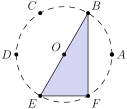
六个等间距点形成正六边形。只有角为 的三角形既不是等边也不是等腰三角形。
斜边是单位圆的直径,长为 。这个 -- 三角形的两条直角边为 和 。
面积为 。
所以正确答案是 B。
Six equally spaced points on the circle form a regular hexagon. A triangle using three of them is not equilateral or isosceles only when its angles are .
The hypotenuse is a diameter of the unit circle, so it has length . The legs of the -- triangle are and .
The area is .
Thus, the correct answer is B .
8.
Ray 的汽车平均每加仑汽油行驶 英里,Tom 的汽车平均每加仑汽油行驶 英里。Ray 和 Tom 各自行驶相同的英里数。两辆车合在一起的平均每加仑行驶英里数是多少?
Ray’s car averages miles per gallon of gasoline, and Tom’s car averages miles per gallon of gasoline. Ray and Tom each drive the same number of miles. What is the cars’ combined rate of miles per gallon of gasoline?
小提示:
让两辆车各自行驶一个方便的相同距离。
Let both cars drive a convenient common distance
大提示:
合并油耗率是总英里数除以总加仑数。
Combined miles per gallon is total miles divided by total gallons
解答:
令每辆车都行驶 英里,则总路程为 英里。
Ray 用 加仑,Tom 用 加仑,总共用 加仑。
合并油耗率为 英里每加仑。
所以正确答案是 B。
Let each car drive miles. Together they drive miles.
Ray uses gallon, while Tom uses gallons, so together they use gallons.
The combined rate is miles per gallon.
Thus, the correct answer is B .
9.
三个正整数都大于 ,乘积为 ,且两两互质。它们的和是多少?
Three positive integers are each greater than have a product of and are pairwise relatively prime. What is their sum?
小提示:
每个素数幂因子必须完整放入三个数中的某一个。
Put each prime-power factor wholly into one of the three numbers
大提示:
两两互质意味着同一个素数不能出现在两个不同的数中。
Pairwise relatively prime means no prime can appear in two different numbers
解答:
分解后可知质因数只有 、、。因为三个数两两互质,每个素数幂只能完整属于其中一个数。
又因为三个数都大于 ,所以每个数都必须含有其中一种质因数。
又因为 所以三个数必为 ,和为 。
所以正确答案是 D。
Only one number is a multiple of only one is a multiple of and only one is a multiple of
Since each positive integer is greater than each must be a multiple of one of these primes.
Now Therefore, the numbers must be and their sum is
Thus, the correct answer is D.
10.
一支篮球队两分球命中率为 ,三分球命中率为 ,共得到 分。他们两分球出手次数比三分球多 。他们出手了多少次三分球?
A basketball team’s players were successful on of their two-point shots and of their three-point shots, which resulted in points. They attempted more two-point shots than three-point shots. How many three-point shots did they attempt?
小提示:
设三分球出手次数为 。
Let be the number of three-point attempts
大提示:
用 表示两类投篮的总得分。
Translate made-shot percentages into total points in terms of
解答:
设三分球出手 次。
三分球命中 次,得分为 。
两分球出手 次,命中 次,得分为 。
因此总分满足 所以 。
所以正确答案是 C。
Let be the number of three-point attempts.
The number of made three-point shots is giving points.
The number of two-point attempts is so the number made is giving points.
Thus the total number of points satisfies so
Thus, the correct answer is C.
11.
实数 和 满足方程 求 的值。
Real numbers and satisfy the equation What is
小提示:
把所有项移到一边并配方。
Move all terms to one side and complete two squares
大提示:
两个平方数之和为零时,每个平方数都必须为零。
A sum of squares equals zero only when both squares are zero
解答:
方程可化为
配方得 两个平方项都非负,而它们的和为 ,所以两者都等于 ,即
因此 ,所以 。
所以正确答案是 B。
This can be rewritten as
Completing the square yields Since both squared terms are nonnegative and their sum is both must be . Thus
Therefore, so
Thus, the correct answer is B.
12.
设 为一个正五边形的边和对角线组成的集合。从 中不放回随机选取两个元素。选出的两条线段长度相同的概率是多少?
Let be the set of sides and diagonals of a regular pentagon. A pair of elements of are selected at random without replacement. What is the probability that the two chosen segments have the same length?
小提示:
正五边形有五条等长边和五条等长对角线。
A regular pentagon has five equal sides and five equal diagonals
大提示:
第一条线段选定后,剩下九条中有四条与它同长。
After one segment is chosen, count same-length choices among the remaining nine
解答:
正五边形有 条边,长度相同;还有 条对角线,长度也相同。
选出第一条后,剩下 条线段,其中恰有 条与第一条同长。
因此概率为 。
所以正确答案是 B。
A regular pentagon has sides of one length and diagonals of another length.
After the first segment is chosen, there are segments left, and exactly of them have the same length as the first chosen segment.
Therefore the probability is .
Thus, the correct answer is B .
13.
Jo 和 Blair 轮流报数,每次从 报到比对方上次报的最后一个数多一。Jo 先说“”,于是 Blair 接着说“、”。然后 Jo 说“、、”,依此类推。第 个被说出的数是多少?
Jo and Blair take turns counting from to one more than the last number said by the other person. Jo starts by saying “”, so Blair follows by saying “ ”. Jo then says “ ”, and so on. What number is spoken in position ?
小提示:
找出小于 的最大三角数。
Find the triangular number just before
大提示:
下一段报数又从 开始。
The next spoken list starts again at
解答:
报完以 结尾的这一轮时,说出的数的总个数为
报完以 结尾的这一轮后,恰好说了 个数。下一轮报的是 ,其中第八项就是总序列中的第 个数,所以这个数是 。
所以正确答案是 E。
Through the turn ending with , the total number of numbers spoken is
After the turn ending with , exactly numbers have been spoken. The next turn is the list , so its eighth entry is the rd number spoken. That entry is .
Thus, the correct answer is E .
14.
定义 。下列哪一项描述了满足 的点 的集合?
Define Which of the following describes the set of points for which
有限个点
A finite set of points
一条直线
One line
两条平行直线
Two parallel lines
两条相交直线
Two intersecting lines
三条直线
Three lines
小提示:
展开自定义运算两边。
Expand both custom-operation expressions
大提示:
把得到的方程因式分解成直线因子。
Factor the resulting equation into line factors
解答:
条件 展开为 。
合并同类项并因式分解得 。
因此 、 或 ,这是三条直线。
所以正确答案是 E。
The condition is , so .
Combining like terms gives .
Thus , , or . These are three lines.
Thus, the correct answer is E .
15.
一根铁丝被剪成两段,长度分别为 和 。长度为 的一段弯成等边三角形,长度为 的一段弯成正六边形。三角形和六边形面积相等。 是多少?
A wire is cut into two pieces, one of length and the other of length The piece of length is bent to form an equilateral triangle, and the piece of length is bent to form a regular hexagon. The triangle and the hexagon have equal area. What is
小提示:
把正六边形看成六个小等边三角形。
Compare the side length of the large equilateral triangle with the small equilateral triangles inside the hexagon
大提示:
面积按边长的平方缩放。
Areas scale as the square of side length
解答:
设等边三角形的边长为 ,面积为 。则 。
边长为 的正六边形由 个边长为 的等边三角形组成,面积为 。
若正六边形面积也为 ,它的边长应为 ,所以
因此
所以正确答案是 B。
Let be the side length of the equilateral triangle and its area. Then
A regular hexagon of side length consists of equilateral triangles of side length so its area is
Therefore, a regular hexagon of area has side length Hence
It follows that
Thus, the correct answer is B.
16.
在 中,中线 和 交于 ,且 、、。四边形 的面积是多少?
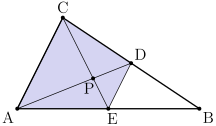
In triangle medians and intersect at and What is the area of
小提示:
在两条中线上使用重心的二比一比例。
Use the centroid ratio on both medians
大提示:
构成直角三角形。
The triangle is right
解答:
因为 ,所以三角形 在 处为直角,即两条中线 和 互相垂直。
重心把每条中线按 分割,所以 ,。
四边形 的对角线 与 垂直,面积为 。
所以正确答案是 B。
Since , triangle is right at . Thus medians and are perpendicular.
The centroid divides each median in a ratio, so and .
Quadrilateral has perpendicular diagonals and , so its area is .
Thus, the correct answer is B .
17.
Alex 有 个红色代币和 个蓝色代币。有一个摊位可以用两个红色代币换一个银色代币和一个蓝色代币;另一个摊位可以用三个蓝色代币换一个银色代币和一个红色代币。Alex 一直交换,直到不能再交换为止。最后 Alex 有多少个银色代币?
Alex has red tokens and blue tokens. There is a booth where Alex can give two red tokens and receive in return a silver token and a blue token, and another booth where Alex can give three blue tokens and receive in return a silver token and a red token. Alex continues to exchange tokens until no more exchanges are possible. How many silver tokens will Alex have at the end?
小提示:
设两类交换次数分别为 和 。
Let and be the numbers of the two exchange types
大提示:
不能再交换意味着红色少于 个且蓝色少于 个。
No more moves means fewer than red and fewer than blue tokens
解答:
设红色摊位交换 次,蓝色摊位交换 次。
最后红色和蓝色代币数分别为 和 。结束时必须红色少于 个、蓝色少于 个。
求解这些终止情况,只得到两组候选终态:,对应 ;或 ,对应 。
终态 不可能,因为最后一次交换一定会产生一个蓝色或一个红色代币。
终态 可以达到。从红、蓝代币数 开始,先在蓝色摊位交换 次,再在红色摊位交换 次,接着依次在蓝色摊位交换 次、红色摊位交换 次、蓝色摊位交换 次,最后在红色摊位交换 次。每个阶段的红、蓝代币数依次为
因此 Alex 最后有 个银色代币,正确答案是 E。
Suppose Alex makes exchanges at the red-token booth and exchanges at the blue-token booth.
He then has red tokens and blue tokens. At the end he must have fewer than red tokens and fewer than blue tokens.
Solving these terminal possibilities gives only two candidate final token counts: , which comes from , or , which comes from .
The final count is impossible, because the last exchange would always create either one blue token or one red token.
The final count is attainable. Starting from red and blue tokens, make blue-booth exchanges, then red-booth exchanges, then blue-booth exchanges, then red-booth exchanges, then blue-booth exchanges, and finally red-booth exchange. The red-blue counts become
Therefore Alex ends with silver tokens, and the correct answer is E .
18.
数 有这样的性质:它的个位数字等于其他数字之和,即 。大于 且小于 的整数中,有多少个具有这个性质?
The number has the property that its units digit is the sum of its other digits, that is How many integers less than but greater than have this property?
小提示:
按个位数字统计 到 的数。
Count numbers from to by their units digit
大提示:
再单独处理 到 的小范围。
Handle the small range from to separately
解答:
给定前三位数字时,如果它们的和不超过 ,就能确定一个满足条件的数。
按千位数字分类讨论。
如果千位是 ,那么百位和十位数字之和必须不超过 。设其和为 ,则有 种取法,因为百位数字可以从 到 。
因此这一情形给出第九个三角数:
如果千位是 ,那么小于 的数中只有 满足条件,所以总数为 。
所以正确答案是 D。
Once the first three digits are given, their sum determines the units digit, provided that the sum is at most
We separate the possibilities according to the thousands digit.
If the thousands digit is then the sum of the hundreds and tens digits must be at most For each possible sum there are choices, because the hundreds digit can range from to
Thus, this case gives the ninth triangular number:
If the thousands digit is the only qualifying number below is giving cases in total.
Thus, the correct answer is D.
19.
实数 ,, 构成等差数列,且 。二次式 恰好有一个根。这个根是什么?
The real numbers form an arithmetic sequence with The quadratic has exactly one root. What is this root?
小提示:
把等差数列写成 。
Write the arithmetic sequence as
大提示:
使用判别式为零的条件。
Use the zero discriminant condition
解答:
设公差为 ,则 、。
二次式恰好有一个实根,所以判别式为 ,即 。代入得 ,因此 。
由于 ,由上式得 。重根为 。
所以正确答案是 D。
Let the common difference be , so and .
A quadratic with exactly one real root has discriminant , so . Substituting gives , hence .
Since , . The double root is .
Thus, the correct answer is D .
20.
数 被表示为 其中 且 都是正整数,并且 尽可能小。求 。
The number is expressed in the form where and are positive integers and is as small as possible. What is
小提示:
分子必须含有因子 。
The numerator must include a factor of
大提示:
小于 的不需要素数,尤其是 ,必须由分母抵消。
Any unwanted prime below , especially , must be canceled from the denominator
解答:
,所以分子必须含因子 ,从而 。
但 还含有素因子 ,而 中没有这个因子,所以分母必须含因子 ,从而 。
因此 。这个下界可以达到:。
所以 ,正确答案是 B。
The prime factorization is , so the numerator must contain a factor of . Hence .
But also contains the prime factor , which is not in , so the denominator must contain a factor of . Hence .
The lower bound is attainable because .
Thus , and the correct answer is B .
21.
两个非递减的非负整数数列首项不同。每个数列都满足从第三项开始,每一项等于前两项之和,并且两个数列的第七项都等于 。 的最小可能值是多少?
Two non-decreasing sequences of nonnegative integers have different first terms. Each sequence has the property that each term beginning with the third is the sum of the previous two terms, and the seventh term of each sequence is What is the smallest possible value of ?
小提示:
用前两项表示第七项。
Write the seventh term in terms of the first two terms
大提示:
利用被 和 的整除关系,迫使最小的不同首项。
Use divisibility by and to force the smallest distinct starts
解答:
若数列前两项为 ,则第七项为 。
设两个数列前两项分别为 和 ,且 。因为两者第七项相同,,所以 。
由于 与 互质, 至少为 。非递减要求 。
取 、、 可达到最小值,得到 。
所以正确答案是 C。
A sequence starting with has seventh term .
For two sequences and with different first terms, assume . Then , so .
Since and are relatively prime, is at least , and then nondecreasing order gives .
The smallest construction is , , and . This gives .
Thus, the correct answer is C .
22.
正八边形 的中心为 。要把数字 到 分别填在八个顶点和中心上,每个数字用一次,使得直线 、、、 上三个数的和都相等。有多少种填法?
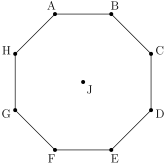
The regular octagon has its center at Each of the vertices and the center are to be associated with one of the digits through with each digit used once, in such a way that the sums of the numbers on the lines and are all equal. In how many ways can this be done?
小提示:
中心数字会出现在四条线的和中。
The center digit contributes to all four line sums
大提示:
选定中心后,把剩下的数字配成和相等的相对点对。
After choosing the center, pair the remaining digits into equal-sum opposite pairs
解答:
设每条线的公共和为 。
四条线的和相加后可知中心数字只能为 。先看 的情况。
当 时,满足条件的数对为 四对可分配给四条直线,有 种,每对内部可交换,有 种,其中 表示同一对的两种顺序。
对 和 也同理,因此总数为 种。
所以正确答案是 C。
Let be defined as:
This means that From here, let’s assume We will see that the other cases are similar enough to omit.
If then we know that the pairs of numbers that satisfy the equality above are: There are ways to distribute the pairs over the four groups, and then ways for these groups to swap elements (i.e. ).
Now, if we look at the and cases, we see a similar pattern in the number of groupings and swaps. As such, we have: possibilities.
Thus, the correct answer is C .
23.
在 中,、、。不同的点 、、 分别在 、、 上,且 、、。线段 的长度可写成 ,其中 和 为互质正整数。求 ?
In triangle and Distinct points and lie on segments and respectively, such that and The length of segment can be written as where and are relatively prime positive integers. What is
小提示:
用 -- 三角形的面积信息求高的垂足。
Use the -- area data to find the altitude foot
大提示:
用圆内接四边形或相似三角形确定 在 上的位置。
Use the cyclic quadrilateral or similar triangles to locate on
解答:
设 ,则 。分别对直角三角形 和 应用勾股定理,得到 因此 ,,且 。
得到下图:
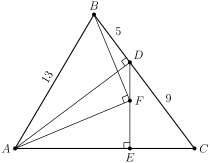
因为 且 ,所以 。又有 ,故 四点共圆。因此 在直角三角形 中,,且 。所以在直角三角形 中,
由托勒密定理,因此,
两边除以 ,得 ,所以 。于是 ,正确答案是 B。
Let , so . Applying the Pythagorean Theorem to right triangles and gives Thus , , and .
This yields the following diagram:
Because and , we have . Also, , so are concyclic. Hence In right triangle , and . Therefore, in right triangle ,
By Ptolemy’s Theorem, we get Therefore,
Dividing by gives , so . Thus , and the correct answer is B .
24.
若存在一个正整数 ,它恰好有四个正因数(包括 和 ),且这四个因数之和等于正整数 ,则称 为“好数”。集合 中有多少个好数?
A positive integer is “nice” if there is a positive integer with exactly four positive divisors (including and ) such that the sum of the four divisors is equal to How many numbers in the set are nice?
小提示:
恰好有四个因数的数形如 或 。
Four-divisor numbers are either or
大提示:
对 的情况,把因数和写成 。
Convert the divisor sum for into
解答:
恰好有四个正因数的数是 或 ,其中 和 是不同素数。
若 ,因数和为 。 与 的对应值分别低于 和高于 ,所以这种情况没有解。
若 ,因数和为 。若其中一个素数为 ,和可被 整除;候选只有 和 ,但 、 都不是质数。
若两个素数都是奇数,和可被 整除,候选为 和 。 会给出 和 ,不可行;而 可行。
所以恰有一个好数,正确答案是 A。
An integer with exactly four positive divisors is either or , where and are distinct primes.
If , the divisor sum is . The values for and fall below and above the interval to , so this case gives none.
In the case, the divisor sum is . If one prime is , the sum is divisible by ; only and qualify, but and are not prime.
If both primes are odd, then the sum is divisible by , leaving and . The factorization would give primes and , impossible, while works.
Thus exactly one number is nice, and the correct answer is A .
25.
Bernardo 选择一个三位正整数 ,并把它的以 为底和以 为底的表示都写在黑板上。后来 LeRoy 看到这两个数,把它们当作以 为底的整数相加,得到整数 。
例如,若 ,Bernardo 写下 , 和 ,,LeRoy 得到 ,。有多少个 的选择,使得 的最右两位数字按顺序与 的最右两位数字相同?
Bernardo chooses a three-digit positive integer and writes both its base- and base- representations on a blackboard. Later LeRoy sees the two numbers Bernardo has written. Treating the two numbers as base- integers, he adds them to obtain an integer
For example, if Bernardo writes the numbers and and LeRoy obtains the sum For how many choices of are the two rightmost digits of in order, the same as those of
小提示:
用同余跟踪以 为底和以 为底的表示的最后两位。
Track the last two base- and base- digits with congruences
大提示:
分别在模 、模 、模 下工作。
Work modulo , , and
解答:
只需在模 下分析,因为 进制、 进制和以十为底表示时的末两位都以此为周期。
设 进制末两位为 , 进制末两位为 。个位条件给出 ,所以 。
写作 。 进制十位条件给出 ,所以 。
比较 和 的十位条件,化简得 。在 、 下,可行对为 。
又 有 种选择,所以共有 个 。
所以正确答案是 E。
It is enough to work modulo , because the last two base-, base-, and decimal digits repeat with that period.
Let the last two base- digits be and the last two base- digits be . The units digit condition gives , so .
Writing , the base- tens digit condition gives , so .
The tens digit condition for and reduces to . With and , the valid pairs are .
There are choices for , so there are choices of .
Thus, the correct answer is E .