
2020 AMC 10A 真题
计时
1:15:00
1.
哪个 的值满足下式?
What value of satisfies
2.
数 ,,, 和 的平均数为 。 和 的平均数是多少?
The numbers and have an average (arithmetic mean) of What is the average of and
答案:C
小提示:
把五个数的平均数转化为总和。
Convert the average of five numbers into a total sum
大提示:
先减去已知的三个数,再求 和 的平均数。
Subtract the known three numbers before averaging and
视频讲解:

Click to load, then click again to play
文字解答:
五个数的总和为 。又 ,所以 。因此 和 的平均数为 。正确答案是 C。
The five numbers have total sum . Since , we have , so the average of and is . Thus, C is the correct answer.
3.
假设 、、,下列表达式的最简值是多少?
Assuming and what is the value in simplest form of the following expression?
小提示:
每个分母都是对应分子因子的相反数。
Each denominator is the negative of a matching numerator factor
大提示:
约分后数一数负号的个数。
Count the number of negative signs after cancellation
视频讲解:
Click to load, then click again to play
文字解答:
将分母各因式改写为 、 和 。原式化为 。正确答案是 A。
Rewrite the denominator factors as , , and . The expression becomes . Thus, A is the correct answer.
4.
一名司机开车 小时,速度为每小时 英里,在此期间汽车每加仑汽油可行驶 英里。她每行驶一英里获得 报酬,唯一开销是每加仑价格为 的汽油。扣除汽油费用后,她每小时的净报酬是多少美元?
A driver travels for hours at miles per hour, during which her car gets miles per gallon of gasoline. She is paid per mile, and her only expense is gasoline at per gallon. What is her net rate of pay, in dollars per hour, after this expense?
小提示:
先求两小时内总共行驶了多少英里。
Find the total miles driven in two hours
大提示:
先扣除汽油成本,再除以小时数。
Subtract gasoline cost before dividing by the number of hours
视频讲解:
Click to load, then click again to play
文字解答:
她行驶 英里,所以收入为 。这次行程用汽油 加仑,花费 。净收入为 美元,用时 小时,所以每小时净报酬为 美元。正确答案是 E。
The driver travels miles, so she is paid . The trip uses gallons of gasoline, costing . Her net pay is dollars over hours, or dollars per hour. Thus, E is the correct answer.
5.
所有满足下式的实数 之和是多少?
What is the sum of all real numbers for which
小提示:
把绝对值方程分成两个二次方程。
Split the absolute-value equation into two quadratic equations
大提示:
对所有实数解求和时,重根只计算一次。
Remember to count the double root only once in the sum of real numbers
视频讲解:
Click to load, then click again to play
文字解答:
方程等价于 或 。第一式化为 ,根为 、;第二式化为 ,根为 。所有实数解的和为 。正确答案是 C。
The equation means or . The first gives , with roots and . The second gives , with root . The sum of all real solutions is . Thus, C is the correct answer.
6.
有多少个 位正整数,也就是 到 之间的整数,只含偶数数字且能被 整除?
How many -digit positive integers (that is, integers between and inclusive) having only even digits are divisible by
小提示:
末位必须同时满足偶数数字和被 整除。
The last digit must be compatible with both evenness and divisibility by
大提示:
固定末位后,独立选择千位、百位、十位。
Choose the thousands, hundreds, and tens digits independently after fixing the last digit
视频讲解:
Click to load, then click again to play
文字解答:
末位只能是 ,因为这个数能被 整除,而且所有数字都是偶数。千位可为 或 ,共有四种;百位和十位各有 种选择。因此共有 个这样的整数。正确答案是 B。
The last digit must be , because the number is divisible by and all digits are even. The thousands digit can be or , and each of the hundreds and tens digits has choices. Thus there are such integers. Thus, B is the correct answer.
7.
个从 到 的整数可以排列成一个 乘 的方阵,使每一行、每一列以及两条主对角线上的数之和都相同。这个公共和是多少?
The integers from to inclusive, can be arranged to form a -by- square in which the sum of the numbers in each row, the sum of the numbers in each column, and the sum of the numbers along each of the main diagonals are all the same. What is the value of this common sum?
小提示:
五个行和加起来等于所有 个整数的总和。
The five row sums together equal the sum of all integers
大提示:
计算从 到 的等差数列和。
Compute the arithmetic-sequence sum from through
视频讲解:
Click to load, then click again to play
文字解答:
从 到 的整数总和为 。若每行公共和为 ,则五行总和为 ,所以 ,从而 。正确答案是 C。
The sum of the integers from to is . If every row has common sum , then the five row sums add to , so and . Thus, C is the correct answer.
8.
求下列表达式的值:
What is the value of
小提示:
把表达式按每四项一组分组。
Group the expression into blocks of four terms
大提示:
求第 组的公式,再对 组求和。
Find a formula for the th block and sum over blocks
视频讲解:
Click to load, then click again to play
文字解答:
按四项一组: 。第 组的和为 。
共有 组,所以和为 。正确答案是 B。
Group the terms in blocks of four: . The th block is .
There are blocks, so the sum is . Thus, B is the correct answer.
9.
学校活动中,一个长凳单元可以坐 名成人或 名儿童。当 个长凳单元首尾相连时,相同人数的成人和儿童一起就坐,刚好占满所有长凳空间。 的最小正整数值是多少?
A single bench section at a school event can hold either adults or children. When bench sections are connected end to end, an equal number of adults and children seated together will occupy all the bench space. What is the least possible positive integer value of
小提示:
设成人和儿童的相同人数为 。
Let the equal number of adults and children be
大提示:
长凳单元数为 。
The number of bench sections is
视频讲解:
Click to load, then click again to play
文字解答:
设成人和儿童各有 人。成人需要 个长凳单元,儿童需要 个长凳单元,因此 。
使其为整数的最小值是 ,此时 。正确答案是 B。
If the equal number of adults and children is , then the adults use bench sections and the children use bench sections. Thus .
The least positive integer occurs when , giving . Thus, B is the correct answer.
10.
七个立方体的体积分别为 、、、、、 和 立方单位。它们竖直堆成一座塔,体积从底部到顶部递减。除最底部的立方体外,每个立方体的底面都完全位于其下方立方体的顶面上。求这座塔的总表面积,包括底面。
Seven cubes, whose volumes are and cubic units, are stacked vertically to form a tower in which the volumes of the cubes decrease from bottom to top. Except for the bottom cube, the bottom face of each cube lies completely on top of the cube below it. What is the total surface area of the tower (including the bottom) in square units?
小提示:
先求七个单独立方体的表面积总和。
Start with the surface areas of all seven separate cubes
大提示:
每个接触面会隐藏两块面积等于较小立方体底面的正方形面。
Each contact hides two faces with the side length of the smaller cube
视频讲解:
Click to load, then click again to play
文字解答:
这些立方体边长为 ,从大到小堆叠。单独表面积之和为 。
每个接触处隐藏两个正方形面,面积分别为 。所以总表面积为 。正确答案是 B。
The cube side lengths are , stacked from largest on bottom to smallest on top. The sum of the surface areas of the separate cubes is .
Each contact hides two square faces, with areas . Subtracting these hidden faces gives . Thus, B is the correct answer.
11.
下列 个数的列表的中位数是多少?
What is the median of the following list of numbers?
小提示:
在中位数附近,分别统计普通整数和平方数。
Near the median, count ordinary integers and square numbers separately
大提示:
使用 。
Use
视频讲解:
Click to load, then click again to play
文字解答:
对中位数附近的一个数,排好序的列表中不超过它的项包括所有不超过它的普通整数和所有不超过它的平方数。因为 且 ,所以从 到 之间的任一数,都恰有 个平方数不超过它。
在 处,不超过它的项有 个,其中普通整数截至 。在 处,不超过该数的项有 个,其中普通整数截至 ,所以第 项为 ,下一项为 。中位数为 。正确答案是 C。
For a number near the median, the sorted list includes all ordinary integers up to that number and all squares up to that number. Since and , there are squares not exceeding any number from through .
At , there are list entries at most . At , there are entries at most , so the th entry is , and the next is . The median is . Thus, C is the correct answer.
12.
三角形 是等腰三角形,且 。中线 和 互相垂直,并且 。求 的面积。
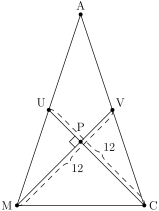
Triangle is isosceles with Medians and are perpendicular to each other, and What is the area of
小提示:
把重心放在原点,并让两条垂直中线沿坐标轴方向。
Put the centroid at the origin and align the perpendicular medians with the axes
大提示:
重心把每条中线按 分割。
The centroid divides each median in a ratio
视频讲解:
Click to load, then click again to play
文字解答:
设重心为原点。重心把中线按 分割,所以可令中线 水平,取 、;中线 竖直,取 、。
因为 是 的中点,所以 。 的面积为 。正确答案是 C。
Let the centroid be the origin. Since a centroid divides each median in a ratio, we may place median horizontally with and , and median vertically with and .
Because is the midpoint of , we get . The area of is . Thus, C is the correct answer.
13.
一只青蛙坐在点 ,开始连续跳跃。每次跳跃都平行于某条坐标轴,长度为 ,方向为上、下、右、左之一,且每次独立随机选择。当青蛙到达以 、、 和 为顶点的正方形的一条边时,跳跃序列结束。跳跃序列在正方形的竖直边上结束的概率是多少?
A frog sitting at the point begins a sequence of jumps, where each jump is parallel to one of the coordinate axes and has length and the direction of each jump (up, down, right, or left) is chosen independently at random. The sequence ends when the frog reaches a side of the square with vertices and What is the probability that the sequence of jumps ends on a vertical side of the square?
小提示:
让每个内部格点表示先碰到竖直边的概率。
Let each interior lattice point store the probability of hitting a vertical side first
大提示:
用对称性把随机游走方程减少到四个未知数。
Use symmetry to reduce the random-walk equations to four unknowns
视频讲解:
Click to load, then click again to play
文字解答:
设 为从 出发最终先碰到竖直边的概率。由对称性,令 、、,并令 。
每一步取四个相邻点概率的平均,得到 、、,以及 。解得 。起点为 ,所以这就是所求概率。正确答案是 B。
Let be the probability of eventually hitting a vertical side first from point . By symmetry, set , , , and .
The averaging equations are , , , and . Solving gives , which is the desired probability from . Thus, B is the correct answer.
14.
实数 和 满足 且 。求下列表达式的值:
Real numbers and satisfy and What is the value of
小提示:
使用幂和 。
Use power sums
大提示:
关系式 给出 的递推。
The relation gives a recurrence for
视频讲解:
Click to load, then click again to play
文字解答:
设 。因为 且 ,数 和 是方程 的两根,所以 。
由 与 出发,得到 、、,以及 。原式为 。正确答案是 D。
Let . Since and , the numbers and satisfy , so .
Using and , we get , , , and . The expression is . Thus, D is the correct answer.
15.
从 的正整数因数中随机选一个。所选因数为完全平方数的概率可写为 ,其中 、 为互质正整数。求 。
A positive integer divisor of is chosen at random. The probability that the divisor chosen is a perfect square can be expressed as where and are relatively prime positive integers. What is
小提示:
把 分解成质因数。
Factor into primes
大提示:
平方因数只能选择偶数质数指数。
A square divisor must choose only even prime exponents
视频讲解:
Click to load, then click again to play
文字解答:
的质因数分解为 。因此 的正因数总数为 。
平方因数的所有质数指数必须为偶数,因此共有 个。所求概率为 ,所以 。正确答案是 E。
The prime factorization of is . Therefore has positive divisors.
A square divisor must use only even exponents, giving square divisors. The probability is , so . Thus, E is the correct answer.
16.
在坐标平面中,从顶点为 、、 和 的正方形内部随机选一点。该点距离某个格点不超过 个单位的概率为 。其中格点指坐标 中 和 均为整数的点。求 四舍五入到最接近的十分位是多少?
A point is chosen at random within the square in the coordinate plane whose vertices are and The probability that the point is within units of a lattice point is (A point is a lattice point if and are both integers.) What is to the nearest tenth?
小提示:
只看一个单位格子。
Look at one unit square of the lattice
大提示:
单位格子四个角的四个四分之一圆面积总和为 。
The four quarter-circles around its corners have total area
视频讲解:
Click to load, then click again to play
文字解答:
对于 ,每个单位正方形中,距离某个格点不超过 的部分由四个四分之一圆组成,总面积为 。大正方形由单位正方形铺成,所以所求概率为 。
令 ,得 ,四舍五入到十分位为 。正确答案是 B。
For , the points within of lattice points occupy, in each unit square, four quarter-circles whose total area is . The enormous square is tiled by unit squares, so the desired probability is .
Setting gives , which rounds to . Thus, B is the correct answer.
17.
定义 有多少个整数 满足 ?
Define How many integers are there such that
小提示:
在根 之间画符号表。
Make a sign chart across the square roots
大提示:
每隔一个区间计数,并包含端点。
Count integer points in every other interval, including endpoints
视频讲解:
Click to load, then click again to play
文字解答:
多项式在每个平方数 处变号,且首项系数为正。因此满足 的整数落在区间 、、、 中。
对奇数 ,区间 中的整数个数为 。对 求和,得到 。正确答案是 E。
The polynomial changes sign at each square , and its leading coefficient is positive. Thus for integers in the intervals , , , .
For odd , the interval contains integers. Summing over odd gives . Thus, E is the correct answer.
18.
设 为一个有序四元组,其中每个数都是集合 中的整数,且不要求互不相同。有多少个这样的四元组满足 为奇数?例如, 是一个这样的四元组,因为 为奇数。
Let be an ordered quadruple of not necessarily distinct integers, each one of them in the set For how many such quadruples is it true that is odd? (For example, is one such quadruple, because is odd.)
小提示:
只有 的奇偶性重要。
Only the parities of matter
大提示:
数一数二元域上的可逆 矩阵。
Count invertible matrices over the two-element field
视频讲解:
Click to load, then click again to play
文字解答:
只需考虑模 的奇偶性。条件是 为 ,也就是说矩阵 在 上可逆。
可逆矩阵共有 个 矩阵,它们都定义在 上。每一种奇偶模式可提升为 个取自 的四元组。因此共有 个四元组。正确答案是 C。
Only parity matters. Modulo , the condition is that is , meaning the matrix is invertible over .
There are invertible matrices over . Each parity pattern lifts to choices from , so there are quadruples. Thus, C is the correct answer.
19.
如下图所示,一个正十二面体,也就是由 个全等正五边形面组成的多面体,漂浮在空间中,并有两个水平面。注意,顶面相邻有一圈五个倾斜面,底面相邻也有一圈五个倾斜面。从顶面出发,经由一系列相邻面移动到底面,且每个面至多访问一次,并且不允许从底部环移动到顶部环。这样的走法有多少种?
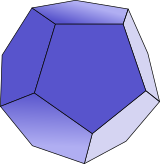
As shown in the figure below, a regular dodecahedron (the polyhedron consisting of congruent regular pentagonal faces) floats in space with two horizontal faces. Note that there is a ring of five slanted faces adjacent to the top face, and a ring of five slanted faces adjacent to the bottom face. How many ways are there to move from the top face to the bottom face via a sequence of adjacent faces so that each face is visited at most once and moves are not permitted from the bottom ring to the top ring?
小提示:
因为禁止向上移动,把每条路径分成顶部环阶段和底部环阶段。
Because upward moves are forbidden, split every path into a top-ring phase and a bottom-ring phase
大提示:
在一个五环上,不自交行走的停止路径有 种。
On a five-cycle, a self-avoiding walk has possible stopping paths
视频讲解:
Click to load, then click again to play
文字解答:
离开顶面后,先选择 个顶部环面之一。由于不允许从底部环回到顶部环,每条有效路径都由顶部环阶段、一次向下移动、底部环阶段组成。
固定第一个顶部环面。在顶部 环上,可以不重复地沿环走若干步后停止;选择不动有一种,选择一个方向后可走一到四步,所以共有 种顶部环路径。停止处有 种向下移动选择,因此顶部部分有 种。
到达底部环后,同理有 种方式在底部 环上不重复移动并进入底面。总数为 。正确答案是 E。
After leaving the top face, choose one of the top-ring faces. Because moves from the bottom ring to the top ring are forbidden, every valid path has a top-ring phase, then one move down to the bottom ring, then a bottom-ring phase.
Fix the first top-ring face. On the top ring, the path can move around the -cycle without revisiting a face and then stop at any point: there are possible top-ring paths. From the stopping face, there are possible downward moves to the bottom ring, so the top part has choices.
Once in the bottom ring, the path can move around the bottom -cycle without revisiting a face and then enter the bottom face; this gives choices. The total is . Thus, E is the correct answer.
20.
四边形 满足 、、。对角线 和 交于点 ,且 。求四边形 的面积。
Quadrilateral satisfies and Diagonals and intersect at point and What is the area of quadrilateral
小提示:
把 放在 轴上,并使用已知点 。
Put on the -axis and use the known point
大提示:
点 既在直线 上,也在以 为直径的圆上。
Point lies both on line and on the circle with diameter
视频讲解:
Click to load, then click again to play
文字解答:
取 ,。因为 且 ,可取 。点 的坐标是 ,所以直线 的方程为 。
因为 ,点 在以 为直径的圆上:。与 联立,得 或 。凸四边形对应 。
于是 ,且 。总面积为 。正确答案是 D。
Place and . Since and , take . The point is , so line has equation .
Because , point lies on the circle with diameter : . Intersecting with gives or . The convex quadrilateral uses .
Then , and . The total area is . Thus, D is the correct answer.
21.
存在唯一严格递增的非负整数序列 ,使得 求 。
There exists a unique strictly increasing sequence of nonnegative integers such that What is
小提示:
令 ,再计算 除以 的商。
Set and divide by
大提示:
把正负幂成对组合,得到二进制表示中连续的全一数位区块。
Pair positive and negative powers to create blocks of binary ones
视频讲解:
Click to load, then click again to play
文字解答:
令 。则
把相邻项配成 、、、,最后剩下 。每一对都形如 ,在二进制表示中贡献 个一。共有 对,再加最后的 ,所以 。正确答案是 C。
Let . Then .
Pair consecutive terms: , , , , and then the final . Each pair is , contributing ones in binary. There are such pairs plus the final , so . Thus, C is the correct answer.
22.
有多少个正整数 ,使得 不能被 整除?这里 表示不超过 的最大整数。
For how many positive integers isnot divisible by (Recall that is the greatest integer less than or equal to )
小提示:
令 。
Let
大提示:
只有当减去 或 跨过 的倍数时,三个取整值之和才不是 的倍数。
The sum of floors fails to be a multiple of only when subtracting or crosses a multiple of
视频讲解:
Click to load, then click again to play
文字解答:
写作 ,其中 。则 。另外两个取整值通常也是 ,只有当减去 或 后,从 跨过了 的倍数时,也就是 较小时,才会减少。
对 ,三个取整值之和不能被 整除当且仅当 或 。 对应 的因数,除去 后有 个。 对应 的因数且不为 ,这样的因数有 个。总数为 。正确答案是 A。
Write , where . Then . The other two floors are usually also , except that subtracting or from crosses a multiple of when is small.
For , the sum is not divisible by exactly when or . The case gives divisors of , excluding , for values. The case gives divisors of , excluding , for values. The total is . Thus, A is the correct answer.
23.
设 为坐标平面中顶点为 , 和 的三角形。考虑平面上的下列五个等距变换:绕原点逆时针旋转 , 和 ,关于 轴反射,关于 轴反射。在这五个变换中选取三个组成序列,允许重复,共 个序列,其中有多少个会把 变回原来的位置?例如,先旋转 ,再关于 轴反射,再关于 轴反射,会把 变回原位;但先旋转 ,再关于 轴反射,再关于 轴反射,则不会把 变回原位。
Let be the triangle in the coordinate plane with vertices and Consider the following five isometries (rigid transformations) of the plane: rotations of and counterclockwise around the origin, reflection across the -axis, and reflection across the -axis. How many of the sequences of three of these transformations (not necessarily distinct) will return to its original position? (For example, a rotation, followed by a reflection across the -axis, followed by a reflection across the -axis will return to its original position, but a rotation, followed by a reflection across the -axis, followed by another reflection across the -axis will not return to its original position.)
小提示:
把 旋转记为 ,两个反射记为 。
Name the rotation and the two reflections
大提示:
前两个变换确定后,第三个必须是它们乘积的逆变换。
Once the first two transformations are fixed, the third must be the inverse of their product
视频讲解:
Click to load, then click again to play
文字解答:
令 表示 旋转,允许的旋转为 。令 和 分别表示关于两个坐标轴的反射。前两个变换确定后,第三个变换必须是它们乘积的逆,才能使总效果为恒等变换。
在两个旋转的组合中,有 个有序对的乘积是非恒等旋转。一个旋转与一个反射的乘积是允许的坐标轴反射,当且仅当该旋转为 ,这给出 个有序对。最后,两个不同的坐标轴反射可以按任一顺序出现,又给出 个有序对。总共有 个有效序列。正确答案是 A。
Let be a rotation, so the allowed rotations are . Let and be the reflections across the coordinate axes. Once the first two transformations are chosen, the third is forced to be the inverse of their product.
Among two rotations, ordered pairs have a nonidentity rotation as their product. A rotation and a reflection have an allowed axis-reflection as their product exactly when the rotation is , giving ordered pairs. Finally, the two different axis-reflections can occur in either order, giving more pairs. Altogether there are valid sequences. Thus, A is the correct answer.
24.
设 为大于 的最小正整数,满足 的各位数字之和是多少?
Let be the least positive integer greater than for which What is the sum of the digits of
小提示:
把每个最大公因数条件转化为一个同余条件加一个排除条件。
Translate each gcd condition into a congruence plus an exclusion
大提示:
先解两个同余,再测试大于 的候选值。
Solve the two congruences first, then test candidates above
视频讲解:
Click to load, then click again to play
文字解答:
第一条给出 ,即 ,但 不能被 整除。第二条给出 ,即 ,但 不能被 整除。
联立 和 ,得 。大于 的候选为 。第一个不满足第一条最大公因数条件,第二个不满足第二条, 满足。数字和为 。正确答案是 C。
The first gcd condition gives , so , but must not be divisible by . The second gives , so , but must not be divisible by .
Solving and gives . The candidates above are . The first fails the first gcd condition, the second fails the second gcd condition, and works. The digit sum is . Thus, C is the correct answer.
25.
Jason 掷三枚公平的标准六面骰。然后他查看结果,并选择其中一个骰子子集重新掷,子集可以为空,也可以是全部三枚。重新掷后,他获胜的条件是三枚骰子朝上的点数之和恰好为 。Jason 总是采用使获胜概率最大的策略。他选择恰好重新掷两枚骰子的概率是多少?
Jason rolls three fair standard six-sided dice. Then he looks at the rolls and chooses a subset of the dice (possibly empty, possibly all three dice) to reroll. After rerolling, he wins if and only if the sum of the numbers face up on the three dice is exactly Jason always plays to optimize his chances of winning. What is the probability that he chooses to reroll exactly two of the dice?
小提示:
比较重新掷 或 枚骰子时的最佳获胜概率。
Compare the best chance from rerolling or dice
大提示:
恰好重新掷两枚最优,只会发生在某些排序后的初始结果中,此时两个较小点数之和较大。
Rerolling two dice is optimal only for certain sorted initial rolls with large two-smallest sum
视频讲解:
Click to load, then click again to play
文字解答:
对任意初始结果,Jason 比较重新掷 或 枚骰子的最佳概率。重新掷三枚的概率为 。若保留两枚、重新掷一枚,获胜概率可达 ,条件是某对保留骰子点数之和不超过 。
若恰好重新掷两枚,则只保留一枚。保留点数 时,获胜结果数分别为 ,总结果数为 。这种选择只有在两个最小点数之和至少为 ,且最小点数为 或 时才可能最优。
满足条件的有序结果排序后为 、,以及 、、、、、。按排列数计数,共有 个结果,总结果数为 ,所以概率为 。正确答案是 A。
For any initial roll, Jason compares the best probabilities from rerolling or dice. Rerolling all three dice has probability . Rerolling one die has probability whenever some pair of kept dice has sum at most .
If he rerolls exactly two dice, he keeps one die. Keeping a die showing gives probabilities out of , respectively. This can be optimal only when the two smallest dice sum at least and the smallest die is or .
The sorted rolls satisfying this are , , and . Counting permutations gives rolls out of , so the probability is . Thus, A is the correct answer.