
Problemas del 2007 AMC 8
¡Desplázate hacia abajo y presiona Iniciar para intentar el examen! O ve al PDF imprimible, la clave de respuestas, o las soluciones profesionales preparadas por LIVE by Po-Shen Loh.
Todos los problemas se usan con el permiso legal oficial de la Mathematical Association of America (MAA).
O salta directamente a un solo problema con su solución: 1 · 2 · 3 · 4 · 5 · 6 · 7 · 8 · 9 · 10 · 11 · 12 · 13 · 14 · 15 · 16 · 17 · 18 · 19 · 20 · 21 · 22 · 23 · 24 · 25
¿Quieres aprender de forma profesional con clases interactivas en video?
Con tiempo
40:00
1.
Los padres de Theresa han aceptado comprarle boletos para ver a su banda favorita si dedica un promedio de horas por semana a ayudar en casa durante semanas. Durante las primeras semanas ayuda en casa y horas. ¿Cuántas horas debe trabajar la última semana para ganarse los boletos?
Theresa’s parents have agreed to buy her tickets to see her favorite band if she spends an average of hours per week helping around the house for weeks. For the first weeks she helps around the house for and hours. How many hours must she work for the final week to earn the tickets?
Respuesta: D
Pista pequeña:
Halla el número total de horas necesarias durante las seis semanas
Find the total number of hours needed over all six weeks.
Pista grande:
Compara ese total con las horas que Theresa ya trabajó en las primeras cinco semanas
Compare that total with the hours Theresa already worked in the first five weeks.
Solución:
Durante las primeras semanas, Theresa trabaja un total de horas.
Prometió trabajar horas en total.
Esto significa que debe trabajar horas la última semana para ganarse los boletos.
Por lo tanto, D es la respuesta correcta.
During the first weeks, Theresa works for a total of hours.
She promised to work hours in all.
This means that she has to work hours during the final week to earn the tickets.
Thus, D is the correct answer.
2.
Se encuestó a estudiantes sobre sus preferencias de pasta. Las opciones eran lasaña, manicotti, ravioli y espagueti. Los resultados de la encuesta se muestran en el gráfico de barras. ¿Cuál es la razón entre el número de estudiantes que prefirieron el espagueti y el número de estudiantes que prefirieron el manicotti?
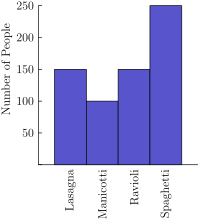
students were surveyed about their pasta preferences. The choices were lasagna, manicotti, ravioli and spaghetti. The results of the survey are displayed in the bar graph. What is the ratio of the number of students who preferred spaghetti to the number of students who preferred manicotti?
Respuesta: E
Pista pequeña:
Lee las alturas de las barras de espagueti y manicotti en el gráfico
Read the spaghetti and manicotti bar heights from the graph.
Pista grande:
La razón pedida es espagueti a manicotti, en ese orden
The requested ratio is spaghetti to manicotti, in that order.
Solución:
Hay estudiantes que prefirieron el espagueti y que prefirieron el manicotti.
Entonces, la razón es
Por lo tanto, E es la respuesta correcta.
There are students who preferred spaghetti and that preferred manicotti.
The ratio is therefore
Thus, E is the correct answer.
3.
¿Cuál es la suma de los dos factores primos más pequeños de ?
What is the sum of the two smallest prime factors of
Respuesta: C
Pista pequeña:
Factoriza en primos
Factor into primes.
Pista grande:
Solo importan los factores primos distintos al buscar los dos factores primos más pequeños
Only distinct prime factors matter when looking for the two smallest prime factors.
Solución:
Podemos factorizar en primos para obtener De aquí, vemos que solo tiene dos factores primos: y La suma de estos es
Por lo tanto, C es la respuesta correcta.
We can prime factorize to get From this, we can see that only has two prime factors: and The sum of these is
Thus, C is the correct answer.
4.
Una casa embrujada tiene seis ventanas. ¿De cuántas maneras puede Georgie el Fantasma entrar en la casa por una ventana y salir por una ventana diferente?
A haunted house has six windows. In how many ways can Georgie the Ghost enter the house by one window and leave by a different window?
Respuesta: D
Pista pequeña:
Elige primero la ventana de entrada
Choose the entrance window first.
Pista grande:
Una vez elegida la entrada, la salida tiene una opción menos
After the entrance is chosen, the exit has one fewer option.
Solución:
Georgie tiene opciones para la ventana por la que entra. Sin embargo, solo tiene opciones para la salida, ya que debe ser diferente de la entrada.
Así, el número total de caminos es
Por lo tanto, D es la respuesta correcta.
Georgie has options for which window he enters through. He, however, only has options for the exit since it must be different from the entrance.
The total number of paths is therefore
Thus, D is the correct answer.
5.
Chandler quiere comprar una bicicleta de montaña de . Por su cumpleaños, sus abuelos le envían , su tía le envía y su primo le da . Gana por semana con su reparto de periódicos. Usará todo su dinero de cumpleaños y todo el dinero que gane con su reparto de periódicos. ¿En cuántas semanas podrá comprar la bicicleta de montaña?
Chandler wants to buy a mountain bike. For his birthday, his grandparents send him , his aunt sends him and his cousin gives him . He earns per week for his paper route. He will use all of his birthday money and all of the money he earns from his paper route. In how many weeks will he be able to buy the mountain bike?
Respuesta: B
Pista pequeña:
Primero suma el dinero de cumpleaños que Chandler ya tiene
First add the birthday money Chandler already has.
Pista grande:
Divide el costo restante entre las ganancias semanales del reparto de periódicos
Divide the remaining cost by the weekly paper-route earnings.
Solución:
El total de dinero de cumpleaños que recibe Chandler es dólares. Por lo tanto, todavía necesita dólares.
Esto se puede ganar en semanas con su reparto de periódicos.
Por lo tanto, B es la respuesta correcta.
The total amount of birthday money Chandler gets is dollars. Therefore, he still needs dollars.
This can be earned in weeks through his paper route.
Thus, B is the correct answer.
6.
El costo promedio de una llamada de larga distancia en EE. UU. en era de centavos por minuto, y el costo promedio de una llamada de larga distancia en EE. UU. en era de centavos por minuto. Halla la disminución porcentual aproximada en el costo por minuto de una llamada de larga distancia.
The average cost of a long-distance call in the USA in was cents per minute, and the average cost of a long-distance call in the USA in was cents per minute. Find the approximate percent decrease in the cost per minute of a long-distance call.
Respuesta: E
Pista pequeña:
La disminución porcentual es la disminución dividida entre la cantidad original
Percent decrease is decrease divided by the original amount.
Pista grande:
La disminución es de centavos a centavos, así que compara con
The decrease is from cents to cents, so compare to
Solución:
La disminución en el costo es centavos por minuto.
La disminución porcentual es , que es un poco más de , así que la respuesta más cercana es .
Por lo tanto, E es la respuesta correcta.
The decrease in cost is cents per minute.
The percent decrease is , which is a little more than , so the closest answer is .
Thus, E is the correct answer.
7.
La edad promedio de personas en una habitación es de años. Una persona de años sale de la habitación. ¿Cuál es la edad promedio de las cuatro personas restantes?
The average age of people in a room is years. An -year-old person leaves the room. What is the average age of the four remaining people?
Respuesta: D
Pista pequeña:
Convierte el promedio original en una edad total
Convert the original average into a total age.
Pista grande:
Resta la edad de la persona que se va antes de dividir entre el número de personas restantes
Subtract the age of the person who leaves before dividing by the remaining number of people.
Solución:
Inicialmente, la edad total de todos en la habitación es años.
Después de que la persona se va, la edad total es Con personas restantes, la edad promedio se vuelve
Por lo tanto, D es la respuesta correcta.
Initially, the total age of everyone in the room is years.
After the person leaves, the total age is With people remaining, the average age becomes
Thus, D is the correct answer.
8.
En el trapecio es perpendicular a y Además, está en y es paralelo a Halla el área de
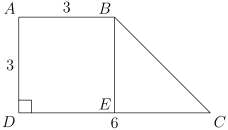
In trapezoid is perpendicular to and In addition, is on and is parallel to Find the area of
Respuesta: B
Pista pequeña:
Determina la base y la altura del triángulo
Figure out the base and height of triangle .
Pista grande:
Como es un cuadrado, y son ambos
Since is a square, and are both
Solución:
Sabemos que También sabemos que Por lo tanto, el área de es
Por lo tanto, B es la respuesta correcta.
We know that We also know that Therefore, the area of is
Thus, B is the correct answer.
9.
Para completar la cuadrícula de abajo, cada uno de los dígitos del al debe aparecer una vez en cada fila y una vez en cada columna. ¿Qué número ocupará la casilla inferior derecha?
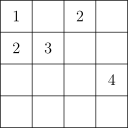
To complete the grid below, each of the digits through must occur once in each row and once in each column. What number will occupy the lower right-hand square?
no se puede determinar
cannot be determined
Respuesta: B
Pista pequeña:
Usa las restricciones de fila y columna para forzar las entradas una a la vez
Use the row and column restrictions to force entries one at a time.
Pista grande:
Empieza con la última casilla de la segunda fila, luego pasa a la casilla superior derecha
Start with the last square in the second row, then move to the top-right square.
Solución:
La última casilla de la segunda fila debe ser , ya que esa fila ya contiene y , y la última columna ya contiene .
Entonces la casilla superior derecha debe ser , ya que la fila superior ya contiene y , y la última columna ya contiene y .
Esto obliga a que el esté en la casilla inferior derecha.
Por lo tanto, B es la respuesta correcta.
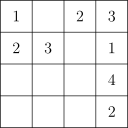
The last square in the second row must be , since that row already contains and , and the last column already contains .
Then the top-right square must be , since the top row already contains and , and the last column already contains and .
This forces the to be in the bottom-right square.
Thus, B is the correct answer.
10.
Para cualquier entero positivo define como la suma de los factores positivos de Por ejemplo, Halla
For any positive integer define to be the sum of the positive factors of For example, Find
Respuesta: D
Pista pequeña:
Aplica primero la operación de la caja una vez a
Apply the boxed operation once to first.
Pista grande:
Luego aplica la misma operación de suma de factores al resultado
Then apply the same sum-of-factors operation to the result.
Solución:
Primero, encontramos que ya que es primo. Luego necesitamos hallar Los factores de son Al sumarlos se obtiene
Por lo tanto, D es la respuesta correcta.
First, we find that since is prime. Then we need to find The factors of are Adding these yields
Thus, D is the correct answer.
11.
Las fichas y se trasladan de modo que una ficha coincida con cada uno de los rectángulos y En la disposición final, los dos números en cualquier lado común a dos fichas adyacentes deben ser iguales. ¿Cuál de las fichas se traslada al rectángulo ?
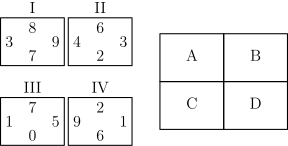
Tiles and are translated so one tile coincides with each of the rectangles and In the final arrangement, the two numbers on any side common to two adjacent tiles must be the same. Which of the tiles is translated to Rectangle
no se puede determinar
cannot be determined
Respuesta: D
Pista pequeña:
Busca números de borde que aparezcan en una sola ficha
Look for edge numbers that appear on only one tile.
Pista grande:
El y el obligan a colocar la ficha antes de decidir qué ficha está en
The and force the placement of Tile before deciding which tile is in .
Solución:
Solo la ficha tiene un en un borde, así que la ficha debe colocarse en o , donde ese borde puede quedar en el exterior.
La ficha también tiene un en su borde derecho, y ninguna otra ficha tiene un . Por lo tanto, la ficha debe colocarse en , con su en el exterior.
La única ficha que puede coincidir con el del borde izquierdo de la ficha es la ficha , así que la ficha se coloca en .
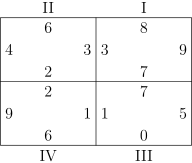
Por lo tanto, D es la respuesta correcta.
Only Tile has a on an edge, so Tile must be placed in or , where that edge can be on the outside.
Tile also has a on its right edge, and no other tile has a . Therefore Tile must be placed in , with its on the outside.
The only tile that can match the on the left edge of Tile is Tile , so Tile is placed in .
Thus, D is the correct answer.
12.
Un hexagrama unitario está compuesto por un hexágono regular de lado y sus extensiones triangulares equiláteras, como se muestra en el diagrama. ¿Cuál es la razón entre el área de las extensiones y el área del hexágono original?
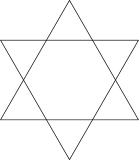
A unit hexagram is composed of a regular hexagon of side length and its equilateral triangular extensions, as shown in the diagram. What is the ratio of the area of the extensions to the area of the original hexagon?
Respuesta: A
Pista pequeña:
Divide el hexágono regular en seis triángulos equiláteros congruentes
Divide the regular hexagon into six congruent equilateral triangles.
Pista grande:
Cada triángulo exterior comparte un lado con uno de los seis triángulos interiores
Each exterior triangle shares a side with one of the six interior triangles.
Solución:
Observa que podemos dividir el hexágono en triángulos equiláteros congruentes de la siguiente manera.
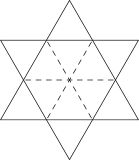
Como cada uno de ellos comparte un lado con un triángulo exterior, todos los triángulos son congruentes. Por lo tanto, la razón de áreas es
Por lo tanto, A es la respuesta correcta.
Note that we can split the hexagon into congruent equilateral triangles as follows.
Since each of them share an edge with an exterior triangle, all the triangles are congruent. Therefore, the ratio of areas is
Thus, A is the correct answer.
13.
Los conjuntos y mostrados en el diagrama de Venn, tienen el mismo número de elementos. Su unión tiene elementos y su intersección tiene elementos. Halla el número de elementos en
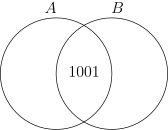
Sets and shown in the Venn diagram, have the same number of elements. Their union has elements and their intersection has elements. Find the number of elements in
Respuesta: C
Pista pequeña:
Supón que cada conjunto tiene elementos
Let each set have elements.
Pista grande:
Usa
Use .
Solución:
Sea el número de elementos en cada uno de y Sea también el número de elementos en su intersección.
Las condiciones nos dan que y Al sustituir en la primera ecuación se obtiene
Por lo tanto, C es la respuesta correcta.
Let be the number of elements in each and Also let be the number of elements in their intersection.
The conditions give us that and Plugging into the first equation yields
Thus, C is the correct answer.
14.
La base del isósceles es y su área es ¿Cuál es la longitud de uno de los lados congruentes?
The base of isosceles is and its area is What is the length of one of the congruent sides?
Respuesta: C
Pista pequeña:
Traza la altura desde el vértice superior hasta la base
Draw the altitude from the top vertex to the base.
Pista grande:
En un triángulo isósceles, esa altura divide la base en dos partes iguales
In an isosceles triangle, that altitude splits the base into two equal parts.
Solución:
Construye como la altura desde hasta
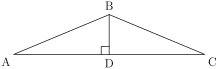
Entonces lo que nos da que
A partir de esto, aplicamos el teorema de Pitágoras en Esto nos da que
Por lo tanto, C es la respuesta correcta.
Construct as the altitude from to
Then which gives us that
From this, we apply the Pythagorean Theorem on This gives us that
Thus, C is the correct answer.
15.
Sean y números con ¿Cuál de las siguientes es imposible?
Let and be numbers with Which of the following is impossible?
Respuesta: A
Pista pequeña:
Usa el hecho de que y .
Use the fact that and .
Pista grande:
Para las otras opciones, un contraejemplo basta para mostrar que son posibles
For the other choices, one counterexample is enough to show they are possible.
Solución:
Sabemos que y Al sumar estas dos desigualdades se obtiene Esto muestra que A es imposible y, por lo tanto, la respuesta correcta.
Para asegurarnos de que esto es correcto, podemos mostrar que las otras opciones son posibles.
B y C: y .
D: y .
E: y .
Por lo tanto, A es la respuesta correcta.
We know that and Adding these two inequalities together yields This shows that A is impossible, and therefore the right answer.
To ensure that this is correct, we can show that the other options are possible.
B and C : and
D : and
E : and
Thus, A is the correct answer.
16.
Amanda Reckonwith dibuja cinco círculos con radios y Luego, para cada círculo, marca el punto donde es su circunferencia y es su área. ¿Cuál de las siguientes podría ser su gráfica?
Amanda Reckonwith draws five circles with radii and Then for each circle she plots the point where is its circumference and is its area. Which of the following could be her graph?
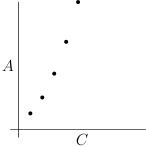
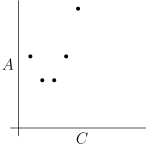
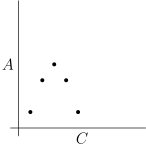
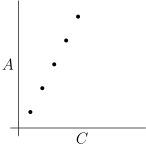
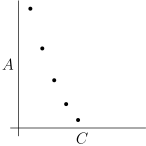
Respuesta: A
Pista pequeña:
Escribe la circunferencia y el área en términos del radio
Write circumference and area in terms of the radius.
Pista grande:
Como la circunferencia crece linealmente con el radio, el área crece cuadráticamente
As the circumference grows linearly with radius, the area grows quadratically.
Solución:
Las circunferencias de los círculos con radios a son y . Sus áreas respectivas son y .
A medida que aumenta en cantidades iguales, aumenta cada vez más rápido, así que los puntos forman un patrón cuadrático creciente. Solo la gráfica A tiene esa forma.
Por lo tanto, A es la respuesta correcta.
The circumferences of circles with radii through are and . Their respective areas are and .
As increases by equal amounts, increases more and more quickly, so the points form an increasing quadratic pattern. Only graph A has that shape.
Thus, A is the correct answer.
17.
Una mezcla de litros de pintura tiene de tinte rojo, de tinte amarillo y de agua. Se añaden cinco litros de tinte amarillo a la mezcla original. ¿Cuál es el porcentaje de tinte amarillo en la nueva mezcla?
A mixture of liters of paint is red tint, yellow tint and water. Five liters of yellow tint are added to the original mixture. What is the percent of yellow tint in the new mixture?
Respuesta: C
Pista pequeña:
Halla el número original de litros de tinte amarillo
Find the original number of liters of yellow tint.
Pista grande:
Después de añadir tinte amarillo, cambian tanto la cantidad de amarillo como la cantidad total de la mezcla
After adding yellow tint, both the yellow amount and the total mixture amount change.
Solución:
La cantidad de tinte amarillo en la mezcla original es litros. Al añadir litros se obtiene un total de litros de tinte amarillo.
La nueva mezcla tiene un total de litros, así que el porcentaje de tinte amarillo es
Por lo tanto, C es la respuesta correcta.
The amount of yellow tint in the original mixture is liters. Adding liters results in a total of liters of yellow tint.
The new mixture has a total of liters, so the percent of yellow tint is
Thus, C is the correct answer.
18.
El producto de los dos números de dígitos y tiene dígito de las unidades de millar y dígito de las unidades ¿Cuánto es ?
The product of the two -digit numbers and has thousands digit and units digit What is
Respuesta: D
Pista pequeña:
Solo los últimos cuatro dígitos pueden afectar los dígitos de las unidades de millar y de las unidades
Only the last four digits can affect the thousands and units digits.
Pista grande:
Reduce cada número de dígitos a sus últimos cuatro dígitos antes de multiplicar
Reduce each -digit number to its last four digits before multiplying.
Solución:
Solo los últimos cuatro dígitos pueden afectar el dígito de las unidades de millar y el dígito de las unidades del producto. Los dos números terminan en y , así que basta con calcular .
Como , los últimos cuatro dígitos del producto completo son .
Esto da y , así que .
Por lo tanto, D es la respuesta correcta.
Only the last four digits can affect the thousands digit and units digit of the product. The two numbers end in and , so it is enough to compute .
Since , the last four digits of the full product are .
This gives and , so .
Thus, D is the correct answer.
19.
Elige dos enteros positivos consecutivos cuya suma sea menor que Eleva al cuadrado ambos enteros y luego halla la diferencia de los cuadrados. ¿Cuál de las siguientes podría ser la diferencia?
Pick two consecutive positive integers whose sum is less than Square both of those integers and then find the difference of the squares. Which of the following could be the difference?
Respuesta: C
Pista pequeña:
Sean los enteros consecutivos y
Let the consecutive integers be and .
Pista grande:
La diferencia de sus cuadrados se simplifica a la suma de los dos enteros
The difference of their squares simplifies to the sum of the two integers.
Solución:
Sean los enteros positivos consecutivos y . Su suma es , que es menor que .
La diferencia de sus cuadrados es
Así que la diferencia debe ser un número impar menor que . Entre las opciones, es la única posibilidad, y ocurre para y .
Por lo tanto, C es la respuesta correcta.
Let the consecutive positive integers be and . Their sum is , which is less than .
The difference of their squares is
So the difference must be an odd number less than . Among the choices, is the only possibility, and it occurs for and .
Thus, C is the correct answer.
20.
Antes de los partidos de distrito, los Unicorns habían ganado el de sus partidos de baloncesto. Durante los partidos de distrito, ganaron seis partidos y perdieron dos, para terminar la temporada habiendo ganado la mitad de sus partidos. ¿Cuántos partidos jugaron los Unicorns en total?
Before district play, the Unicorns had won of their basketball games. During district play, they won six more games and lost two, to finish the season having won half their games. How many games did the Unicorns play in all?
Respuesta: A
Pista pequeña:
Sea el número de partidos antes de los partidos de distrito
Let be the number of games before district play.
Pista grande:
Escribe una ecuación que compare el total de victorias después de los partidos de distrito con la mitad de todos los partidos jugados
Write an equation comparing total wins after district play with half of all games played.
Solución:
Sea el número de partidos que los Unicorns habían jugado antes de los partidos de distrito. Entonces habían ganado partidos antes de los partidos de distrito y partidos después.
En total, jugaron partidos. El enunciado del problema nos dice que
Al resolver se obtiene , así que , y . Por lo tanto, los Unicorns jugaron partidos en total.
Por lo tanto, A es la respuesta correcta.
Let be the number of games the Unicorns had played before district play. Then they had won games before district play and games after district play.
In total, they played games. The problem statement tells us that
Solving gives , so , and . Therefore, the Unicorns played games in all.
Thus, A is the correct answer.
21.
Se reparten dos cartas de una baraja de cuatro cartas rojas etiquetadas y cuatro cartas verdes etiquetadas Un par ganador consta de dos cartas del mismo color o dos cartas de la misma letra. ¿Cuál es la probabilidad de sacar un par ganador?
Two cards are dealt from a deck of four red cards labeled and four green cards labeled A winning pair is two of the same color or two of the same letter. What is the probability of drawing a winning pair?
Respuesta: D
Pista pequeña:
Después de sacar la primera carta, cuenta las segundas cartas favorables
After the first card is drawn, count favorable second cards.
Pista grande:
Las cartas del mismo color y la carta de la misma letra no se solapan después de retirar la primera carta
The same-color cards and same-letter card do not overlap after the first card is removed.
Solución:
Después de sacar la primera carta, quedan . de ellas tienen el mismo color y de ellas tiene la misma letra. Por lo tanto, hay de posibilidades que resultan en un par ganador.
La probabilidad de sacar un par es entonces
Por lo tanto, D es la respuesta correcta.
After drawing the first card, there are left. of them have the same color, and of them has the same letter. Therefore, there are out of possibilities that result in a winning pair.
The probability of drawing a pair is then
Thus, D is the correct answer.
22.
Un lemming se encuentra en una esquina de un cuadrado de lado metros. El lemming corre metros a lo largo de una diagonal hacia la esquina opuesta. Se detiene, hace un giro de a la derecha y corre metros más. Un científico mide la distancia más corta entre el lemming y cada lado del cuadrado. ¿Cuál es el promedio de estas cuatro distancias en metros?
A lemming sits at a corner of a square with side length meters. The lemming runs meters along a diagonal toward the opposite corner. It stops, makes a right turn and runs more meters. A scientist measures the shortest distance between the lemming and each side of the square. What is the average of these four distances in meters?
Respuesta: C
Pista pequeña:
Para cualquier punto dentro de un cuadrado, las distancias a lados opuestos suman la longitud del lado
For any point inside a square, distances to opposite sides add to the side length.
Pista grande:
Aplica esa idea a ambos pares de lados opuestos
Apply that idea to both pairs of opposite sides.
Solución:
Según las longitudes dadas en el problema, el lemming sigue dentro del cuadrado después de detenerse.
Como el lemming sigue dentro del cuadrado, la suma de las distancias a los lados horizontales es metros y lo mismo para los lados verticales. Por lo tanto, las distancias suman metros, lo que hace que el promedio sea metros.
Por lo tanto, C es la respuesta correcta.

Based on the lengths given in the problem, the lemming is still in the square after it stops.
Since the lemming is still in the square, the sum of the distances to the horizontal sides is meters and the same for the vertical sides. Therefore, the distances sum to meters, making the average meters.
Thus, C is the correct answer.
23.
¿Cuál es el área del molinete sombreado que se muestra en la cuadrícula ?

What is the area of the shaded pinwheel shown in the grid?
Respuesta: B
Pista pequeña:
Es más fácil restar el área no sombreada de toda la cuadrícula
It is easier to subtract the unshaded area from the whole grid.
Pista grande:
La parte no sombreada consta de cuatro cuadrados en las esquinas y cuatro triángulos congruentes
The unshaded part consists of four corner squares and four congruent triangles.
Solución:
Podemos hallar el área de la parte sombreada restando el área de la parte no sombreada del área total.
Hay cuadrados de lado que aportan cada uno al área no sombreada, para un total de
También hay triángulos de base y altura Esto aporta un área total de
El área total no sombreada es, por lo tanto,
El área total es y restar el área no sombreada da como área de la región sombreada.
Por lo tanto, B es la respuesta correcta.
We can find the area of the shaded part by subtracting the area of the unshaded part from the whole area.
There are squares with side length contributing each to the unshaded area, for a total of
There are also triangles with base and height This contributes a total area of
The total unshaded area is therefore
The total area is and subtracting the unshaded area yields as the area of the shaded region.
Thus, B is the correct answer.
24.
Una bolsa contiene cuatro trozos de papel, cada uno etiquetado con uno de los dígitos o sin repeticiones. Se sacan tres de estos trozos, uno a la vez sin reemplazo, para construir un número de tres dígitos. ¿Cuál es la probabilidad de que el número de tres dígitos sea un múltiplo de ?
A bag contains four pieces of paper, each labeled with one of the digits or with no repeats. Three of these pieces are drawn, one at a time without replacement, to construct a three-digit number. What is the probability that the three-digit number is a multiple of
Respuesta: C
Pista pequeña:
Un número es divisible entre exactamente cuando la suma de sus dígitos es divisible entre
A number is divisible by exactly when its digit sum is divisible by
Pista grande:
En lugar de ordenar los tres dígitos sacados, fíjate en qué dígito queda fuera
Instead of ordering the three drawn digits, look at which digit is left out.
Solución:
Recuerda que un número es divisible entre si la suma de sus dígitos es divisible entre .
Las únicas ternas de dígitos distintos de cuya suma es divisible entre son y .
Esto significa que el número construido es un múltiplo de exactamente cuando o queda en la bolsa.
Cada uno de estos eventos tiene probabilidad , para una probabilidad total de .
Por lo tanto, C es la respuesta correcta.
Recall that a number is divisible by if the sum of its digits is divisible by .
The only triples of distinct digits from whose sum is divisible by are and .
This means the constructed number is a multiple of exactly when either or is left in the bag.
Each of these events has probability , for a total probability of .
Thus, C is the correct answer.
25.
En el tablero de dardos que se muestra en la figura de abajo, el círculo exterior tiene radio y el círculo interior tiene radio Tres radios dividen cada círculo en tres regiones congruentes, con los valores de puntos indicados. La probabilidad de que un dardo golpee una región dada es proporcional al área de la región. Cuando dos dardos golpean este tablero, la puntuación es la suma de los valores de puntos de las regiones golpeadas. ¿Cuál es la probabilidad de que la puntuación sea impar?

On the dart board shown in the figure below, the outer circle has radius and the inner circle has radius Three radii divide each circle into three congruent regions, with point values shown. The probability that a dart will hit a given region is proportional to the area of the region. When two darts hit this board, the score is the sum of the point values of the regions hit. What is the probability that the score is odd?
Respuesta: B
Pista pequeña:
Una puntuación impar proviene de un dardo que cae en una región de punto y el otro en una región de puntos
An odd score comes from one dart landing on a -region and the other on a -region.
Pista grande:
Calcula la probabilidad total ponderada por área de caer en y luego de caer en
Compute the total area-weighted probability of landing on then of landing on
Solución:
El área del círculo exterior es y el área del círculo interior es Por lo tanto, el área del anillo exterior es
Esto significa que la probabilidad de golpear un segmento exterior es De manera similar, la probabilidad de golpear un segmento interior es
Sumando sobre todas las posibilidades, la probabilidad de golpear un es De manera similar, la probabilidad de golpear un es
La única manera de obtener una puntuación impar es golpear un y un
La probabilidad de golpear estos números en cualquier orden es
Por lo tanto, B es la respuesta correcta.
The area of the outer circle is and the area of the inner circle is Therefore, the area of the outer ring is
This means that the probability of hitting an outer segment is Similarly, the probability of hitting an inner segment is
Summing over all possibilities, the probability of hitting a is Similarly, the probability of hitting a is
The only way to get an odd score is to hit one and one
The probability of hitting these numbers in either order is
Thus, B is the correct answer.