
Soluciones del 2020 AMC 10A
Desplázate hacia abajo para ver las soluciones profesionales en video y soluciones escritas de LIVE by Po-Shen Loh, imprime las soluciones en PDF, consulta la clave de respuestas, o haz el examen cronometrado completo.
Todos los problemas se usan con el permiso legal oficial de la Mathematical Association of America (MAA).
1.
¿Qué valor de satisface
What value of satisfies
Pista pequeña:
Primero simplifica el lado derecho usando el denominador .
First simplify the right side using denominator
Pista grande:
Después de hallar el lado derecho, suma a ambos lados.
After finding the right side, add to both sides
Solución en video:

Click to load, then click again to play
Solución escrita:
El lado derecho es . Por lo tanto . Así, E es la respuesta correcta.
The right side is . Thus . Thus, E is the correct answer.
2.
Los números y tienen un promedio (media aritmética) de ¿Cuál es el promedio de y ?
The numbers and have an average (arithmetic mean) of What is the average of and
Pista pequeña:
Convierte el promedio de cinco números en una suma total.
Convert the average of five numbers into a total sum
Pista grande:
Resta los tres números conocidos antes de promediar y .
Subtract the known three numbers before averaging and
Solución en video:
Click to load, then click again to play
Solución escrita:
Los cinco números tienen suma total . Como , tenemos , así que el promedio de y es . Así, C es la respuesta correcta.
The five numbers have total sum . Since , we have , so the average of and is . Thus, C is the correct answer.
3.
Suponiendo que y ¿cuál es el valor, en su forma más simple, de la siguiente expresión?
Assuming and what is the value in simplest form of the following expression?
Pista pequeña:
Cada denominador es el opuesto de un factor correspondiente del numerador.
Each denominator is the negative of a matching numerator factor
Pista grande:
Cuenta el número de signos negativos después de simplificar.
Count the number of negative signs after cancellation
Solución en video:
Click to load, then click again to play
Solución escrita:
Reescribe los factores del denominador como , y . La expresión se convierte en . Así, A es la respuesta correcta.
Rewrite the denominator factors as , , and . The expression becomes . Thus, A is the correct answer.
4.
Una conductora viaja durante horas a millas por hora, y durante ese tiempo su auto rinde millas por galón de gasolina. Le pagan por milla, y su único gasto es la gasolina a por galón. ¿Cuál es su tasa neta de pago, en dólares por hora, después de este gasto?
A driver travels for hours at miles per hour, during which her car gets miles per gallon of gasoline. She is paid per mile, and her only expense is gasoline at per gallon. What is her net rate of pay, in dollars per hour, after this expense?
Pista pequeña:
Halla el total de millas recorridas en dos horas.
Find the total miles driven in two hours
Pista grande:
Resta el costo de la gasolina antes de dividir entre el número de horas.
Subtract gasoline cost before dividing by the number of hours
Solución en video:
Click to load, then click again to play
Solución escrita:
La conductora recorre millas, así que le pagan . El viaje usa galones de gasolina, con un costo de . Su pago neto es dólares en horas, o sea dólares por hora. Así, E es la respuesta correcta.
The driver travels miles, so she is paid . The trip uses gallons of gasoline, costing . Her net pay is dollars over hours, or dollars per hour. Thus, E is the correct answer.
5.
¿Cuál es la suma de todos los números reales para los cuales
What is the sum of all real numbers for which
Pista pequeña:
Divide la ecuación con valor absoluto en dos ecuaciones cuadráticas.
Split the absolute-value equation into two quadratic equations
Pista grande:
Recuerda contar la raíz doble solo una vez en la suma de números reales.
Remember to count the double root only once in the sum of real numbers
Solución en video:
Click to load, then click again to play
Solución escrita:
La ecuación significa o . La primera da , con raíces y ; la segunda da , con raíz . La suma de todas las soluciones reales es . Así, C es la respuesta correcta.
The equation means or . The first gives , with roots and . The second gives , with root . The sum of all real solutions is . Thus, C is the correct answer.
6.
¿Cuántos enteros positivos de dígitos, es decir, enteros entre y inclusive, que tienen solo dígitos pares son divisibles entre ?
How many -digit positive integers (that is, integers between and inclusive) having only even digits are divisible by
Pista pequeña:
El último dígito debe ser compatible tanto con la paridad como con la divisibilidad entre .
The last digit must be compatible with both evenness and divisibility by
Pista grande:
Después de fijar el último dígito, elige de forma independiente los dígitos de las millares, centenas y decenas.
Choose the thousands, hundreds, and tens digits independently after fixing the last digit
Solución en video:
Click to load, then click again to play
Solución escrita:
El último dígito debe ser , porque el número es divisible entre y todos los dígitos son pares. El dígito de las millares puede ser u , y cada uno de los dígitos de las centenas y las decenas tiene opciones. Así que hay de esos enteros. Así, B es la respuesta correcta.
The last digit must be , because the number is divisible by and all digits are even. The thousands digit can be or , and each of the hundreds and tens digits has choices. Thus there are such integers. Thus, B is the correct answer.
7.
Los enteros desde hasta inclusive se pueden acomodar formando un cuadrado de por en el que la suma de los números de cada fila, la suma de los números de cada columna y la suma de los números a lo largo de cada una de las diagonales principales son todas iguales. ¿Cuál es el valor de esta suma común?
The integers from to inclusive, can be arranged to form a -by- square in which the sum of the numbers in each row, the sum of the numbers in each column, and the sum of the numbers along each of the main diagonals are all the same. What is the value of this common sum?
Pista pequeña:
Las cinco sumas de las filas juntas son iguales a la suma de los enteros.
The five row sums together equal the sum of all integers
Pista grande:
Calcula la suma de la sucesión aritmética desde hasta .
Compute the arithmetic-sequence sum from through
Solución en video:
Click to load, then click again to play
Solución escrita:
La suma de los enteros desde hasta es . Si cada fila tiene suma común , entonces las cinco sumas de las filas suman , así que y . Así, C es la respuesta correcta.
The sum of the integers from to is . If every row has common sum , then the five row sums add to , so and . Thus, C is the correct answer.
8.
¿Cuál es el valor de
What is the value of
Pista pequeña:
Agrupa la expresión en bloques de cuatro términos.
Group the expression into blocks of four terms
Pista grande:
Halla una fórmula para el bloque y suma sobre los bloques.
Find a formula for the th block and sum over blocks
Solución en video:
Click to load, then click again to play
Solución escrita:
Agrupa en bloques de cuatro: . El bloque suma .
Hay bloques, así que la suma es . Así, B es la respuesta correcta.
Group the terms in blocks of four: . The th block is .
There are blocks, so the sum is . Thus, B is the correct answer.
9.
Una sola sección de banca en un evento escolar puede acomodar adultos u niños. Cuando se conectan secciones de banca de extremo a extremo, un número igual de adultos y niños sentados juntos ocupará todo el espacio de las bancas. ¿Cuál es el menor valor entero positivo posible de ?
A single bench section at a school event can hold either adults or children. When bench sections are connected end to end, an equal number of adults and children seated together will occupy all the bench space. What is the least possible positive integer value of
Pista pequeña:
Sea el número igual de adultos y niños.
Let the equal number of adults and children be
Pista grande:
El número de secciones de banca es .
The number of bench sections is
Solución en video:
Click to load, then click again to play
Solución escrita:
Si el número igual de adultos y niños es , entonces los adultos usan secciones de banca y los niños usan secciones de banca. Así, .
El menor entero positivo ocurre cuando , lo que da . Así, B es la respuesta correcta.
If the equal number of adults and children is , then the adults use bench sections and the children use bench sections. Thus .
The least positive integer occurs when , giving . Thus, B is the correct answer.
10.
Siete cubos, cuyos volúmenes son y unidades cúbicas, se apilan verticalmente para formar una torre en la que los volúmenes de los cubos decrecen de abajo hacia arriba. Excepto por el cubo inferior, la cara inferior de cada cubo descansa completamente sobre la cara superior del cubo que está debajo. ¿Cuál es el área superficial total de la torre, incluyendo la base, en unidades cuadradas?
Seven cubes, whose volumes are and cubic units, are stacked vertically to form a tower in which the volumes of the cubes decrease from bottom to top. Except for the bottom cube, the bottom face of each cube lies completely on top of the cube below it. What is the total surface area of the tower (including the bottom) in square units?
Pista pequeña:
Empieza con las áreas superficiales de los siete cubos por separado.
Start with the surface areas of all seven separate cubes
Pista grande:
Cada contacto oculta dos caras con la longitud del lado del cubo más pequeño.
Each contact hides two faces with the side length of the smaller cube
Solución en video:
Click to load, then click again to play
Solución escrita:
Las longitudes de los lados de los cubos son , apilados del más grande abajo al más pequeño arriba. La suma de las áreas superficiales de los cubos por separado es .
Cada contacto oculta dos caras cuadradas, con áreas . Al restar estas caras ocultas se obtiene . Así, B es la respuesta correcta.
The cube side lengths are , stacked from largest on bottom to smallest on top. The sum of the surface areas of the separate cubes is .
Each contact hides two square faces, with areas . Subtracting these hidden faces gives . Thus, B is the correct answer.
11.
¿Cuál es la mediana de la siguiente lista de números?
What is the median of the following list of numbers?
Pista pequeña:
Cerca de la mediana, cuenta por separado los enteros ordinarios y los números cuadrados.
Near the median, count ordinary integers and square numbers separately
Pista grande:
Usa .
Use
Solución en video:
Click to load, then click again to play
Solución escrita:
Para un número cercano a la mediana, la lista ordenada incluye todos los enteros ordinarios hasta ese número y todos los cuadrados hasta ese número. Como y , hay cuadrados que no exceden ningún número desde hasta .
En , hay elementos de la lista que son a lo sumo . En , hay elementos que son a lo sumo , así que el elemento número es , y el siguiente es . La mediana es . Así, C es la respuesta correcta.
For a number near the median, the sorted list includes all ordinary integers up to that number and all squares up to that number. Since and , there are squares not exceeding any number from through .
At , there are list entries at most . At , there are entries at most , so the th entry is , and the next is . The median is . Thus, C is the correct answer.
12.
El triángulo es isósceles con Las medianas y son perpendiculares entre sí, y ¿Cuál es el área de ?
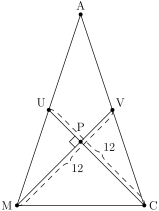
Triangle is isosceles with Medians and are perpendicular to each other, and What is the area of
Pista pequeña:
Coloca el baricentro en el origen y alinea las medianas perpendiculares con los ejes.
Put the centroid at the origin and align the perpendicular medians with the axes
Pista grande:
El baricentro divide cada mediana en razón .
The centroid divides each median in a ratio
Solución en video:
Click to load, then click again to play
Solución escrita:
Sea el baricentro el origen. Como el baricentro divide cada mediana en razón , podemos colocar la mediana horizontalmente con y , y la mediana verticalmente con y .
Como es el punto medio de , obtenemos . El área de es . Así, C es la respuesta correcta.
Let the centroid be the origin. Since a centroid divides each median in a ratio, we may place median horizontally with and , and median vertically with and .
Because is the midpoint of , we get . The area of is . Thus, C is the correct answer.
13.
Una rana sentada en el punto comienza una sucesión de saltos, donde cada salto es paralelo a uno de los ejes coordenados y tiene longitud y la dirección de cada salto (arriba, abajo, derecha o izquierda) se elige de forma independiente al azar. La sucesión termina cuando la rana alcanza un lado del cuadrado con vértices y ¿Cuál es la probabilidad de que la sucesión de saltos termine en un lado vertical del cuadrado?
A frog sitting at the point begins a sequence of jumps, where each jump is parallel to one of the coordinate axes and has length and the direction of each jump (up, down, right, or left) is chosen independently at random. The sequence ends when the frog reaches a side of the square with vertices and What is the probability that the sequence of jumps ends on a vertical side of the square?
Pista pequeña:
Deja que cada punto reticular interior guarde la probabilidad de tocar primero un lado vertical.
Let each interior lattice point store the probability of hitting a vertical side first
Pista grande:
Usa la simetría para reducir las ecuaciones de la caminata aleatoria a cuatro incógnitas.
Use symmetry to reduce the random-walk equations to four unknowns
Solución en video:
Click to load, then click again to play
Solución escrita:
Sea la probabilidad de tocar finalmente primero un lado vertical desde el punto . Por simetría, define , , y .
Las ecuaciones de promedio son , , y . Al resolver se obtiene , que es la probabilidad buscada desde . Así, B es la respuesta correcta.
Let be the probability of eventually hitting a vertical side first from point . By symmetry, set , , , and .
The averaging equations are , , , and . Solving gives , which is the desired probability from . Thus, B is the correct answer.
14.
Los números reales y satisfacen y ¿Cuál es el valor de la siguiente expresión?
Real numbers and satisfy and What is the value of
Pista pequeña:
Usa las sumas de potencias .
Use power sums
Pista grande:
La relación da una recurrencia para .
The relation gives a recurrence for
Solución en video:
Click to load, then click again to play
Solución escrita:
Sea . Como y , los números y satisfacen , así que .
Usando y , obtenemos , , y . La expresión es . Así, D es la respuesta correcta.
Let . Since and , the numbers and satisfy , so .
Using and , we get , , , and . The expression is . Thus, D is the correct answer.
15.
Se elige al azar un divisor entero positivo de . La probabilidad de que el divisor elegido sea un cuadrado perfecto se puede expresar como donde y son enteros positivos primos entre sí. ¿Cuánto vale ?
A positive integer divisor of is chosen at random. The probability that the divisor chosen is a perfect square can be expressed as where and are relatively prime positive integers. What is
Pista pequeña:
Factoriza en primos.
Factor into primes
Pista grande:
Un divisor cuadrado debe elegir solo exponentes primos pares.
A square divisor must choose only even prime exponents
Solución en video:
Click to load, then click again to play
Solución escrita:
La factorización en primos de es . Por lo tanto, tiene divisores positivos.
Un divisor cuadrado debe usar solo exponentes pares, lo que da divisores cuadrados. La probabilidad es , así que . Así, E es la respuesta correcta.
The prime factorization of is . Therefore has positive divisors.
A square divisor must use only even exponents, giving square divisors. The probability is , so . Thus, E is the correct answer.
16.
Se elige un punto al azar dentro del cuadrado del plano coordenado cuyos vértices son y La probabilidad de que el punto esté a menos de unidades de un punto reticular es (Un punto es un punto reticular si y son ambos enteros.) ¿Cuánto vale redondeado a la décima más cercana?
A point is chosen at random within the square in the coordinate plane whose vertices are and The probability that the point is within units of a lattice point is (A point is a lattice point if and are both integers.) What is to the nearest tenth?
Pista pequeña:
Observa un cuadrado unitario de la retícula.
Look at one unit square of the lattice
Pista grande:
Los cuatro cuartos de círculo alrededor de sus esquinas tienen área total .
The four quarter-circles around its corners have total area
Solución en video:
Click to load, then click again to play
Solución escrita:
Para , los puntos a menos de de los puntos reticulares ocupan, en cada cuadrado unitario, cuatro cuartos de círculo cuya área total es . El enorme cuadrado se cubre con cuadrados unitarios, así que la probabilidad buscada es .
Al hacer se obtiene , que se redondea a . Así, B es la respuesta correcta.
For , the points within of lattice points occupy, in each unit square, four quarter-circles whose total area is . The enormous square is tiled by unit squares, so the desired probability is .
Setting gives , which rounds to . Thus, B is the correct answer.
17.
Define ¿Cuántos enteros hay tales que ?
Define How many integers are there such that
Pista pequeña:
Haz una tabla de signos a lo largo de las raíces .
Make a sign chart across the square roots
Pista grande:
Cuenta los puntos enteros en un intervalo sí y otro no, incluyendo los extremos.
Count integer points in every other interval, including endpoints
Solución en video:
Click to load, then click again to play
Solución escrita:
El polinomio cambia de signo en cada cuadrado , y su coeficiente principal es positivo. Así, para los enteros en los intervalos , , , .
Para impar, el intervalo contiene enteros. Sumando sobre los impares se obtiene . Así, E es la respuesta correcta.
The polynomial changes sign at each square , and its leading coefficient is positive. Thus for integers in the intervals , , , .
For odd , the interval contains integers. Summing over odd gives . Thus, E is the correct answer.
18.
Sea una cuádrupla ordenada de enteros no necesariamente distintos, cada uno de ellos en el conjunto ¿Para cuántas de esas cuádruplas se cumple que es impar? (Por ejemplo, es una de esas cuádruplas, porque es impar.)
Let be an ordered quadruple of not necessarily distinct integers, each one of them in the set For how many such quadruples is it true that is odd? (For example, is one such quadruple, because is odd.)
Pista pequeña:
Solo importan las paridades de .
Only the parities of matter
Pista grande:
Cuenta las matrices invertibles sobre el cuerpo de dos elementos.
Count invertible matrices over the two-element field
Solución en video:
Click to load, then click again to play
Solución escrita:
Solo importa la paridad. Módulo , la condición es que sea , lo que significa que la matriz es invertible sobre .
Hay matrices invertibles sobre . Cada patrón de paridad se eleva a elecciones de , así que hay cuádruplas. Así, C es la respuesta correcta.
Only parity matters. Modulo , the condition is that is , meaning the matrix is invertible over .
There are invertible matrices over . Each parity pattern lifts to choices from , so there are quadruples. Thus, C is the correct answer.
19.
Como se muestra en la figura de abajo, un dodecaedro regular, o sea el poliedro formado por caras pentagonales regulares congruentes, flota en el espacio con dos caras horizontales. Observa que hay un anillo de cinco caras inclinadas adyacentes a la cara superior, y un anillo de cinco caras inclinadas adyacentes a la cara inferior. ¿De cuántas maneras se puede ir de la cara superior a la cara inferior mediante una sucesión de caras adyacentes de modo que cada cara se visite a lo sumo una vez y no se permitan movimientos del anillo inferior al anillo superior?
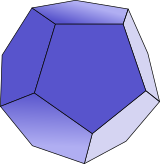
As shown in the figure below, a regular dodecahedron (the polyhedron consisting of congruent regular pentagonal faces) floats in space with two horizontal faces. Note that there is a ring of five slanted faces adjacent to the top face, and a ring of five slanted faces adjacent to the bottom face. How many ways are there to move from the top face to the bottom face via a sequence of adjacent faces so that each face is visited at most once and moves are not permitted from the bottom ring to the top ring?
Pista pequeña:
Como los movimientos hacia arriba están prohibidos, divide cada camino en una fase del anillo superior y una fase del anillo inferior.
Because upward moves are forbidden, split every path into a top-ring phase and a bottom-ring phase
Pista grande:
En un ciclo de cinco, una caminata sin autointersección tiene posibles caminos de parada.
On a five-cycle, a self-avoiding walk has possible stopping paths
Solución en video:
Click to load, then click again to play
Solución escrita:
Después de dejar la cara superior, elige una de las caras del anillo superior. Como los movimientos del anillo inferior al anillo superior están prohibidos, todo camino válido tiene una fase del anillo superior, luego un movimiento hacia abajo al anillo inferior, y luego una fase del anillo inferior.
Fija la primera cara del anillo superior. En el anillo superior, el camino puede recorrer el ciclo de sin revisitar una cara y luego detenerse en cualquier punto: hay posibles caminos del anillo superior. Desde la cara donde se detiene, hay posibles movimientos hacia abajo al anillo inferior, así que la parte superior tiene opciones.
Una vez en el anillo inferior, el camino puede recorrer el ciclo de inferior sin revisitar una cara y luego entrar en la cara inferior; esto da opciones. El total es . Así, E es la respuesta correcta.
After leaving the top face, choose one of the top-ring faces. Because moves from the bottom ring to the top ring are forbidden, every valid path has a top-ring phase, then one move down to the bottom ring, then a bottom-ring phase.
Fix the first top-ring face. On the top ring, the path can move around the -cycle without revisiting a face and then stop at any point: there are possible top-ring paths. From the stopping face, there are possible downward moves to the bottom ring, so the top part has choices.
Once in the bottom ring, the path can move around the bottom -cycle without revisiting a face and then enter the bottom face; this gives choices. The total is . Thus, E is the correct answer.
20.
El cuadrilátero satisface y Las diagonales y se cortan en el punto y ¿Cuál es el área del cuadrilátero ?
Quadrilateral satisfies and Diagonals and intersect at point and What is the area of quadrilateral
Pista pequeña:
Coloca sobre el eje y usa el punto conocido .
Put on the -axis and use the known point
Pista grande:
El punto está tanto en la recta como en la circunferencia de diámetro .
Point lies both on line and on the circle with diameter
Solución en video:
Click to load, then click again to play
Solución escrita:
Coloca y . Como y , toma . El punto es , así que la recta tiene ecuación .
Como , el punto está en la circunferencia de diámetro : . Al intersecarla con se obtiene o . El cuadrilátero convexo usa .
Entonces , y . El área total es . Así, D es la respuesta correcta.
Place and . Since and , take . The point is , so line has equation .
Because , point lies on the circle with diameter : . Intersecting with gives or . The convex quadrilateral uses .
Then , and . The total area is . Thus, D is the correct answer.
21.
Existe una única sucesión estrictamente creciente de enteros no negativos tal que ¿Cuánto vale ?
There exists a unique strictly increasing sequence of nonnegative integers such that What is
Pista pequeña:
Haz y divide entre .
Set and divide by
Pista grande:
Empareja las potencias positivas y negativas para crear bloques de unos binarios.
Pair positive and negative powers to create blocks of binary ones
Solución en video:
Click to load, then click again to play
Solución escrita:
Sea . Entonces .
Empareja términos consecutivos: , , , , y luego el final. Cada par es , y aporta unos en binario. Hay de esos pares más el final, así que . Así, C es la respuesta correcta.
Let . Then .
Pair consecutive terms: , , , , and then the final . Each pair is , contributing ones in binary. There are such pairs plus the final , so . Thus, C is the correct answer.
22.
¿Para cuántos enteros positivos el valor no es divisible entre ? (Recuerda que es el mayor entero menor o igual que )
For how many positive integers isnot divisible by (Recall that is the greatest integer less than or equal to )
Pista pequeña:
Sea .
Let
Pista grande:
La suma de los pisos deja de ser múltiplo de solo cuando restar o cruza un múltiplo de .
The sum of floors fails to be a multiple of only when subtracting or crosses a multiple of
Solución en video:
Click to load, then click again to play
Solución escrita:
Escribe , donde . Entonces . Los otros dos pisos suelen ser también , salvo que restar o a cruza un múltiplo de cuando es pequeño.
Para , la suma no es divisible entre exactamente cuando o . El caso da los divisores de , excluyendo el , lo que son valores. El caso da los divisores de , excluyendo el , lo que son valores. El total es . Así, A es la respuesta correcta.
Write , where . Then . The other two floors are usually also , except that subtracting or from crosses a multiple of when is small.
For , the sum is not divisible by exactly when or . The case gives divisors of , excluding , for values. The case gives divisors of , excluding , for values. The total is . Thus, A is the correct answer.
23.
Sea el triángulo del plano coordenado con vértices y Considera las siguientes cinco isometrías (transformaciones rígidas) del plano: rotaciones de y en sentido antihorario alrededor del origen, reflexión respecto al eje , y reflexión respecto al eje . ¿Cuántas de las sucesiones de tres de estas transformaciones (no necesariamente distintas) devuelven a su posición original? (Por ejemplo, una rotación de , seguida de una reflexión respecto al eje , seguida de una reflexión respecto al eje devuelve a su posición original, pero una rotación de , seguida de una reflexión respecto al eje , seguida de otra reflexión respecto al eje no devuelve a su posición original.)
Let be the triangle in the coordinate plane with vertices and Consider the following five isometries (rigid transformations) of the plane: rotations of and counterclockwise around the origin, reflection across the -axis, and reflection across the -axis. How many of the sequences of three of these transformations (not necessarily distinct) will return to its original position? (For example, a rotation, followed by a reflection across the -axis, followed by a reflection across the -axis will return to its original position, but a rotation, followed by a reflection across the -axis, followed by another reflection across the -axis will not return to its original position.)
Pista pequeña:
Nombra la rotación de como y las dos reflexiones como .
Name the rotation and the two reflections
Pista grande:
Una vez fijadas las dos primeras transformaciones, la tercera debe ser la inversa de su producto.
Once the first two transformations are fixed, the third must be the inverse of their product
Solución en video:
Click to load, then click again to play
Solución escrita:
Sea una rotación de , de modo que las rotaciones permitidas son . Sean y las reflexiones respecto a los ejes coordenados. Una vez elegidas las dos primeras transformaciones, la tercera queda forzada a ser la inversa de su producto.
Entre dos rotaciones, hay pares ordenados cuyo producto es una rotación distinta de la identidad. Una rotación y una reflexión tienen como producto una reflexión permitida respecto a un eje exactamente cuando la rotación es , lo que da pares ordenados. Por último, las dos reflexiones distintas respecto a los ejes pueden aparecer en cualquier orden, lo que da pares más. En total hay sucesiones válidas. Así, A es la respuesta correcta.
Let be a rotation, so the allowed rotations are . Let and be the reflections across the coordinate axes. Once the first two transformations are chosen, the third is forced to be the inverse of their product.
Among two rotations, ordered pairs have a nonidentity rotation as their product. A rotation and a reflection have an allowed axis-reflection as their product exactly when the rotation is , giving ordered pairs. Finally, the two different axis-reflections can occur in either order, giving more pairs. Altogether there are valid sequences. Thus, A is the correct answer.
24.
Sea el menor entero positivo mayor que para el cual ¿Cuál es la suma de los dígitos de ?
Let be the least positive integer greater than for which What is the sum of the digits of
Pista pequeña:
Traduce cada condición de mcd en una congruencia más una exclusión.
Translate each gcd condition into a congruence plus an exclusion
Pista grande:
Resuelve primero las dos congruencias, luego prueba los candidatos mayores que .
Solve the two congruences first, then test candidates above
Solución en video:
Click to load, then click again to play
Solución escrita:
La primera condición de mcd da , así que , pero no debe ser divisible entre . La segunda da , así que , pero no debe ser divisible entre .
Al resolver y se obtiene . Los candidatos mayores que son . El primero no cumple la primera condición de mcd, el segundo no cumple la segunda, y sí funciona. La suma de los dígitos es . Así, C es la respuesta correcta.
The first gcd condition gives , so , but must not be divisible by . The second gives , so , but must not be divisible by .
Solving and gives . The candidates above are . The first fails the first gcd condition, the second fails the second gcd condition, and works. The digit sum is . Thus, C is the correct answer.
25.
Jason lanza tres dados justos estándar de seis caras. Luego mira los resultados y elige un subconjunto de los dados (posiblemente vacío, posiblemente los tres) para volver a lanzar. Después de volver a lanzar, gana si y solo si la suma de los números que quedan hacia arriba en los tres dados es exactamente Jason siempre juega para optimizar sus probabilidades de ganar. ¿Cuál es la probabilidad de que elija volver a lanzar exactamente dos de los dados?
Jason rolls three fair standard six-sided dice. Then he looks at the rolls and chooses a subset of the dice (possibly empty, possibly all three dice) to reroll. After rerolling, he wins if and only if the sum of the numbers face up on the three dice is exactly Jason always plays to optimize his chances of winning. What is the probability that he chooses to reroll exactly two of the dice?
Pista pequeña:
Compara la mejor probabilidad de volver a lanzar o dados.
Compare the best chance from rerolling or dice
Pista grande:
Volver a lanzar dos dados es óptimo solo para ciertos resultados iniciales ordenados en los que la suma de los dos menores es grande.
Rerolling two dice is optimal only for certain sorted initial rolls with large two-smallest sum
Solución en video:
Click to load, then click again to play
Solución escrita:
Para cualquier resultado inicial, Jason compara las mejores probabilidades de volver a lanzar o dados. Volver a lanzar los tres dados tiene probabilidad . Volver a lanzar un dado tiene probabilidad siempre que algún par de dados conservados tenga suma a lo sumo .
Si vuelve a lanzar exactamente dos dados, conserva un dado. Conservar un dado que muestra da probabilidades sobre , respectivamente. Esto puede ser óptimo solo cuando los dos dados menores suman al menos y el dado menor es o .
Los resultados ordenados que cumplen esto son , , y . Al contar las permutaciones se obtienen resultados de , así que la probabilidad es . Así, A es la respuesta correcta.
For any initial roll, Jason compares the best probabilities from rerolling or dice. Rerolling all three dice has probability . Rerolling one die has probability whenever some pair of kept dice has sum at most .
If he rerolls exactly two dice, he keeps one die. Keeping a die showing gives probabilities out of , respectively. This can be optimal only when the two smallest dice sum at least and the smallest die is or .
The sorted rolls satisfying this are , , and . Counting permutations gives rolls out of , so the probability is . Thus, A is the correct answer.