
Problemas del 2015 AMC 10B
¡Desplázate hacia abajo y presiona Iniciar para intentar el examen! O ve al PDF imprimible, la clave de respuestas, o las soluciones profesionales preparadas por LIVE by Po-Shen Loh.
Todos los problemas se usan con el permiso legal oficial de la Mathematical Association of America (MAA).
O salta directamente a un solo problema con su solución: 1 · 2 · 3 · 4 · 5 · 6 · 7 · 8 · 9 · 10 · 11 · 12 · 13 · 14 · 15 · 16 · 17 · 18 · 19 · 20 · 21 · 22 · 23 · 24 · 25
¿Quieres aprender de forma profesional con clases interactivas en video?
Con tiempo
1:15:00
1.
¿Cuál es el valor de ?
What is the value of
Respuesta: C
Pista pequeña:
Un exponente negativo significa el recíproco de una potencia.
Negative exponent means reciprocal of a power
Pista grande:
Calcula .
Compute
Solución:
Como , la expresión es
Por lo tanto, la respuesta correcta es C.
Since , the expression is
Thus, the correct answer is C.
2.
Marie hace tres tareas igualmente demoradas seguidas sin tomar descansos. Comienza la primera tarea a la PM y termina la segunda tarea a las PM. ¿Cuándo termina la tercera tarea?
Marie does three equally time-consuming tasks in a row without taking breaks. She begins the first task at PM and finishes the second task at PM. When does she finish the third task?
PM
PM
PM
PM
PM
Respuesta: B
Pista pequeña:
Dos tareas toman minutos.
Two tasks take minutes
Pista grande:
Agrega una tarea más de minutos después de las PM.
Add one more -minute task after PM
Solución:
El tiempo que toma hacer tareas es de minutos. Así, toma minutos más después de las lo que da las
Por lo tanto, la respuesta correcta es B.
The time it takes to do tasks is minutes. Thus, it takes more minutes after which is
Thus, the correct answer is B .
3.
Isaac ha escrito un entero dos veces y otro entero tres veces. La suma de los cinco números es y uno de los números es ¿Cuál es el otro número?
Isaac has written down one integer two times and another integer three times. The sum of the five numbers is and one of the numbers is What is the other number?
Respuesta: A
Pista pequeña:
Prueba si se repite dos o tres veces.
Test whether is repeated two or three times
Pista grande:
El total restante debe ser divisible por la cantidad restante.
The remaining total must divide by the remaining count
Solución:
Sea el número escrito dos veces, y sea el número escrito tres veces. Entonces .
Si , entonces , imposible para un entero . Por lo tanto , y , así que .
Por lo tanto, la respuesta correcta es A.
Let the number written twice be , and let the number written three times be . Then .
If , then , impossible for an integer . Therefore , and , so .
Thus, the correct answer is A.
4.
Cuatro hermanos pidieron una pizza extra grande. Alex comió Beth y Cyril de la pizza. Dan se quedó con las sobras. ¿Cuál es la secuencia de los hermanos en orden decreciente según la parte de la pizza que consumieron?
Four siblings ordered an extra large pizza. Alex ate Beth and Cyril of the pizza. Dan got the leftovers. What is the sequence of the siblings in decreasing order of the part of the pizza they consumed?
Alex, Beth, Cyril, Dan
Beth, Cyril, Alex, Dan
Beth, Cyril, Dan, Alex
Beth, Dan, Cyril, Alex
Dan, Beth, Cyril, Alex
Respuesta: C
Pista pequeña:
Dan recibe .
Dan receives
Pista grande:
Compara todas las porciones con denominador .
Compare all shares with denominator
Solución:
Como sabemos que Beth comió más que Cyril y Cyril comió más que Alex. Así, esos tres quedan ordenados.
La cantidad que comió Dan es Esto es mayor que y menor que así que Dan queda entre Cyril y Alex. Esto hace que el orden sea Beth, Cyril, Dan, Alex.
Por lo tanto, la respuesta correcta es C.
Since we know Beth ate more than Cyril and Cyril ate more than Alex. Thus, those three are in order.
The amount Dan ate is This is greater than and less than so Dan is in between Cyril and Alex. This makes the order Beth, Cyril, Dan, Alex.
Thus, the correct answer is C .
5.
David, Hikmet, Jack, Marta, Rand y Todd participaron en una carrera de personas junto con otras personas. Rand terminó puestos por delante de Hikmet. Marta terminó puesto por detrás de Jack. David terminó puestos por detrás de Hikmet. Jack terminó puestos por detrás de Todd. Todd terminó puesto por detrás de Rand. Marta terminó en el .º puesto. ¿Quién terminó en el .º puesto?
David, Hikmet, Jack, Marta, Rand, and Todd were in a -person race with other people. Rand finished places ahead of Hikmet. Marta finished place behind Jack. David finished places behind Hikmet. Jack finished places behind Todd. Todd finished place behind Rand. Marta finished in th place. Who finished in th place?
David
Hikmet
Jack
Rand
Todd
Respuesta: B
Pista pequeña:
Trabaja hacia atrás desde el .º puesto de Marta.
Work backward from Marta’s th place
Pista grande:
Hikmet está puestos por detrás de Rand.
Hikmet is places behind Rand
Solución:
Marta terminó en el .º puesto, así que Jack terminó en el .º. Como Jack terminó puestos por detrás de Todd, Todd terminó en el .º. Como Todd terminó puesto por detrás de Rand, Rand terminó en el .º.
Hikmet terminó puestos por detrás de Rand, así que Hikmet terminó en el .º puesto.
Por lo tanto, la respuesta correcta es B.
Marta finished th, so Jack finished th. Since Jack finished places behind Todd, Todd finished rd. Since Todd finished place behind Rand, Rand finished nd.
Hikmet finished places behind Rand, so Hikmet finished th.
Thus, the correct answer is B.
6.
Marley practica exactamente un deporte cada día de la semana. Corre tres días a la semana pero nunca en dos días consecutivos. El lunes juega baloncesto y dos días después golf. También nada y juega tenis, pero nunca juega tenis el día siguiente a correr o nadar. ¿Qué día de la semana nada Marley?
Marley practices exactly one sport each day of the week. She runs three days a week but never on two consecutive days. On Monday she plays basketball and two days later golf. She swims and plays tennis, but she never plays tennis the day after running or swimming. Which day of the week does Marley swim?
Domingo
Sunday
Martes
Tuesday
Jueves
Thursday
Viernes
Friday
Sábado
Saturday
Respuesta: E
Pista pequeña:
El lunes y el miércoles están fijos.
Monday and Wednesday are fixed
Pista grande:
El martes debe ser un día de correr.
Tuesday must be a running day
Solución:
Marley juega baloncesto el lunes y golf el miércoles. No puede ubicar los tres días de correr entre el jueves, viernes, sábado y domingo sin tener dos días de correr consecutivos, así que el martes debe ser un día de correr.
Del jueves al domingo, debe correr dos veces, nadar una vez y jugar tenis una vez. El tenis no puede ser el día siguiente a correr o nadar, así que el tenis debe ser el jueves. Entonces los dos días de correr restantes deben ser el viernes y el domingo, dejando el sábado para nadar.
Por lo tanto, la respuesta correcta es E.
Marley plays basketball on Monday and golf on Wednesday. She cannot fit all three running days among Thursday, Friday, Saturday, and Sunday without having two consecutive running days, so Tuesday must be a running day.
From Thursday through Sunday, she must run twice, swim once, and play tennis once. Tennis cannot be the day after running or swimming, so tennis must be Thursday. Then the two remaining running days must be Friday and Sunday, leaving Saturday for swimming.
Thus, the correct answer is E.
7.
Considera la operación “menos el recíproco de”, definida por ¿Cuánto vale
Consider the operation “minus the reciprocal of,” defined by What is
Respuesta: A
Pista pequeña:
Primero calcula y .
Compute and first
Pista grande:
Recuerda que .
Remember
Solución:
Por lo tanto, la respuesta correcta es A.
Thus, the correct answer is A .
8.
La letra F que se muestra abajo se rota en sentido horario alrededor del origen, luego se refleja respecto al eje , y después se rota media vuelta alrededor del origen. ¿Cuál es la imagen final?

The letter F shown below is rotated clockwise around the origin, then reflected in the -axis, and then rotated a half turn around the origin. What is the final image?


Respuesta: E
Pista pequeña:
Sigue lo que les pasa a los ejes bajo las tres transformaciones.
Track what happens to the axes under the three transformations
Pista grande:
Media vuelta después de una reflexión respecto al eje es una reflexión respecto al eje .
A half turn after a -reflection is a reflection in the -axis
Solución:
La primera rotación coloca la F debajo del eje .
Media vuelta equivale a reflejar respecto a los dos ejes coordenados. Por lo tanto, la media vuelta final cancela la reflexión previa respecto al eje y deja una reflexión respecto al eje .
Al reflejar la figura rotada respecto al eje se obtiene la opción E.
Por lo tanto, la respuesta correcta es E.
The first rotation puts the F below the -axis.
A half turn is equivalent to reflecting in both coordinate axes. Therefore the final half turn cancels the preceding reflection in the -axis and leaves a reflection in the -axis.
Reflecting the rotated figure in the -axis produces choice E.
Thus, the correct answer is E .
9.
La región sombreada de abajo se llama falcata de aleta de tiburón, una figura estudiada por Leonardo da Vinci. Está limitada por la porción del círculo de radio y centro que está en el primer cuadrante, la porción del círculo de radio y centro que está en el primer cuadrante, y el segmento de recta de a ¿Cuál es el área de la falcata de aleta de tiburón?
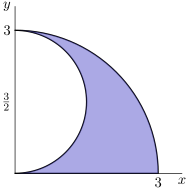
The shaded region below is called a shark’s fin falcata, a figure studied by Leonardo da Vinci. It is bounded by the portion of the circle of radius and center that lies in the first quadrant, the portion of the circle with radius and center that lies in the first quadrant, and the line segment from to What is the area of the shark’s fin falcata?
Respuesta: B
Pista pequeña:
Resta el semicírculo menor al cuarto de círculo mayor.
Subtract the smaller semicircle from the larger quarter circle
Pista grande:
El círculo menor tiene radio .
The smaller circle has radius
Solución:
El borde mayor es un cuarto de círculo de radio , así que su área es .
El borde interior es la mitad derecha de un círculo de radio , así que su área es .
El área sombreada es la diferencia, .
Por lo tanto, la respuesta correcta es B.
The larger boundary is a quarter circle of radius , so its area is .
The inner boundary is the right half of a circle of radius , so its area is .
The shaded area is the difference, .
Thus, the correct answer is B.
10.
¿Cuáles son el signo y la cifra de las unidades del producto de todos los enteros negativos impares estrictamente mayores que ?
What are the sign and units digit of the product of all the odd negative integers strictly greater than
Es un número negativo que termina en
It is a negative number ending with a
Es un número positivo que termina en
It is a positive number ending with a
Es un número negativo que termina en
It is a negative number ending with a
Es un número positivo que termina en
It is a positive number ending with a
Es un número negativo que termina en
It is a negative number ending with a
Respuesta: C
Pista pequeña:
Cuenta cuántos factores negativos impares hay.
Count how many odd negative factors there are
Pista grande:
Un producto impar con un factor de tiene cifra de las unidades .
An odd product with a factor of has units digit
Solución:
Hay números impares mayores que
Nuestro producto es de una cantidad impar de números negativos, así que el resultado es negativo.
Además, ahí multiplicamos por , así que el producto es un múltiplo de lo que hace que termine en o en Ninguno de nuestros factores es par, así que el producto no puede ser par.
Por lo tanto, el producto debe terminar en
Por lo tanto, la respuesta correcta es C.
There are odd numbers greater than
Our product is of an odd number of negative numbers, so the result is negative.
Also, we multiply by in there, so the product is a multiple of making it end in or None of our factors are even, so the product can’t be even.
Therefore, the product must end in
Thus, the correct answer is C .
11.
Entre los enteros positivos menores que cada uno de cuyos dígitos es un número primo, se selecciona uno al azar. ¿Cuál es la probabilidad de que el número seleccionado sea primo?
Among the positive integers less than each of whose digits is a prime number, one is selected at random. What is the probability that the selected number is prime?
Respuesta: B
Pista pequeña:
Lista los primos de una cifra y los números de dos cifras que usan solo .
List one-digit primes and two-digit numbers using only
Pista grande:
Los primos de dos cifras que terminan en o aún deben pasar las pruebas de divisibilidad.
Two-digit primes ending in or must still pass divisibility tests
Solución:
Los dígitos disponibles son . Hay números de una cifra y números de dos cifras, para opciones en total.
Las opciones de una cifra son todas primas. Un primo de dos cifras no puede terminar en ni en , así que revisar las terminaciones y da los primos de dos cifras .
Así, de las opciones son primas, y la probabilidad es .
Por lo tanto, la respuesta correcta es B.
The available digits are . There are one-digit numbers and two-digit numbers, for total choices.
All one-digit choices are prime. A two-digit prime cannot end in or , so checking endings and gives the two-digit primes .
Thus of the choices are prime, and the probability is .
Thus, the correct answer is B.
12.
¿Para cuántos enteros el punto está dentro o sobre el círculo de radio con centro en ?
For how many integers is the point inside or on the circle of radius centered at
Respuesta: A
Pista pequeña:
Sustituye en la fórmula de la distancia desde .
Substitute into the distance formula from
Pista grande:
Resuelve .
Solve
Solución:
La distancia al cuadrado de a es
Estar dentro o sobre el círculo significa , así que . Por lo tanto , lo que da valores enteros.
Por lo tanto, la respuesta correcta es A.
The squared distance from to is
Being inside or on the circle means , so . Thus , giving integer values.
Thus, the correct answer is A.
13.
La recta forma un triángulo con los ejes coordenados. ¿Cuál es la suma de las longitudes de las alturas de este triángulo?
The line forms a triangle with the coordinate axes. What is the sum of the lengths of the altitudes of this triangle?
Respuesta: E
Pista pequeña:
Las intersecciones con los ejes son y .
The intercepts are and
Pista grande:
Usa el área para hallar la altura hacia la hipotenusa.
Use area to find the altitude to the hypotenuse
Solución:
El triángulo es un triángulo rectángulo con catetos de y Esto hace que la hipotenusa sea
Dos de las alturas son entonces y Además, para cualquier lado, donde es la base y es la altura.
El área es así que la otra altura se puede hallar con Por lo tanto, esta altura es
Por lo tanto, la suma es
Por lo tanto, la respuesta correcta es E.
The triangle is a right triangle with legs of and This makes the hypotenuse
Two of the altitudes are then and Also, for any side, where is the base and is the altitude.
The area is so the other altitude can be found with Thus, this altitude is
Therefore, the sum is
Thus, the correct answer is E .
14.
Sean y tres números de una cifra distintos. ¿Cuál es el valor máximo de la suma de las raíces de la ecuación
Let and be three distinct one-digit numbers. What is the maximum value of the sum of the roots of the equation
Respuesta: D
Pista pequeña:
Factoriza .
Factor out
Pista grande:
Maximiza usando números de una cifra distintos.
Maximize using distinct one-digit numbers
Solución:
Al factorizar el lado izquierdo, obtenemos Por tanto, las raíces son y cuya suma es
El coeficiente de en esta suma es el doble del coeficiente de o así que asignamos el dígito más grande a Los siguientes dos dígitos distintos más grandes deben ser y
Tomando y , obtenemos
Así, la respuesta correcta es D.
Factoring the left-hand side gives Thus the roots are and whose sum is
The coefficient of in this sum is twice the coefficient of either or so assign the largest digit to The next two largest distinct digits should be and
Taking and gives
Thus, the correct answer is D .
15.
El pueblo de Hamlet tiene personas por cada caballo, ovejas por cada vaca, y patos por cada persona. ¿Cuál de las siguientes no podría ser el número total de personas, caballos, ovejas, vacas y patos en Hamlet?
The town of Hamlet has people for each horse, sheep for each cow, and ducks for each person. Which of the following could not possibly be the total number of people, horses, sheep, cows, and ducks in Hamlet?
Respuesta: B
Pista pequeña:
Escribe el total como .
Write the total as
Pista grande:
Revisa cada opción módulo después de restar múltiplos de .
Check each option modulo after subtracting multiples of
Solución:
Si hay caballos y vacas, entonces hay personas, patos, y ovejas. El total es por lo tanto .
Los valores listados salvo se pueden escribir en esa forma: Para , restar deja , ninguno de los cuales es divisible por .
Por lo tanto, la respuesta correcta es B.
If there are horses and cows, then there are people, ducks, and sheep. The total is therefore .
The listed values except can be written in that form: For , subtracting leaves , none of which is divisible by .
Thus, the correct answer is B.
16.
A Al, Bill y Cal se les asignará al azar un número entero de a inclusive, sin que dos de ellos reciban el mismo número. ¿Cuál es la probabilidad de que el número de Al sea un múltiplo entero del de Bill y el número de Bill sea un múltiplo entero del de Cal?
Al, Bill, and Cal will each randomly be assigned a whole number from to inclusive, with no two of them getting the same number. What is the probability that Al’s number will be a whole number multiple of Bill’s and Bill’s number will be a whole number multiple of Cal’s?
Respuesta: C
Pista pequeña:
Cuenta las ternas ordenadas con múltiplo de y múltiplo de .
Count ordered triples with a multiple of and a multiple of
Pista grande:
Empieza con el número más pequeño en la cadena de divisibilidad.
Start with the smallest number in the divisibility chain
Solución:
Sean los números asignados a Al, Bill y Cal. Necesitamos que sea múltiplo de , y que sea múltiplo de , con los tres números distintos.
Las ternas válidas son Hay asignaciones favorables.
El número total de asignaciones es , así que la probabilidad es .
Por lo tanto, la respuesta correcta es C.
Let be the numbers assigned to Al, Bill, and Cal. We need to be a multiple of , and to be a multiple of , with all three numbers distinct.
The valid triples are There are favorable assignments.
The total number of assignments is , so the probability is .
Thus, the correct answer is C.
17.
Se unen los centros de las caras del prisma rectangular recto que se muestra abajo para formar un octaedro. ¿Cuál es el volumen de este octaedro?
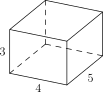
The centers of the faces of the right rectangular prism shown below are joined to create an octahedron. What is the volume of this octahedron?
Pista pequeña:
Ve el octaedro como dos pirámides con una base rómbica central.
View the octahedron as two pyramids with a central rhombus base
Pista grande:
El rombo de la base tiene diagonales y .
The base rhombus has diagonals and
Solución:
El octaedro se puede ver como dos pirámides congruentes cuya base compartida es el rombo que pasa por los centros de las cuatro caras laterales. Este rombo tiene diagonales y , así que su área es .
Cada pirámide tiene altura , la mitad de la altura del prisma. Así, el volumen total es
Por lo tanto, la respuesta correcta es B.
The octahedron can be viewed as two congruent pyramids whose shared base is the rhombus through the centers of the four side faces. This rhombus has diagonals and , so its area is .
Each pyramid has height , half the prism’s height. Thus the total volume is
Thus, the correct answer is B.
18.
Johann tiene monedas justas. Lanza todas las monedas. Cualquier moneda que caiga en cruz se lanza de nuevo. Las monedas que caen en cruz en el segundo lanzamiento se lanzan una tercera vez. ¿Cuál es el número esperado de monedas que ahora están en cara?
Johann has fair coins. He flips all the coins. Any coin that lands on tails is tossed again. Coins that land on tails on the second toss are tossed a third time. What is the expected number of coins that are now heads?
Respuesta: D
Pista pequeña:
Una moneda queda en cruz al final solo tras tres cruces.
A coin is tails at the end only after three tails
Pista grande:
Usa la linealidad de la esperanza.
Use linearity of expectation
Solución:
Una moneda termina en cruz si y solo si tiene lanzamientos que son cruz, lo que ocurre con probabilidad Así, la probabilidad de que cualquier moneda quede en cara es
Como la probabilidad de que una moneda dada quede en cara es y hay monedas en total, el número esperado de monedas que ahora están en cara es:
Por lo tanto, la respuesta correcta es D.
A coin ends as tails if and only if it has flips that are tails, which happens with probability Thus, the probability of any coin being heads is
Since each of the coins ends as heads with probability linearity of expectation gives the expected number of coins that are now heads:
Thus, the correct answer is D .
19.
En y Se construyen los cuadrados y fuera del triángulo. Los puntos y están sobre un círculo. ¿Cuál es el perímetro del triángulo?
In and Squares and are constructed outside of the triangle. The points and lie on a circle. What is the perimeter of the triangle?
Respuesta: C
Pista pequeña:
El centro del círculo es el circuncentro del triángulo rectángulo.
The circle center is the circumcenter of the right triangle
Pista grande:
Coloca el circuncentro en el punto medio de la hipotenusa.
Put the circumcenter at the midpoint of the hypotenuse
Solución:
El centro del círculo que pasa por está sobre las mediatrices de y . Estas son también las mediatrices de y , así que el mismo punto es el circuncentro del triángulo rectángulo .
Por lo tanto el centro es el punto medio de la hipotenusa , así que . Sea y . Entonces .
Del cuadrado sobre , . Del cuadrado sobre , el radio correspondiente también da . Por lo tanto Al restar de esta ecuación se obtiene . Pero también se cumple , así que . Como , obtenemos .
Así , y el perímetro es .
Por lo tanto, la respuesta correcta es C.
The center of the circle through lies on the perpendicular bisectors of and . These are also the perpendicular bisectors of and , so the same point is the circumcenter of right triangle .
Therefore the center is the midpoint of hypotenuse , so . Let and . Then .
From the square on , . From the square on , the corresponding radius also gives . Hence Subtracting from this equation gives . But as well, so . Since , we get .
Thus , and the perimeter is .
Thus, the correct answer is C.
20.
La hormiga Erin comienza en una esquina dada de un cubo y se arrastra a lo largo de exactamente aristas de tal manera que visita cada esquina exactamente una vez y luego descubre que no puede regresar por una arista a su punto de partida. ¿Cuántas trayectorias cumplen estas condiciones?
Erin the ant starts at a given corner of a cube and crawls along exactly edges in such a way that she visits every corner exactly once and then finds that she is unable to return along an edge to her starting point. How many paths are there meeting these conditions?
Respuesta: A
Pista pequeña:
Después de dos movimientos, el siguiente vértice en la cara inicial queda forzado.
After two moves, the next vertex on the starting face is forced
Pista grande:
Termina rodeando la cara opuesta y conserva solo las trayectorias que no pueden regresar.
Finish around the opposite face and keep only paths that cannot return
Solución:
Las primeras dos aristas se pueden elegir de maneras. Estas dos aristas determinan una cara inicial del cubo. Después de esos movimientos, hay un vértice no visitado en esa cara inicial.
Ese vértice restante debe visitarse a continuación; de lo contrario, Erin lo alcanzaría más tarde cuando todos sus vecinos ya hubieran sido visitados, y la trayectoria no podría continuar. Los últimos cuatro vértices están entonces en la cara opuesta y se pueden visitar en dos órdenes cíclicos.
De esos dos órdenes, exactamente uno termina en un vértice no adyacente al punto de partida. Por lo tanto hay trayectorias válidas.
Por lo tanto, la respuesta correcta es A.
The first two edges can be chosen in ways. These two edges determine an initial face of the cube. After those moves, there is one unvisited vertex on that initial face.
That remaining vertex must be visited next; otherwise Erin would later reach it after all of its neighbors had already been visited, and the path could not continue. The last four vertices are then on the opposite face and can be visited in two cyclic orders.
Of those two orders, exactly one ends at a vertex not adjacent to the starting point. Hence there are valid paths.
Thus, the correct answer is A.
21.
Cozy el Gato y Dash el Perro están subiendo una escalera con cierto número de escalones. Sin embargo, en lugar de subir los escalones de uno en uno, tanto Cozy como Dash saltan.
Cozy sube dos escalones con cada salto (aunque si es necesario, simplemente saltará el último escalón).
Dash sube cinco escalones con cada salto (aunque si es necesario, simplemente saltará los últimos escalones si quedan menos de ).
Supongamos que Dash da saltos menos que Cozy para llegar a la cima de la escalera. Sea la suma de todos los posibles números de escalones que puede tener esta escalera. ¿Cuál es la suma de los dígitos de ?
Cozy the Cat and Dash the Dog are going up a staircase with a certain number of steps. However, instead of walking up the steps one at a time, both Cozy and Dash jump.
Cozy goes two steps up with each jump (though if necessary, he will just jump the last step).
Dash goes five steps up with each jump (though if necessary, he will just jump the last steps if there are fewer than steps left).
Suppose Dash takes fewer jumps than Cozy to reach the top of the staircase. Let denote the sum of all possible numbers of steps this staircase can have. What is the sum of the digits of
Respuesta: D
Pista pequeña:
Supón que Dash da saltos y Cozy da .
Let Dash take jumps and Cozy take
Pista grande:
Empareja entre y .
Match between and
Solución:
Supongamos que Dash da saltos. Entonces el número de escalones es uno de Cozy da saltos más, así que Cozy da saltos, lo que significa que es o .
Emparejando estas posibilidades, las soluciones enteras son Estas dan , respectivamente.
Así , y la suma de sus dígitos es .
Por lo tanto, la respuesta correcta es D.
Suppose Dash takes jumps. Then the number of steps is one of Cozy takes more jumps, so Cozy takes jumps, which means is either or .
Matching these possibilities, the integer solutions are They give , respectively.
Thus , and the sum of its digits is .
Thus, the correct answer is D.
22.
En la figura que se muestra abajo, es un pentágono regular y ¿Cuánto vale ?
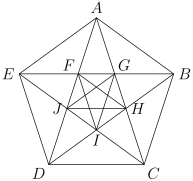
In the figure shown below, is a regular pentagon and What is
Respuesta: D
Pista pequeña:
Usa triángulos semejantes con longitudes de lado , , y .
Use similar triangles with side lengths , , and
Pista grande:
La primera semejanza da .
The first similarity gives
Solución:
Por simetría, , y los triángulos y son congruentes, así que . Sea , y sea .
Los triángulos semejantes en el pentágono dan y La primera ecuación es , así que . Entonces .
Por lo tanto
Por lo tanto, la respuesta correcta es D.
By symmetry, , and triangles and are congruent, so . Let , and let .
The similar triangles in the pentagon give and The first equation is , so . Then .
Therefore
Thus, the correct answer is D.
23.
Sea un entero positivo mayor que tal que la representación decimal de termina en ceros y la representación decimal de termina en ceros. Sea la suma de los cuatro menores valores posibles de ¿Cuál es la suma de los dígitos de ?
Let be a positive integer greater than such that the decimal representation of ends in zeros and the decimal representation of ends in zeros. Let denote the sum of the four least possible values of What is the sum of the digits of
Respuesta: B
Pista pequeña:
Cuenta los factores de en y .
Count factors of in and
Pista grande:
Prueba los primeros rangos donde y .
Test the first ranges where and
Solución:
El número de ceros finales es el número de factores de . Para , tiene cero. Necesitamos que tenga ceros, lo que ocurre cuando . Así .
Para , tiene ceros. Necesitamos que tenga ceros, lo que ocurre cuando . Así .
Estos son los cuatro menores valores posibles, así que . La suma de los dígitos de es .
Por lo tanto, la respuesta correcta es B.
The number of trailing zeros is the number of factors of . For , has zero. We need to have zeros, which happens when . Thus .
For , has zeros. We need to have zeros, which happens when . Thus .
These are the four least possible values, so . The sum of the digits of is .
Thus, the correct answer is B.
24.
La hormiga Aaron camina sobre el plano coordenado según las siguientes reglas.
Empieza en el origen mirando hacia el este y camina una unidad, llegando a
Para justo después de llegar al punto si Aaron puede girar a la izquierda y caminar una unidad hasta un punto no visitado lo hace. De lo contrario, camina una unidad hacia adelante para llegar a Así la sucesión de puntos continúa siguiendo un patrón de espiral en sentido antihorario. ¿Cuánto vale ?
Aaron the ant walks on the coordinate plane according to the following rules.
He starts at the origin facing to the east and walks one unit, arriving at
For right after arriving at the point if Aaron can turn left and walk one unit to an unvisited point he does that. Otherwise, he walks one unit straight ahead to reach Thus the sequence of points continues in a counterclockwise spiral pattern. What is
Respuesta: D
Pista pequeña:
Compara con .
Compare to
Pista grande:
Usa y retrocede paso a paso.
Use and step backward
Solución:
Cuando Aaron llega a , acaba de completar la espiral cuadrada que contiene todos los puntos de la cuadrícula con coordenadas entre y . Por lo tanto
Con , esto da . Como , retroceder por el borde inferior resta a la coordenada , así que
Por lo tanto, la respuesta correcta es D.
When Aaron reaches , he has just completed the square spiral containing all grid points with coordinates between and . Therefore
With , this gives . Since , stepping backward along the bottom edge subtracts from the -coordinate, so
Thus, the correct answer is D.
25.
Una caja rectangular mide donde y son enteros y El volumen y el área de la superficie de la caja son numéricamente iguales. ¿Cuántas ternas ordenadas son posibles?
A rectangular box measures where and are integers and The volume and the surface area of the box are numerically equal. How many ordered triples are possible?
Respuesta: B
Pista pequeña:
Parte de .
Start from
Pista grande:
Fija y factoriza la ecuación restante.
Fix and factor the remaining equation
Solución:
La condición es Como , tenemos . Además y no dan soluciones positivas, así que probamos .
Para , , lo que da . Para , , lo que da .
Para , , y la única solución con es . Para , , y la única solución con es .
El número total de ternas es .
Por lo tanto, la respuesta correcta es B.
The condition is Since , we have . Also and give no positive solutions, so test .
For , , giving . For , , giving .
For , , and the only solution with is . For , , and the only solution with is .
The total number of triples is .
Thus, the correct answer is B.