
Problemas del 2013 AMC 10A
25 problemas · 75 minutos
¡Desplázate hacia abajo y presiona Iniciar para intentar el examen! O ve al PDF imprimible, la clave de respuestas, o las soluciones profesionales preparadas por LIVE by Po-Shen Loh.
O salta directamente a un solo problema con su solución: 1 · 2 · 3 · 4 · 5 · 6 · 7 · 8 · 9 · 10 · 11 · 12 · 13 · 14 · 15 · 16 · 17 · 18 · 19 · 20 · 21 · 22 · 23 · 24 · 25
Todos los problemas se usan con el permiso legal oficial de la Mathematical Association of America (MAA).
¿Quieres aprender de forma profesional con clases interactivas en video?
Aprende con LIVECon tiempo
1:15:00
1.
Un viaje en taxi cuesta más por milla recorrida. ¿Cuánto cuesta un viaje en taxi de millas?
A taxi ride costs plus per mile traveled. How much does a -mile taxi ride cost?
Pista pequeña:
Primero calcula el cargo por millaje.
Compute the mileage charge first
Pista grande:
Después del cargo por millaje, suma el cargo fijo inicial.
Add the fixed starting charge after the mileage charge
Solución:
El cargo por millaje es .
Al sumar el cargo fijo se obtiene .
Por lo tanto, C es la respuesta correcta.
The mileage charge is .
Adding the fixed charge gives .
Thus, C is the correct answer.
2.
Alice está haciendo una tanda de galletas y necesita tazas de azúcar. Por desgracia, su taza medidora solo contiene de taza de azúcar. ¿Cuántas veces debe llenar esa taza para obtener la cantidad correcta de azúcar?
Alice is making a batch of cookies and needs cups of sugar. Unfortunately, her measuring cup holds only cup of sugar. How many times must she fill that cup to get the correct amount of sugar?
Respuesta: B
Conceptos:fracción
Pista pequeña:
Convierte el número mixto de tazas en una fracción impropia.
Convert the mixed number of cups to an improper fraction
Pista grande:
Divide el azúcar necesaria entre el tamaño de la taza.
Divide the needed sugar by the cup size
Solución:
Alice necesita tazas de azúcar.
Cada taza medidora llena aporta de taza, así que el número de llenados es .
Por lo tanto, B es la respuesta correcta.
Alice needs cups of sugar.
Each full measuring cup gives cup, so the number of fillings is .
Thus, B is the correct answer.
3.
El cuadrado tiene lado de longitud El punto está sobre y el área de es ¿Cuánto vale ?
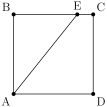
Square has side length Point is on and the area of is What is
Respuesta: E
Conceptos:área del triángulo
Pista pequeña:
Usa como la altura de .
Use as the height of
Pista grande:
Iguala al área dada.
Set equal to the given area
Solución:
Por la fórmula del área de un triángulo tenemos que Esto nos da Por lo tanto, E es la respuesta correcta.
We have by the formula for the area of a triangle that This gives us Thus, E is the correct answer.
4.
Un equipo de softbol jugó diez partidos, anotando y carreras. Perdieron por una carrera en exactamente cinco partidos. En cada uno de sus demás partidos, anotaron el doble de carreras que su oponente. ¿Cuántas carreras anotaron en total sus oponentes?
A softball team played ten games, scoring and runs. They lost by one run in exactly five games. In each of their other games, they scored twice as many runs as their opponent. How many total runs did their opponents score?
Respuesta: C
Pista pequeña:
Los partidos con puntuación doblada deben ser los partidos con anotación par.
The doubled-score games must be the even scoring games
Pista grande:
Empareja las anotaciones impares con las derrotas por una carrera y las pares con la mitad de la anotación del oponente.
Pair odd scores with one-run losses and even scores with halved opponent scores
Solución:
Observa que si anotaron el doble de carreras que sus oponentes, entonces anotaron un número par de carreras.
Esto significa que en los partidos donde anotaron y carreras, sus oponentes anotaron y carreras respectivamente.
Esto suma
En los demás partidos, sus oponentes anotaron y carreras.
Esto suma
El número total de carreras es entonces Por lo tanto, C es la respuesta correcta.
Note that if they scored twice as many runs as their opponents, then they scored an even number of runs.
This means in the games where they scored and runs, their opponents scored and runs respectively.
This sums to
In the other games, their opponents scored and runs.
This sums to
The total number of runs is then Thus, C is the correct answer.
5.
Tom, Dorothy y Sammy se fueron de vacaciones y acordaron dividir los gastos por partes iguales. Durante el viaje Tom pagó Dorothy pagó y Sammy pagó Para compartir los gastos por igual, Tom le dio a Sammy dólares, y Dorothy le dio a Sammy dólares. ¿Cuánto vale ?
Tom, Dorothy, and Sammy went on a vacation and agreed to split the costs evenly. During their trip Tom paid Dorothy paid and Sammy paid In order to share costs equally, Tom gave Sammy dollars, and Dorothy gave Sammy dollars. What is
Pista pequeña:
Primero halla el costo total del viaje y la parte justa de cada persona.
First find the total trip cost and each person’s fair share
Pista grande:
Tom y Dorothy le pagan a Sammy la cantidad que les falta para su parte justa.
Tom and Dorothy each pay Sammy the amount they are short of a fair share
Solución:
El costo total fue , así que la parte de cada persona fue .
Tom pagó menos que su parte, y Dorothy pagó menos que la suya, así que y .
Por lo tanto .
Por lo tanto, B es la respuesta correcta.
The total cost was , so each person’s share was .
Tom paid less than his share, and Dorothy paid less than her share, so and .
Therefore .
Thus, B is the correct answer.
6.
Joey y sus cinco hermanos tienen y años. Una tarde dos de sus hermanos cuyas edades suman fueron al cine, dos hermanos menores de años fueron a jugar béisbol, y Joey y el de años se quedaron en casa. ¿Cuántos años tiene Joey?
Joey and his five brothers are ages and One afternoon two of his brothers whose ages sum to went to the movies, two brothers younger than went to play baseball, and Joey and the -year-old stayed home. How old is Joey?
Respuesta: D
Pista pequeña:
Enumera los pares de edades cuya suma es , recordando que el de años se quedó en casa.
List the age pairs whose sum is , remembering the -year-old stayed home
Pista grande:
Después de elegir el par que fue al cine, el par de béisbol debe ser dos hermanos restantes menores de años.
After choosing the movie pair, the baseball pair must be two remaining brothers younger than
Solución:
Los pares de edades que suman son , , y .
El de años se quedó en casa, así que el par del cine no puede ser . Si los de y años fueron al cine, entonces el único hermano restante menor de años sería el de años, insuficiente para el béisbol.
Así que el par del cine fue , el par del béisbol fue , y Joey es el hermano restante, de años.
Por lo tanto, D es la respuesta correcta.
The age pairs that sum to are , , and .
The -year-old stayed home, so the movie pair cannot be . If and went to the movies, then the only remaining brother younger than would be the -year-old, not enough for baseball.
Thus the movie pair was , the baseball pair was , and Joey is the remaining brother, age .
Thus, D is the correct answer.
7.
Un estudiante debe elegir un programa de cuatro cursos de un menú compuesto por Inglés, Álgebra, Geometría, Historia, Arte y Latín. Este programa debe incluir Inglés y al menos un curso de matemáticas. ¿De cuántas maneras se puede elegir este programa?
A student must choose a program of four courses from a menu of courses consisting of English, Algebra, Geometry, History, Art, and Latin. This program must contain English and at least one mathematics course. In how many ways can this program be chosen?
Respuesta: C
Pista pequeña:
Inglés está fijo, así que elige tres de los cinco cursos restantes.
English is fixed, so choose three of the five remaining courses
Pista grande:
Cuenta todas las elecciones de tres cursos de los cursos restantes, luego quita la que no tiene matemáticas.
Count all three-course choices from the remaining courses, then remove the choice with no math
Solución:
Inglés es obligatorio, así que elige los otros cursos de los cursos Álgebra, Geometría, Historia, Arte y Latín.
Hay elecciones de este tipo, pero una de ellas, Historia-Arte-Latín, no contiene ningún curso de matemáticas.
Por lo tanto, el número de programas válidos es .
Por lo tanto, C es la respuesta correcta.
English is required, so choose the other courses from the courses Algebra, Geometry, History, Art, and Latin.
There are such choices, but one of them, History-Art-Latin, contains no mathematics course.
Therefore the number of valid programs is .
Thus, C is the correct answer.
8.
¿Cuál es el valor de
What is the value of
Respuesta: C
Pista pequeña:
Factoriza la potencia menor .
Factor out the smaller power
Pista grande:
Después de factorizar, en cada paréntesis solo queda .
After factoring, only remains in each parenthesis
Solución:
Al factorizar obtenemos:
Por lo tanto, C es la respuesta correcta.
Factoring out a we get:
Thus, C is the correct answer.
9.
En un partido reciente de baloncesto, Shenille solo intentó tiros de tres puntos y tiros de dos puntos. Acertó el de sus tiros de tres puntos y el de sus tiros de dos puntos. Shenille intentó tiros. ¿Cuántos puntos anotó?
In a recent basketball game, Shenille attempted only three-point shots and two-point shots. She was successful on of her three-point shots and of her two-point shots. Shenille attempted shots. How many points did she score?
Respuesta: B
Pista pequeña:
Sean y el número de intentos de dos puntos y de tres puntos.
Let and be the numbers of two-point and three-point attempts
Pista grande:
Compara los puntos obtenidos por cada tipo de tiro intentado después de aplicar los porcentajes de acierto.
Compare the points earned per attempted shot type after applying the success percentages
Solución:
Sea el número de tiros de dos puntos y el número de tiros de tres puntos.
Entonces, Shenille acierta tiros de dos puntos y tiros de tres puntos, para una puntuación total de
Sabemos que
Por lo tanto, B es la respuesta correcta.
Let be the number of two-point shots and be the number of three-point shots.
Then, Shenille makes two-point shots and three-point shots, for a total score of
We know that
Thus, B is the correct answer.
10.
Un ramo de flores contiene rosas rosadas, rosas rojas, claveles rosados y claveles rojos. Un tercio de las flores rosadas son rosas, tres cuartos de las flores rojas son claveles, y seis décimos de las flores son rosadas. ¿Qué porcentaje de las flores son claveles?
A flower bouquet contains pink roses, red roses, pink carnations, and red carnations. One third of the pink flowers are roses, three fourths of the red flowers are carnations, and six tenths of the flowers are pink. What percent of the flowers are carnations?
Respuesta: E
Pista pequeña:
Separa el ramo en claveles rosados y claveles rojos.
Break the bouquet into pink carnations and red carnations
Pista grande:
Usa por separado las fracciones dadas de flores rosadas y rojas.
Use the given fractions of pink and red flowers separately
Solución:
Sea el número total de flores igual a Hay flores rosadas y flores rojas.
Entonces hay rosas rosadas, lo que significa que hay claveles rosados.
También hay claveles rojos. Esto significa que hay claveles. Esto es el del total de flores.
Por lo tanto, E es la respuesta correcta.
Let the total number of flowers be There are pink flowers and red flowers.
Then there are pink roses, which means there are pink carnations.
There are also red carnations. This means there are carnations. This is of the total flowers.
Thus, E is the correct answer.
11.
Un consejo estudiantil debe seleccionar un comité de bienvenida de dos personas y un comité de planificación de tres personas de entre sus miembros. Hay exactamente maneras de seleccionar un equipo de dos personas para el comité de bienvenida. Es posible que los estudiantes sirvan en ambos comités. ¿De cuántas maneras diferentes se puede seleccionar un comité de planificación de tres personas?
A student council must select a two-person welcoming committee and a three-person planning committee from among its members. There are exactly ways to select a two-person team for the welcoming committee. It is possible for students to serve on both committees. In how many different ways can a three-person planning committee be selected?
Respuesta: A
Pista pequeña:
Sea el número de miembros del consejo y usa .
Let be the number of council members and use
Pista grande:
Después de hallar , cuenta comités de planificación.
After finding , count planning committees
Solución:
Sea el número de estudiantes. Entonces el número de maneras de elegir un comité de dos personas es Sabemos que esto es igual a así que Al factorizar se obtiene ya que no puede haber un número negativo de estudiantes.
Entonces, el número de maneras de elegir un comité de personas es
Por lo tanto, A es la respuesta correcta.
Let be the number of students. Then the number of ways to pick a two-person committee is We know that this equals so Factoring yields since there cannot be a negative number of students.
Then, the number of ways to pick a -person committee is
Thus, A is the correct answer.
12.
En y Los puntos y están sobre los lados y respectivamente, de modo que y son paralelos a y respectivamente. ¿Cuál es el perímetro del paralelogramo ?
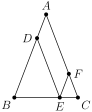
In and Points and are on sides and respectively, such that and are parallel to and respectively. What is the perimeter of parallelogram
Respuesta: C
Pista pequeña:
Usa los paralelismos para obtener triángulos semejantes cerca de y .
Use the parallels to get similar triangles near and
Pista grande:
Reescribe los lados opuestos del paralelogramo como partes de y .
Rewrite opposite sides of the parallelogram as pieces of and
Solución:
Observa que y debido a las rectas paralelas.
Esto nos dice que y Tenemos que el perímetro de es
Por lo tanto, C es la respuesta correcta.
Note that and due to the parallel lines.
This tells us that and We have that the perimeter of is
Thus, C is the correct answer.
13.
¿Cuántos números de tres dígitos no son divisibles por tienen dígitos que suman menos de y tienen el primer dígito igual al tercero?
How many three-digit numbers are not divisible by have digits that sum to less than and have the first digit equal to the third digit?
Respuesta: B
Pista pequeña:
El número tiene la forma .
The number has form
Pista grande:
Haz casos según el dígito repetido , excluyendo los valores que hacen que el número sea divisible por .
Case on the repeated digit , excluding values that make the number divisible by
Solución:
Observa que para que el número no sea divisible por el dígito de las unidades no puede ser ni ni
Sea el dígito de las centenas y de las unidades, e el dígito de las decenas. Entonces queremos Haciendo casos según los valores posibles de obtenemos:
Si es o entonces puede ser cualquier cosa, ya que
Si entonces lo que nos da soluciones.
Si entonces lo que nos da soluciones.
Si entonces lo que nos da soluciones.
Si entonces lo que nos da soluciones.
Esto nos da un total de soluciones.
Por lo tanto, B es la respuesta correcta.
Note that for the number to not be divisible by the units digits cannot be either or
Let be the hundreds and units digit and be the tens digit. Then we want Casing on the possible values of we get:
If is or then can be anything since
If then which gives us solutions.
If then which gives us solutions.
If then which gives us solutions.
If then which gives us solutions.
This gives us a total of solutions.
Thus, B is the correct answer.
14.
Se retira un cubo sólido de lado de cada esquina de un cubo sólido de lado ¿Cuántas aristas tiene el sólido restante?
A solid cube of side length is removed from each corner of a solid cube of side length How many edges does the remaining solid have?
Respuesta: D
Pista pequeña:
Cada esquina retirada crea nuevas aristas expuestas.
Each corner removal creates new exposed edges
Pista grande:
Cuenta las aristas del cubo original más las nuevas aristas de cada esquina retirada.
Count the original cube edges plus the new edges from each removed corner
Solución:
Retirar los cubos no elimina ninguna arista del cubo original. Solo añade aristas.
Después de retirar cada cubo, podemos ver que se añaden aristas adicionales al sólido.
Se retiran cubos, lo que significa que se añaden aristas a las aristas originales, para un total de aristas.
Por lo tanto, D es la respuesta correcta.
Removing the cubes does not remove any edges from the original cube. It only adds edges.
After removing each cube, we can see that extra edges are added to the solid.
cubes are removed, which means edges are added to the original edges, for a total of edges.
Thus, D is the correct answer.
15.
Dos lados de un triángulo tienen longitudes y La longitud de la altura al tercer lado es el promedio de las longitudes de las alturas a los dos lados dados. ¿Cuánto mide el tercer lado?
Two sides of a triangle have lengths and The length of the altitude to the third side is the average of the lengths of the altitudes to the two given sides. How long is the third side?
Respuesta: D
Pista pequeña:
Expresa la misma área doblada usando cada lado y su altura.
Express the same doubled area using each side and its altitude
Pista grande:
Usa la condición del promedio de alturas para relacionar el tercer lado desconocido con una altura conocida.
Use the average-altitude condition to relate the unknown third side to a known altitude
Solución:
Sea la longitud de la altura al lado de longitud y define de forma análoga para el otro lado dado.
Tenemos que
La tercera altura es el promedio de las otras dos, lo que hace que su longitud sea
Sea la longitud del tercer lado igual a Entonces
Por lo tanto, D es la respuesta correcta.
Let be the length of the altitude to the side of length and similarly define for the other given side.
We have that
The third altitude is the average of the other two, which makes its length
Let the third side have length Then
Thus, D is the correct answer.
16.
Un triángulo con vértices y se refleja respecto a la recta para crear un segundo triángulo. ¿Cuál es el área de la unión de los dos triángulos?
A triangle with vertices and is reflected about the line to create a second triangle. What is the area of the union of the two triangles?
Respuesta: E
Pista pequeña:
Refleja los dos vértices no fijos a través de .
Reflect the two non-fixed vertices across
Pista grande:
Halla el segmento vertical común creado por los dos triángulos superpuestos.
Find the shared vertical segment created by the two overlapping triangles
Solución:
El triángulo reflejado tiene vértices , , y .
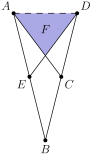
La recta que pasa por y es , así que corta a en . Por simetría, la unión son dos triángulos congruentes con base vertical desde hasta .
Esa base tiene longitud , y cada triángulo tiene altura horizontal . Por lo tanto el área de la unión es .
Por lo tanto, E es la respuesta correcta.
The reflected triangle has vertices , , and .
The line through and is , so it meets at . By symmetry, the union is two congruent triangles with vertical base from to .
That base has length , and each triangle has horizontal height . Hence the union area is .
Thus, E is the correct answer.
17.
A Daphne la visitan periódicamente sus tres mejores amigas: Alice, Beatrix y Claire. Alice la visita cada tres días, Beatrix la visita cada cuatro días, y Claire la visita cada cinco días.
Las tres amigas visitaron a Daphne ayer. ¿En cuántos días del siguiente periodo de días la visitarán exactamente dos amigas?
Daphne is visited periodically by her three best friends: Alice, Beatrix, and Claire. Alice visits every third day, Beatrix visits every fourth day, and Claire visits every fifth day.
All three friends visited Daphne yesterday. How many days of the next -day period will exactly two friends visit her?
Respuesta: B
Pista pequeña:
Cuenta los días de encuentro por parejas usando mínimos comunes múltiplos.
Count pairwise meeting days using least common multiples
Pista grande:
Resta de cada conteo por parejas los días en que se encuentran las tres.
Subtract the triple-meeting days from each pair count
Solución:
Las visitas por parejas ocurren cada , , y días.
En los siguientes días, estos conteos por parejas son , , y .
Las tres visitan cada días, lo que ocurre veces. Restar esos días de cada conteo por parejas da .
Por lo tanto, B es la respuesta correcta.
Pairwise visits occur every , , and days.
In the next days, these pair counts are , , and .
All three visit every days, which happens times. Subtracting those days from each pair count gives .
Thus, B is the correct answer.
18.
Sean los puntos y El cuadrilátero se divide en dos partes de igual área mediante una recta que pasa por Esta recta corta a en el punto donde las fracciones están reducidas. ¿Cuánto vale ?
Let points and Quadrilateral is cut into equal area pieces by a line passing through This line intersects at point where these fractions are in lowest terms. What is
Respuesta: B
Pista pequeña:
Primero calcula el área total de .
First compute the total area of
Pista grande:
La recta de corte que pasa por hace que sea la mitad del área del cuadrilátero.
The cutting line through makes half the quadrilateral area
Solución:
Sea el punto donde la recta de corte encuentra a . Traza perpendiculares desde , , y hasta el eje , como en el diagrama.
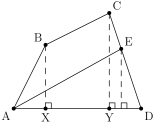
Las áreas de , el trapecio , y son , , y , respectivamente, así que .
Por lo tanto tiene área . Como , la altura de es .
La recta tiene ecuación , así que , lo que da . Por lo tanto .
Por lo tanto, B es la respuesta correcta.
Let the cutting line meet at . Drop perpendiculars from , , and to the -axis as in the diagram.
The areas of , trapezoid , and are , , and , respectively, so .
Thus has area . Since , the height of is .
The line has equation , so , giving . Therefore .
Thus, B is the correct answer.
19.
En base el número termina en el dígito En base en cambio, el mismo número se escribe como y termina en el dígito ¿Para cuántos enteros positivos la representación en base de termina en el dígito ?
In base the number ends in the digit In base on the other hand, the same number is written as and ends in the digit For how many positive integers does the base--representation of end in the digit
Respuesta: C
Pista pequeña:
Un dígito final en una base es un residuo.
A final base digit is a remainder
Pista grande:
La base debe ser mayor que y dividir a .
The base must be greater than and divide
Solución:
Observa que el dígito de las unidades representa el residuo al dividir el número entre la base.
La pregunta se reduce entonces a hallar todos los números tales que deja un residuo de al dividirse entre
Esto significa que debe dividir a Observa también que ya que de lo contrario el residuo no puede ser
La factorización prima de es Entonces, tiene factores. Tiene factores menores que a saber y Esto significa que hay valores válidos para
Por lo tanto, C es la respuesta correcta.
Note that the units digit represents the remainder when the number is divided by the base.
The question then boils down to finding all numbers, such that leaves a remainder of when divided by
This means that must divide Also note that since otherwise the remainder cannot be
The prime factorization of is Then, has factors. It has factors less than namely and This means there are valid values for
Thus, C is the correct answer.
20.
Un cuadrado unitario se gira alrededor de su centro. ¿Cuál es el área de la región barrida por el interior del cuadrado?
A unit square is rotated about its center. What is the area of the region swept out by the interior of the square?
Respuesta: C
Pista pequeña:
Trabaja con un cuadrante de la región barrida.
Work with one quadrant of the swept region
Pista grande:
Descompón ese cuadrante en un sector y dos piezas triangulares rectángulas.
Decompose that quadrant into a sector and two right-triangle pieces
Solución:

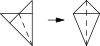
Considera una cuarta parte de la región barrida y multiplica su área por .
El sector tiene ángulo y radio , así que su área es .
Las dos piezas triangulares rectángulas de ese cuarto tienen áreas y .
Multiplicar la suma de áreas del cuarto por da .
Por lo tanto, C es la respuesta correcta.
Consider one quarter of the swept region and multiply its area by .
The sector has angle and radius , so its area is .
The two right-triangle pieces in that quarter have areas and .
Multiplying the quarter-area sum by gives .
Thus, C is the correct answer.
21.
piratas acuerdan dividir un cofre del tesoro de monedas de oro entre ellos de la siguiente manera. El pirata en tomar una parte toma de las monedas que quedan en el cofre. El número de monedas que hay inicialmente en el cofre es el menor número para el cual este arreglo permite que cada pirata reciba un número entero positivo de monedas. ¿Cuántas monedas recibe el pirata?
A group of pirates agree to divide a treasure chest of gold coins among themselves as follows. The pirate to take a share takes of the coins that remain in the chest. The number of coins initially in the chest is the smallest number for which this arrangement will allow each pirate to receive a positive whole number of coins. How many coins does the pirate receive?
Respuesta: D
Pista pequeña:
Trabaja hacia atrás a partir del número que queda para el último pirata.
Work backward from the number left for the last pirate
Pista grande:
Al revertir al pirata , la cantidad restante se multiplica por .
The remaining amount is multiplied by when reversing pirate
Solución:
Trabajemos hacia atrás. Si quedan monedas para el pirata número , entonces, antes de que el pirata tomara su parte, el cofre tenía veces las monedas que tuvo después.
Por tanto, el número inicial de monedas es .
Como , el menor que hace entero el número inicial es .
Este valor es alcanzable. El número de monedas que hay justo antes de que el pirata tome su parte es Para , todas estas cantidades son enteras. La parte de cada pirata es la diferencia entre dos cantidades restantes consecutivas, así que cada parte también es entera.
Por tanto, el pirata número recibe monedas, y D es la respuesta correcta.
Work backward. If coins remain for the th pirate, then before pirate took a share, the chest had times as many coins as it had afterward.
Therefore the initial number of coins is .
Since , the smallest that makes the initial number an integer is .
This value is attainable. The number of coins present just before pirate takes a share is For , all these amounts are integers. Each pirate’s share is the difference between two consecutive remaining amounts, so every share is an integer as well.
Thus, the th pirate receives coins, and D is the correct answer.
22.
Seis esferas de radio se colocan de modo que sus centros están en los vértices de un hexágono regular de lado Las seis esferas son tangentes internamente a una esfera mayor cuyo centro es el centro del hexágono. Una octava esfera es tangente externamente a las seis esferas menores y tangente internamente a la esfera mayor. ¿Cuál es el radio de esta octava esfera?
Six spheres of radius are positioned so that their centers are at the vertices of a regular hexagon of side length The six spheres are internally tangent to a larger sphere whose center is the center of the hexagon. An eighth sphere is externally tangent to the six smaller spheres and internally tangent to the larger sphere. What is the radius of this eighth sphere?
Respuesta: B
Pista pequeña:
La esfera grande tiene radio .
The large sphere has radius
Pista grande:
Usa un triángulo rectángulo que une el centro grande, el centro de una esfera pequeña y el centro de la octava esfera.
Use a right triangle joining the large center, a small-sphere center, and the eighth-sphere center
Solución:
Los centros de las seis esferas de radio forman un hexágono regular de lado , así que cada uno está a unidades del centro de la esfera grande. Por lo tanto, la esfera grande tiene radio .

Sea el radio de la octava esfera, y sea la distancia de su centro al centro de la esfera grande. La tangencia interna da , así que .
Usando el triángulo rectángulo entre el centro grande, el centro de una esfera pequeña y el centro de la octava esfera, . Así , de modo que .
Por lo tanto, B es la respuesta correcta.
The centers of the six radius- spheres form a regular hexagon of side length , so each is units from the large sphere’s center. Hence the large sphere has radius .
Let the eighth sphere have radius , and let its center be distance from the large sphere’s center. Internal tangency gives , so .
Using the right triangle between the large center, a small-sphere center, and the eighth-sphere center, . Thus , so .
Thus, B is the correct answer.
23.
En y Una circunferencia con centro y radio corta a en los puntos y Además, y tienen longitudes enteras. ¿Cuánto vale ?
In and A circle with center and radius intersects at points and Moreover and have integer lengths. What is
Respuesta: D
Pista pequeña:
Usa la potencia de un punto desde .
Use power of a point from
Pista grande:
Factoriza y usa la desigualdad triangular para elegir el par de factores válido.
Factor and use the triangle inequality to choose the valid factor pair
Solución:
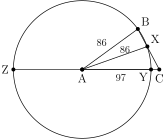
Por la potencia de un punto desde , .
Esto es igual a .
Tanto como son enteros, así que es un factor entero emparejado con . Además, , por lo que el único par posible es , .
Por lo tanto, D es la respuesta correcta.
By power of a point from , .
This equals .
Both and are integers, so is an integer factor paired with . Also , so the only possible pair is , .
Thus, D is the correct answer.
24.
Central High School compite contra Northern High School en un torneo de backgammon. Cada escuela tiene tres jugadores, y las reglas del torneo exigen que cada jugador juegue dos partidas contra cada uno de los jugadores de la otra escuela. El torneo se desarrolla en seis rondas, con tres partidas jugadas simultáneamente en cada ronda. ¿De cuántas maneras diferentes se puede programar el torneo?
Central High School is competing against Northern High School in a backgammon match. Each school has three players, and the contest rules require that each player play two games against each of the other school’s players. The match takes place in six rounds, with three games played simultaneously in each round. In how many different ways can the match be scheduled?
Respuesta: E
Pista pequeña:
Primero fija el calendario de seis rondas de un jugador.
Fix one player’s six-round schedule first
Pista grande:
Para el segundo jugador, cuenta las cadenas que evitan al oponente del primer jugador en cada ronda.
For the second player, count strings avoiding the first player’s opponent in every round
Solución:
Etiqueta a los jugadores de Central como y a los de Northern como .
La cadena de oponentes de seis rondas del jugador contiene dos de cada , así que se puede elegir de maneras.
Para una cadena de fija, digamos , la cadena del jugador también debe contener dos de cada y no puede coincidir con el oponente de en ninguna posición.
Si las dos primeras entradas de son en cualquier orden, entonces las dos entradas centrales deben ser en cualquier orden y las dos últimas deben ser en cualquier orden, lo que da cadenas. Las dos posibilidades restantes son y , para un total de cadenas de .
Una vez que y están programados, el calendario de queda forzado. Por lo tanto, hay calendarios.
Por lo tanto, E es la respuesta correcta.
Label Central’s players and Northern’s players .
Player ’s six-round opponent string contains two each of , so it can be chosen in ways.
For a fixed -string, say , player ’s string must also contain two each of and cannot match ’s opponent in any position.
If ’s first two entries are in either order, then the middle two entries must be in either order and the last two must be in either order, giving strings. The two remaining possibilities are and , for total -strings.
Once and are scheduled, ’s schedule is forced. Hence there are schedules.
Thus, E is the correct answer.
25.
Se trazan las diagonales de un octágono regular. ¿En cuántos puntos distintos del interior del octágono (no sobre la frontera) se cortan dos o más diagonales?
All diagonals are drawn in a regular octagon. At how many distinct points in the interior of the octagon (not on the boundary) do two or more diagonals intersect?
Respuesta: A
Pista pequeña:
Empieza con las intersecciones que dan cuatro vértices.
Start with intersections from four vertices
Pista grande:
Corrige por el centro y los otros ocho puntos de triple concurrencia.
Correct for the center and the eight other triple-concurrence points
Solución:
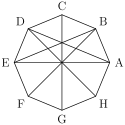
Si no hubiera tres diagonales concurrentes, cada elección de vértices determinaría una intersección interior, dando .
Las diagonales largas que pasan por vértices opuestos se cortan todas en el centro, así que el centro se contó veces y debería contarse una vez. Resta .
También hay puntos simétricos donde se cortan diagonales. Cada uno se contó veces y debería contarse una vez, así que resta .
El número de puntos de intersección interiores distintos es .
Por lo tanto, A es la respuesta correcta.
If no three diagonals were concurrent, each choice of vertices would determine one interior intersection, giving .
The long diagonals through opposite vertices all meet at the center, so the center was counted times and should be counted once. Subtract .
There are also symmetric points where diagonals meet. Each was counted times and should be counted once, so subtract .
The number of distinct interior intersection points is .
Thus, A is the correct answer.