2000 AMC 8 Solutions
Typeset by: LIVE by Po-Shen Loh
https://live.poshenloh.com/past-contests/amc8/2000/solutions
Problems © Mathematical Association of America. Reproduced with permission.
1.
Aunt Anna is years old. Caitlin is years younger than Brianna, and Brianna is half as old as Aunt Anna. How old is Caitlin?
Small Hint:
Find Brianna’s age first
Big Hint:
Caitlin is years younger than Brianna
Solution:
Brianna is years old. Caitlin is therefore years old.
Thus, B is the correct answer.
2.
Which of these numbers is less than its reciprocal?
Small Hint:
Check whether has a reciprocal
Big Hint:
Compare with
Solution:
has no reciprocal, and and are their own reciprocals.
The reciprocal of is but is not less than
Therefore, as we know that is the only one of the answer choices that is less than its reciprocal.
Thus, A is the correct answer.
3.
How many whole numbers lie in the interval between and
infinitely many
Small Hint:
Locate and between whole numbers
Big Hint:
Count the whole numbers strictly inside the interval
Solution:
The smallest whole number greater than is The greatest whole number less than is
The whole numbers within this range are
Thus, D is the correct answer.
4.
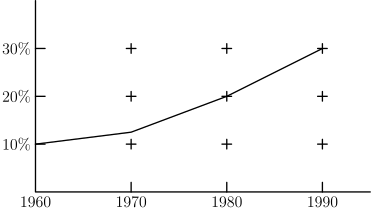
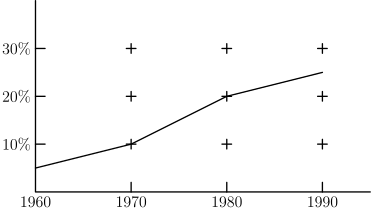
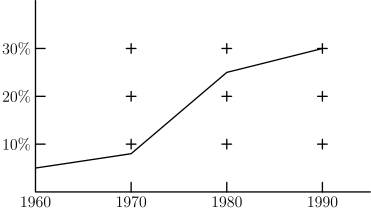
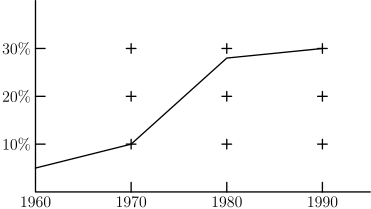
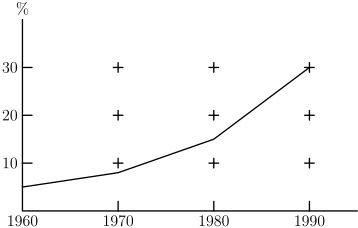
In only of the working adults in Carlin City worked at home. By the “at-home” work force had increased to In there were approximately working at home, and in there were The graph that best illustrates this is
Small Hint:
Match the four percentages to the four years
Big Hint:
The plotted values should rise from about to
Solution:
The only graph that shows all the data points is graph E .
Thus, E is the correct answer.
5.
Each principal of Lincoln High School serves exactly one -year term. What is the maximum number of principals this school could have during an -year period?
Small Hint:
Let the -year window start at the end of a term
Big Hint:
A principal can appear for only part of the -year period
Solution:
To maximize the number of principals, assume that the first year of this period is the final year of some principal’s term.
Then, there can be more principals for years, followed by another principal who works the final year.
This is principals.
Thus, C is the correct answer.
6.
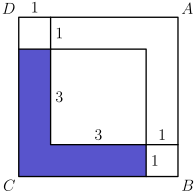
Figure is a square. Inside this square three smaller squares are drawn with side lengths as labeled. The area of the shaded L-shaped region is
Small Hint:
Break the shaded L into rectangles
Big Hint:
A square minus a square also works
Solution:
We can subtract out the areas of the top unit square, the bottom right unit square, and the top right square.
The shaded area in is therefore
Thus, A is the correct answer.
7.
What is the minimum possible product of three different numbers of the set
Small Hint:
A negative product needs an odd number of negative factors
Big Hint:
Compare using three negatives versus one negative and two positives
Solution:
A negative product comes either from three negative factors or from one negative factor and two positive factors.
With three negative factors, the minimum is With one negative factor, use the most negative number and the two largest positive numbers to get Since the minimum possible product is
Thus, B is the correct answer.
8.
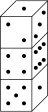
Three dice with faces numbered through are stacked as shown. Seven of the eighteen faces are visible, leaving eleven faces hidden (back, bottom, between). The total number of dots NOT visible in this view is
Small Hint:
Each die has total dots
Big Hint:
Subtract the visible dots from the total on all three dice
Solution:
The sum of the numbers on one die is Therefore, the sum of the numbers on all dice is
The visible numbers add up to This makes the sum of the unseen numbers
Thus, D is the correct answer.
9.
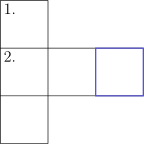
Three-digit powers of and are used in this “cross-number” puzzle. What is the only possible digit for the outlined square?
Small Hint:
List the three-digit powers of
Big Hint:
The across entry is a three-digit power of starting with
Solution:
The only -digit powers of are and This means that the spot is filled with a
The only -digit power of beginning with a is so the outlined square is filled with a
Thus, D is the correct answer.
10.
Ara and Shea were once the same height. Since then Shea has grown while Ara has grown half as many inches as Shea. Shea is now inches tall. How tall, in inches, is Ara now?
Small Hint:
Recover the original common height from Shea’s new height
Big Hint:
Ara grew half as many inches as Shea
Solution:
Let be Ara and Shea’s initial height. Then we get that
This means that Shea grew inches, which means that Ara grew inches, making her inches tall.
Thus, E is the correct answer.
11.
The number has the property that it is divisible by its unit digit. How many whole numbers between and have this property?
Small Hint:
Group numbers by their units digit
Big Hint:
Remember numbers ending in do not work
Solution:
Numbers ending in or all work in the lists and and and and This gives numbers.
The remaining working numbers are and Numbers ending in do not work because division by is undefined.
Thus there are such numbers.
Thus, C is the correct answer.
12.
A block wall feet long and feet high will be constructed using blocks that are foot high and either feet long or foot long (no blocks may be cut). The vertical joins in the blocks must be staggered as shown, and the wall must be even on the ends. What is the smallest number of blocks needed to build this wall?

Small Hint:
Start with all -foot blocks
Big Hint:
Only every other row needs an extra block to stagger joins
Solution:
The total number of rows in the wall is with each row being foot high.
To use the minimum number of bricks, rows and will have the same pattern as the bottom row in the picture, which requires bricks to construct.
Rows and will have the same pattern as the upper row in the picture, which has -foot bricks in the middle and one -foot brick on each end, for a total of bricks.
When you add up rows of bricks and rows of bricks, you get a total of bricks.
Thus, D is the correct answer.
13.
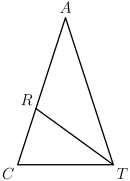
In triangle we have and If bisects then
Small Hint:
First find the two equal base angles of
Big Hint:
Use the angle bisector at
Solution:
We get
Due to bisection, we also know that
Finally, we see that
Thus, C is the correct answer.
14.
What is the units digit of
Small Hint:
Only the units digit matters
Big Hint:
Odd powers of a number ending in end in
Solution:
Note that the units digit of a power depends only upon the units digit of the base.
Experimenting, we get that to an even power ends with a and to an odd power ends with a
Therefore, ends with a and also ends with a Adding them together yields a number that ends in
Thus, D is the correct answer.
15.
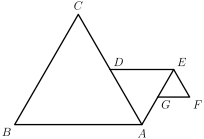
Triangles and are all equilateral. Points and are midpoints of and respectively. If what is the perimeter of figure
Small Hint:
Use the midpoint information to find smaller equilateral side lengths
Big Hint:
Add the outside boundary lengths only
Solution:
The large equilateral triangle has side length the middle one has side length and the smaller one has side length
The perimeter is therefore
Thus, C is the correct answer.
16.
In order for Mateen to walk a kilometer ( meters) in his rectangular backyard, he must walk the length times or walk its perimeter times. What is the area of Mateen’s backyard in square meters?
Small Hint:
The length comes from walking it times
Big Hint:
The perimeter comes from walking it times
Solution:
We can see that the length is meters, and the perimeter is meters.
Note that the perimeter is times the sum of the length and width.
This means that the width is meters, and the area is square meters.
Thus, C is the correct answer.
17.
The operation is defined for all nonzero numbers by
Determine
Small Hint:
Evaluate each expression from the inside out
Big Hint:
Keep the parentheses; the operation is not associative
Solution:
We can calculate it as follows.
Thus, A is the correct answer.
18.
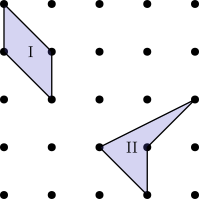
Consider these two geoboard quadrilaterals. Which of the following statements is true?
The area of quadrilateral is more than the area of quadrilateral
The area of quadrilateral is less than the area of quadrilateral
The quadrilaterals have the same area and the same perimeter.
The quadrilaterals have the same area, but the perimeter of is more than the perimeter of
The quadrilaterals have the same area, but the perimeter of is less than the perimeter of
Small Hint:
Decompose both quadrilaterals into unit right triangles
Big Hint:
Compute all four side lengths of each quadrilateral
Solution:
Assume that the pegs on this grid are separated by unit.
Note that region is a parallelogram with base and height making its area
We can split region into triangles, both with base and height This makes the sum of the areas This shows that both regions have the same area.
Note that each region has sides that are of length Region has unit sides, whereas region only has
The other side of region is clearly greater than which shows that region has the greater perimeter.
Thus, E is the correct answer.
19.
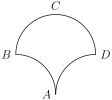
Three circular arcs of radius units bound the region shown. Arcs and are quarter-circles, and arc is a semicircle. What is the area, in square units, of the region?
Small Hint:
Move the curved pieces to make a rectangle
Big Hint:
The rearranged rectangle has dimensions and
Solution:
Create a rectangle that covers the bottom half of the figure as shown below.
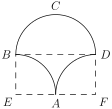
Then, we get that
We also know that
and are both quarter-circles that form a semicircle with the same area as
This means that and
Thus, C is the correct answer.
20.
You have nine coins: a collection of pennies, nickels, dimes, and quarters having a total value of with at least one coin of each type. How many dimes must you have?
Small Hint:
Use cents modulo to find the number of pennies
Big Hint:
After the pennies, solve for nickels, dimes, and quarters
Solution:
The number of pennies must have the same remainder as modulo so there are either or pennies. Seven pennies would leave only two coins for nickels, dimes, and quarters, impossible because at least one of each type is needed.
So there are pennies. The remaining coins are worth cents. If and are the numbers of nickels, dimes, and quarters, then and
Dividing the value equation by and subtracting the coin-count equation gives The only positive solution is and
Thus there must be dime.
Thus, A is the correct answer.
21.
Keiko tosses one penny and Ephraim tosses two pennies. The probability that Ephraim gets the same number of heads that Keiko gets is
Small Hint:
List Keiko’s result and Ephraim’s two-coin result
Big Hint:
Count matching head totals among the equally likely outcomes
Solution:
There are equally likely outcomes if we record Keiko’s coin and Ephraim’s two coins.
If Keiko gets heads, Ephraim must get exactly one head; this happens in outcomes. If Keiko gets tails, Ephraim must get no heads; this happens in outcome.
So of the equally likely outcomes work, and the probability is
Thus, B is the correct answer.
22.
A cube has edge length Suppose that we glue a cube of edge length on top of the big cube so that one of its faces rests entirely on the top face of the larger cube. The percent increase in the surface area (sides, top, and bottom) from the original cube to the new solid formed is closest to

Small Hint:
The original cube has surface area
Big Hint:
The small cube hides one unit square but adds five
Solution:
The original surface area is just
Note that the top face of the unit cube plus the visible area of the top face of the larger cube is the same as the area of one face of the larger cube.
This means that the unit square on top only adds unit squares to the total surface area, making the increase
The percent increase is therefore
Thus, C is the correct answer.
23.
There is a list of seven numbers. The average of the first four numbers is and the average of the last four numbers is If the average of all seven numbers is then the number common to both sets of four numbers is
Small Hint:
Convert each average into a sum
Big Hint:
The shared number is counted twice in the two four-number sums
Solution:
The sum of the first four numbers is The sum of the last four numbers is
The sum of all seven numbers is We know that the number common to both sets is included in both of the first two sums.
This means that the sum of the first two sums includes every number once, except for the common number which is included twice.
The third sum, however, only includes every number once. This means that the sum of the first two sums minus the third sum yields our desired number.
Therefore, the common number is
Thus, B is the correct answer.
24.
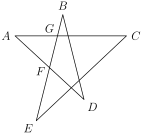
If and then
Small Hint:
Use the isosceles triangle first
Big Hint:
Then use the angle sum of
Solution:
In the two base angles are equal and so
Since and form a straight angle,
In
Thus, D is the correct answer.
25.
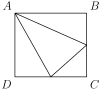
The area of rectangle is square units. If point and the midpoints of and are joined to form a triangle, the area of that triangle is
Small Hint:
Let the rectangle sides be and
Big Hint:
Subtract the three outside right triangles from the rectangle
Solution:
Let the rectangle have side lengths and so its area is and
The three right triangles outside the desired triangle have areas and
Their total area is Therefore the desired triangle has area
Thus, B is the correct answer.
Problems: https://live.poshenloh.com/past-contests/amc8/2000