2020 AMC 8 Solutions
Typeset by: LIVE by Po-Shen Loh
https://live.poshenloh.com/past-contests/amc8/2020/solutions
Problems © Mathematical Association of America. Reproduced with permission.
1.
Luka is making lemonade to sell at a school fundraiser. His recipe requires times as much water as sugar and twice as much sugar as lemon juice. He uses cups of lemon juice. How many cups of water does he need?
Solution:
Since Luka needs twice as much sugar as lemon, he needs cups of sugar. Since Luka also needs times as much water as sugar, he needs cups of water.
Thus, the correct answer is E.
2.
Four friends do yardwork for their neighbors over the weekend, earning and respectively. They decide to split their earnings equally among themselves. In total how many dollars will the friend who earned give to the others?
Solution:
First, the total amount of money that they make is
Since they divide this equally, they each get dollars.
This means that the person who earned earned more than what he will end up with, so he gives to the others.
Thus, the correct answer is C.
3.
Carrie has a rectangular garden that measures feet by feet. She plants the entire garden with strawberry plants. Carrie is able to plant strawberry plants per square foot, and she harvests an average of strawberries per plant. How many strawberries can she expect to harvest?
Solution:
First, the size of the garden is
Next, since there are plants per square foot, Carrie can plant plants total.
Finally, since there are strawberries per plant, Carrie can harvest strawberries total.
Thus, the correct answer is D.
4.
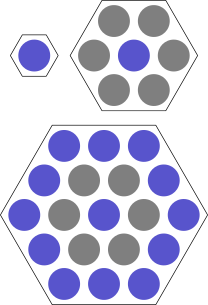
Three hexagons of increasing size are shown below. Suppose the dot pattern continues so that each successive hexagon contains one more band of dots. How many dots are in the next hexagon?
Solution:
The first three hexagons contain and dots. Each new band adds more dots than the previous band.
The fourth hexagon adds dots around the third hexagon, so it contains dots.
Thus, the correct answer is B.
5.
Three fourths of a pitcher is filled with pineapple juice. The pitcher is emptied by pouring an equal amount of juice into each of cups. What percent of the total capacity of the pitcher did each cup receive?
Solution:
Since we start with of the pitcher, we have of the pitcher full as
Now, since cups each have the same amount of juice, they each have one-fifth of the
This means they have
Thus, the correct answer is C.
6.
Aaron, Darren, Karen, Maren, and Sharon rode on a small train that has five cars that seat one person each. Maren sat in the last car. Aaron sat directly behind Sharon. Darren sat in one of the cars in front of Aaron. At least one person sat between Karen and Darren. Who sat in the middle car?
Aaron
Darren
Karen
Maren
Sharon
Solution:
Maren is in the last car. Since Aaron is directly behind Sharon and Darren is in front of Aaron, the possible placements of Darren, Sharon, and Aaron before Maren are limited.
If Sharon and Aaron were in cars and Darren could not be in front of Aaron. If they were in cars and then Darren and Karen would have to occupy cars and which are adjacent.
Thus Sharon and Aaron must be in cars and Darren is then in car Karen is in car and Aaron is in the middle car.
Thus, the correct answer is A.
7.
How many integers between and have four distinct digits arranged in increasing order? (For example, is one integer.)
Solution:
The thousands digit must be Since the digits are distinct and increasing, the hundreds digit must be
The last two digits must be chosen from Once the two digits are chosen, their order is forced.
There are such integers.
Thus, the correct answer is C.
8.
Ricardo has coins, some of which are pennies (-cent coins) and the rest of which are nickels (-cent coins). He has at least one penny and at least one nickel. What is the difference in cents between the greatest possible and least possible amounts of money that Ricardo can have?
Solution:
Let be the number of pennies Ricardo has and let be the number of nickels he has.
We know that and by the problem statement.
This means Therefore, It follows, then, that Ricardo has cents.
Therefore, to maximize the money he has, we maximize the number of nickels he has, and minimizing the money he has involves minimizing the number of nickels he has. The maximum number of nickels he can have is so he can have at most cents. The minimum number of nickels he can have is so he has at least cents. The difference between the maximum and minimum amount of money he can have is:
Thus, the correct answer is C.
9.
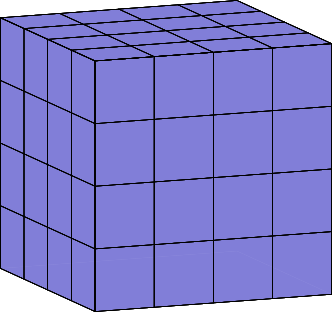
Akash's birthday cake is in the form of a inch cube. The cake has icing on the top and the four side faces, and no icing on the bottom. Suppose the cake is cut into smaller cubes, each measuring inch, as shown below. How many small pieces will have icing on exactly two sides?
Solution:
In the top layer, the non-corner edge pieces have icing on exactly two sides. There are edges with such pieces each, for pieces.
In each of the other layers, the only pieces with exactly two iced sides are the corner pieces. This adds pieces.
The total is
Thus, the correct answer is D.
10.
Zara has a collection of marbles: an Aggie, a Bumblebee, a Steelie, and a Tiger. She wants to display them in a row on a shelf, but does not want to put the Steelie and the Tiger next to one another. In how many ways can she do this?
Solution:
There are total arrangements of the marbles.
If the Steelie and Tiger are adjacent, treat them as one block. Then there are ways to arrange the block with the other two marbles, and orders inside the block, for adjacent arrangements.
Therefore, arrangements keep the Steelie and Tiger separated.
Thus, the correct answer is C.
11.
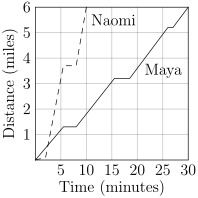
After school, Maya and Naomi headed to the beach, miles away. Maya decided to bike while Naomi took a bus. The graph below shows their journeys, indicating the time and distance traveled. What was the difference, in miles per hour, between Naomi's and Maya's average speeds?
Solution:
Naomi traveled miles in minutes. This ratio is
Maya traveled miles in minutes. This ratio is
This difference is
Thus, the correct answer is E.
12.
For a positive integer the factorial notation represents the product of the integers from to For example:
What value of satisfies the following equation?
Solution:
Note first that
With that in mind, further observe that:
Since we know
Using our note from above, we know that so
Thus, the correct answer is A.
13.
Jamal has a drawer containing green socks, purple socks, and orange socks. After adding more purple socks, Jamal noticed that there is now a chance that a sock randomly selected from the drawer is purple. How many purple socks did Jamal add?
Solution:
Suppose Jamal adds purple socks. Then, there will be purple socks.
Also, since there are total socks to begin with, we have socks after adding the socks.
Since we have a chance of choosing a purple sock afterwards, we know
Solving for yields:
Therefore, socks are added.
Thus, the correct answer is B.
14.
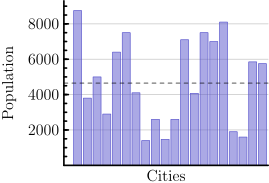
There are cities in the County of Newton. Their populations are shown in the bar chart below. The average population of all the cities is indicated by the horizontal dashed line. Which of the following is closest to the total population of all cities?
Solution:
Looking at the horizontal dashed line, the average population is around
Since there are cities, and the average population is we know:
Multiplication yields that the total population is
Thus, the correct answer is D.
15.
Suppose of equals of What percentage of is
Solution:
The statement gives
Solving for gives
Therefore, is of
Thus, the correct answer is C.
16.
Each of the points and in the figure below represents a different digit from to Each of the five lines shown passes through some of these points. The digits along each line are added to produce five sums, one for each line. The total of the five sums is What is the digit represented by
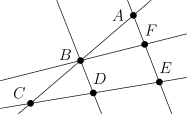
Solution:
Each number is added once per line it is on. Every point is on lines except for which is on
This means so
Since are unique digits from to each digit is represented exactly once, making
With we know so
Thus, the correct answer is E.
17.
How many factors of have more than factors? (As an example, has factors, namely and )
Solution:
Let's begin by firstly simply factoring :
These twelve factors of can be classified by the number of their factors:
- has one factor
- and has two factors
- has three (distinct) factors
Thus, all the remaining seven numbers must have more than three factors.
Thus, the correct answer is B.
18.
Rectangle is inscribed in a semicircle with diameter as shown in the figure. Let and let What is the area of
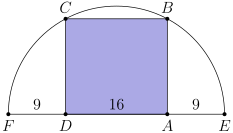
Solution:
Since is the diameter of the semicircle, we know the length of the diameter is and so the radius is Let be the center of the diameter.
The length from therefore is
Since is on we know
Also, since we have a semicircle, we know
Finally, since is a rectangle, we know is a right angle. This means we can find by the Pythagorean Theorem. We know
Thus, the area of the rectangle is
Thus, the correct answer is A.
19.
A number is called flippy if its digits alternate between two distinct digits. For example, and are flippy, but and are not. How many five-digit flippy numbers are divisible by
Solution:
For a number to be divisible by the number must be divisible by and by
First, to ensure the number is divisible by it must end in or in
Since the digits alternate between two distinct digits, we call the other digit
This would make our number either or Since the last digit must be or and the first digit cannot be the number must have the form
Thus, we know our number is for some digit
To ensure our number is also a multiple of the sum of the digits must be a multiple of
The sum of our digits is Since is a multiple of all that is required is that is a multiple of so is a multiple of
This means can be or
Therefore, we have solutions.
Thus, the correct answer is B.
20.
A scientist walking through a forest recorded as integers the heights of trees standing in a row. She observed that each tree was either twice as tall or half as tall as the one to its right. Unfortunately some of her data was lost when rain fell on her notebook. Her notes are shown below, with blanks indicating the missing numbers. Based on her observations, the scientist was able to reconstruct the lost data. What was the average height of the trees, in meters?
Solution:
Tree is meters tall. Since all heights are integers and neighboring trees differ by a factor of trees and must both be meters tall.
The first three trees total meters. Tree is either or meters. If tree were then tree would be or nonintegral giving averages ending in or invalid.
If tree then tree can be or These give averages and respectively. The only listed average ending in is
Thus, the correct answer is B.
21.
A game board consists of squares that alternate between shaded and unshaded. The figure below shows square in the bottom row and square in the top row. A marker is placed at A step consists of moving the marker onto one of the adjoining unshaded squares in the row above. How many -step paths are there from to (The figure shows a sample path.)
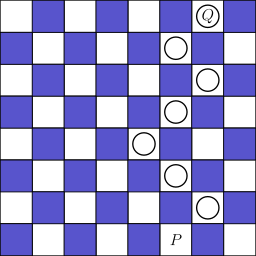
Solution:
Each move must go up one row and either left or right. Counting row by row from each reachable square gets the sum of the counts from the two adjoining squares below it.
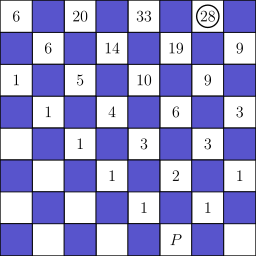
The count at is so there are paths.
Thus, the correct answer is A.
22.
When a positive integer is fed into a machine, the output is a number calculated according to the rule shown below.
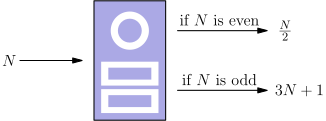
For example, starting with an input of the machine will output Then if the output is repeatedly inserted into the machine five more times, the final output is When the same -step process is applied to a different starting value of the final output is What is the sum of all such integers
Solution:
To see which numbers we can make by inverting it, let's make an inverting machine.
This would take and yield either if is even (which it always is) or if is an odd integer. Note that is an integer only if Also, if is even, then is odd. That would mean would be odd. Therefore, our inverter machine yields and also if and is even.
Now, we must see what the inverting machine can yield after moves:
We can only get
From we can only get
From we can get and
From we can get only ; from we can only get
From we can get only ; from we can get and
From we can get and ; we can get ; from we can get
Move can yield and and their sum is
Thus, the correct answer is E.
23.
Five different awards are to be given to three students. Each student will receive at least one award. In how many different ways can the awards be distributed?
Solution:
There are ways to give each of the distinct awards to one of the students.
Subtract the distributions in which at least one student receives no award. If a particular student receives none, the awards go to the other two students in ways. This gives counts, but the cases in which one student receives all awards have each been subtracted twice.
By inclusion-exclusion, the desired number is
Thus, the correct answer is B.
24.
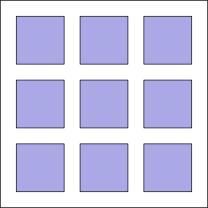
A large square region is paved with shaded square tiles, each measuring inches on a side. A border inches wide surrounds each tile. The figure below shows the case for When the shaded tiles cover of the area of the large square region. What is the ratio for this larger value of
Solution:
For the shaded tile area is Each side of the large square consists of tiles and borders, so its side length is
The shaded tiles cover of the large square, so Taking positive square roots gives
Thus so and
Thus, the correct answer is A.
25.
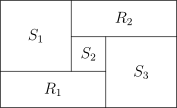
Rectangles and and squares and shown below, combine to form a rectangle that is 3322 units wide and 2020 units high. What is the side length of in units?
Solution:
We represent the lengths of each square as and respectively. The length of the rectangle is as these squares span the entirety of a side of the large rectangle. Therefore,
Also, the height of the large rectangle is the sum of the height of and Now, note that the sum of height of and is so height of is equal to Therefore, the height of the large rectangle is which means Subtracting both of our results yields This would mean
Thus, the correct answer is A.
Problems: https://live.poshenloh.com/past-contests/amc8/2020